BELAGAVI
Though they left Goa about four centuries ago, Goan settlers in the Upper Ghat region of southern Maharashtra have neither forgotten their Konkani language and culture nor has their deep-rooted faith in their Goencho Saib diminished.
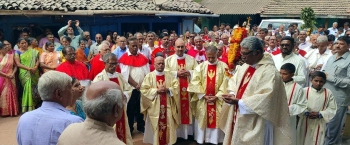
This enduring bond was vividly witnessed during the annual feast of St Francis Xavier celebrated at Nesari town in Gadhinglaj taluka on January 11.
THE PLACE AND COMMUNITY
Nestled amid the serene and picturesque plateau along the banks of the Ghataprabha River, about 35 km towards the west of Belagavi, Nesari is a substation of St Anthony Parish, Gadhinglaj.
With around 30 families of Goan origin, the town houses a Church dedicated to St Francis Xavier which has remained the spiritual nucleus for about 30 Goan families settled in the area. The church falls under the jurisdiction of the Diocese of Sindhudurg and is administered by Jesuits of the Goa Province.
Families bearing traditional Goan surnames such as Rego, Kuris (Cruz), Ferrao, D’Souza, Soz and Viegas among others, belonging to various communidades of Goa, continue to proudly propagate the faith inculcated by their ancestors through the intercession of Goencho Saib. Around Nesari within a vicinity of around 10-15 kms lie villages of Watangi, Hebbal, Sambre, Adkur, among others, where Konkani-speaking Goan settlers have settled for little under four centuries.
“Our grandfather, Cornel Ruzai Rege (Bardeskar), used to tell us that after the conquest of Goa by the Portuguese and later, the infamous Inquisition by the Portuguese, our ancestors left Goa and reached Nesari via Ramghat and different routes on foot,” said Thomas Rege (Rego), president of the St Francis Xavier Church committee.
Commenting about the St Francis Xavier Church, Rege said about 150 years ago, some of their ancestors who had gone to collect their annual Zonn at the Aldona Communidade, travelled to Old Goa on foot for about three days and nights.
“After reaching Goa, they found a statue of St Francis Xavier in a church. They requested the priest for it and brought it back to Nesari and installed the same in a small donated mud structure. The annual feast of St Francis Xavier is observed since then,” Rege informed.
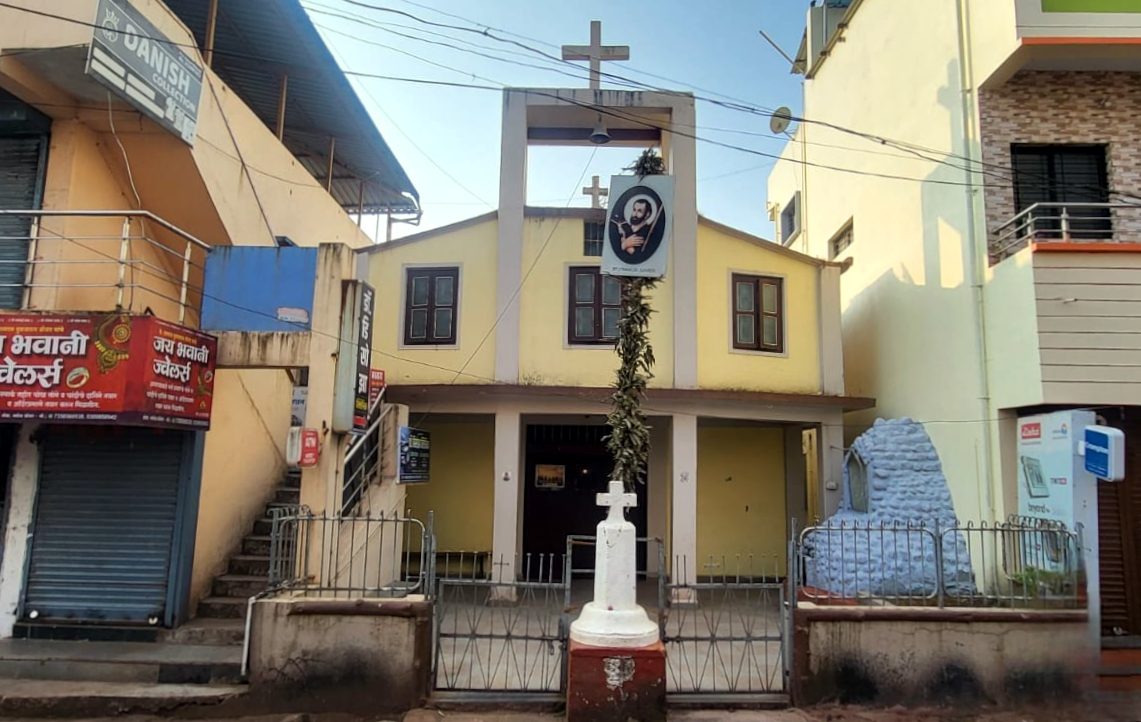
The St Francis Xavier Church at Nesari in Gadhinglaj taluka of southern Maharashtra.
These Goan settlers opted to cultivate the lands of locals for paddy and little later by selling dry fish they made their living here.
Later under the Maharashtra Tenancy and Agricultural Lands Act, 1948 (MTAL Act) 1948, they either owned or purchased the lands they cultivated and became the owners of land.
A few years later while some families engaged in trading of fish, the womenfolk took to retail selling of dry fish. They used to travel to neighbouring villages on foot with the basket of dry mackerel and other dry fish on their heads and made their family living. They also sold dry fish in the weekly market in Nesari town.
While some settlers from Nesari still continue with farming, trade and selling of dry fish, the new generation has excelled various fields. Adv Bastu Rege, a noted social activist from Pune, runs a famous NGO ‘Santulan’ in Pune, while another youth, Sqn Ldr Wg Cdr Xavier Pasku Rege (named after St Francis Xavier) has become a fighter pilot and was engaged in recent Rafale fighter attacks against Pakistan.
THE FEAST AND FERVOUR
This year’s feast assumed special significance for the Catholic community with the presence of Fr Pedro Rodrigues SJ, Provincial of the Goa Province. Fr Rodrigues presided over the solemn feast Mass, which was concelebrated by Parish priest Fr Allwyn Cruz and Jesuit priests Fr Motiram Bardeskar, Fr Paul Fernandes, Fr Joseph Nazareth and Fr Sebastiao D’Souza.
The Feast Mass was celebrated in Konkani, with the choir singing traditional Konkani hymns, including the popular hymn, ‘San Franciscu Xavier-a’.
In his sermon, Fr Mervyn Dsouza, treasurer of the Goa Province of the Jesuits, highlighted the life and mission of St Francis Xavier, emphasising that the saint’s sole intention was to devote his life for the greater glory of God.
“Every devotee, especially Goenkars, treat him as the ‘Zantto’ (elder) of their families. It is for this reason that our ancestors began the tradition of praying through the intercession of St Francis Xavier,” he said.
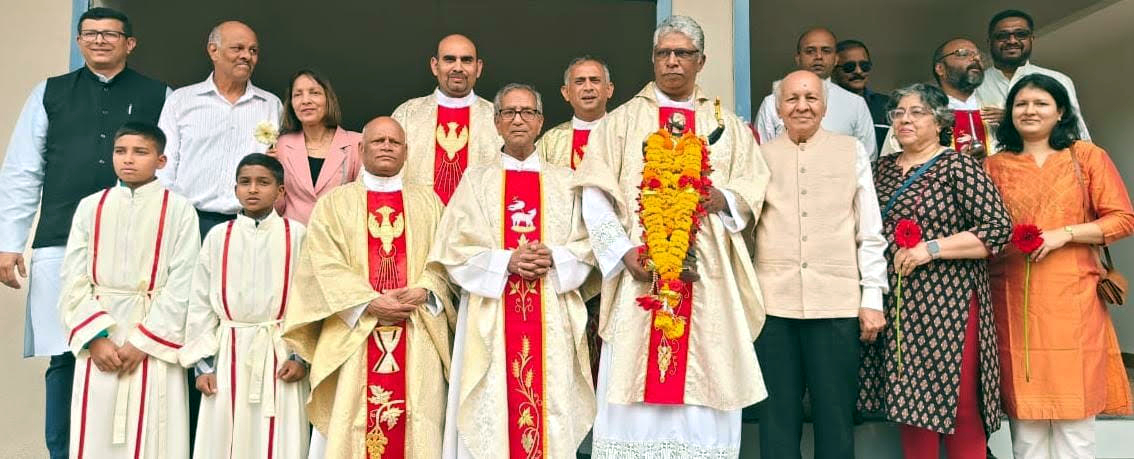
Provincial of the Goa Province Fr Pedro Rodrigues SJ and other priests along with the Rego family during the inauguration of the St Francis Community Hall at Nesari in Gadhinglaj taluka of southern Maharashtra. Photo: Louis Rodrigues
The age-old tradition of the ‘irmaos’ continues to thrive, with ‘Comfrad’ from neighbouring villages joining the local ‘Confrad’ in a vibrant display of unity and deep routed faith.
Another prominent feature of the Feast was the participation of walking pilgrims from Gadhinglaj and surrounding areas, who covered a distance of nearly 25 km on foot, chanting the name of St Francis Xavier to reach Nesari in time for the Feast Mass and the celebrations.
“Since the time of our ancestors, our ‘angvonns’ and petitions to Goencho Saib have always been answered through his intercession,” said Thomas Rego, president of the Gaonkars Committee.
Echoing similar sentiments, Xavier Fernandes, a retired teacher, and several other faithful reiterated their unwavering devotion to their Goencho Saib.
Fr Pedro Rodrigues later blessed and inaugurated a spacious new community hall, constructed on land generously donated by Thomas, Lawrence and Julius Rego and his brothers, who are now residing in Goa and Mumbai.
Amid a region predominantly dominated by Marathi-speaking communities, Nesari town and neighbouring villages continue to stand as a beacon of faith, Konkani language and Goan cultural identity, preserved and passed on steadfastly from generation to generation.