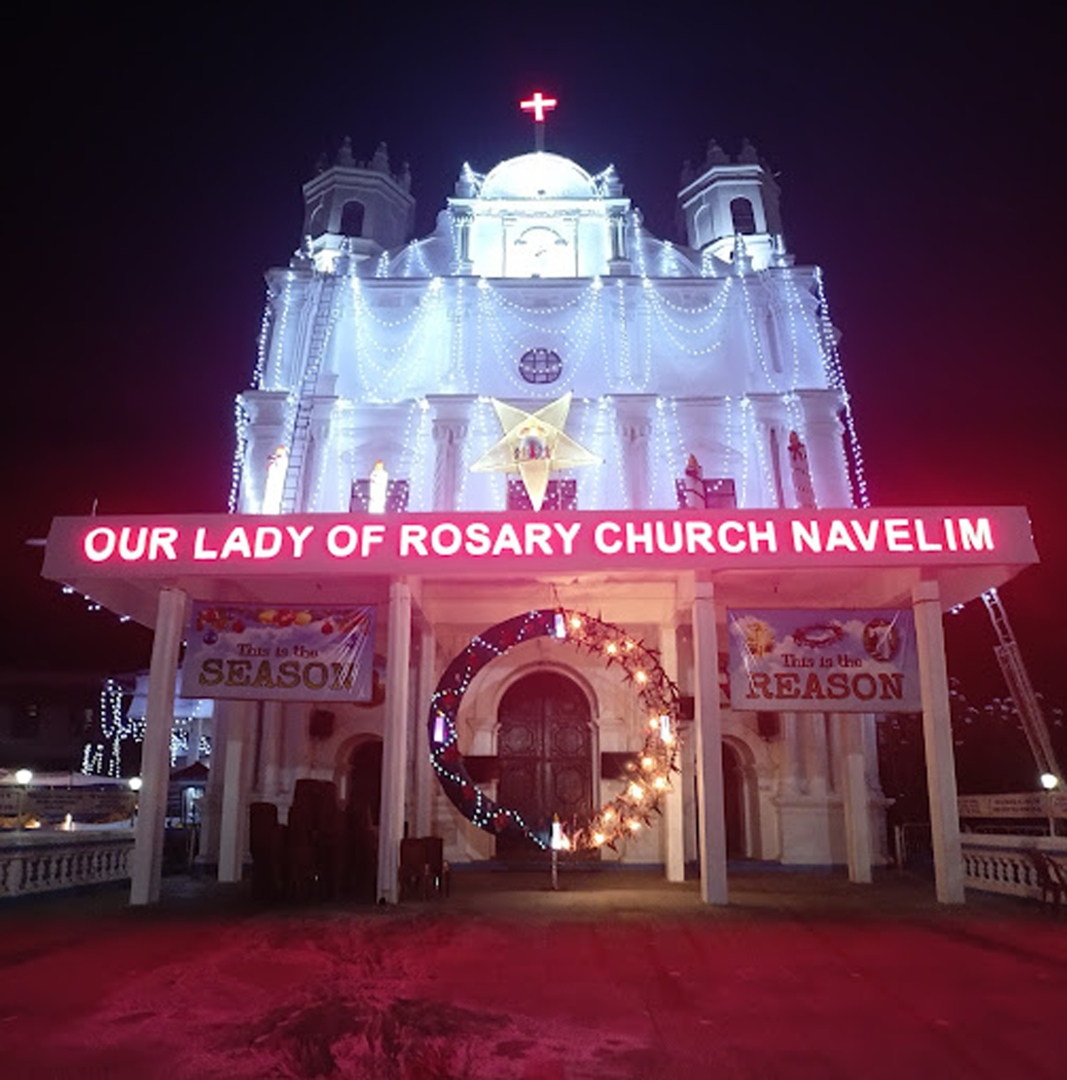
The air is thriving with excitement, and the fragrance of flowers and incense fills the streets. It is as though there is a different level of fervour which comes alive with a unique blend of tradition, spirituality, and festivity. The anticipation for the feast begins weeks in advance. It's a time when the entire village unites to adorn the church, its surroundings, and the streets with vibrant banners, twinkling lights, and colourful flowers. The very act of preparation evokes a sense of togetherness that sets the tone for the festivities. The nine-day preparations begin with the ‘Maddi’ which is sort of a sign of the commencement of the proximate preparation of the feast. On the first day of the novena the statue of Our Lady of Fatima is brought to the main church in a solemn procession from the Mount Carmel Chapel, Telaulim. The faithful partake in this solemn procession with candles in their hands and piety in their hearts.
The feast of Our Lady of Rosary (‘Igreja De Nossa Senhora Do Rosario’ in Portuguese) is not just a tradition but an emotion that holds a special place in the hearts of the Catholic faithful as well as the people of other faiths. It stands out as a vibrant and cherished tradition that has been passed down through generations, standing tall as a symbol of unity, spirituality, and community in the heart of the village. It's not just an occasion of celebration and worship but a cornerstone of the faith of the people, which is celebrated with unparalleled fervor. It's a reminder of the strong bonds of community, the sense of belonging, and the pride in the shared heritage.
The village feast of Our Lady of the Rosary Church is a testament to the enduring power of tradition, faith and community. It serves as a reminder of the importance of coming together, celebrating the shared values, and cherishing our cultural heritage. In a rapidly changing world, such celebrations offer a glimpse into the past, preserving and passing on the rich tapestry of the collective history and spirituality.
In preparation for the feast, every year 9 days prior to the feast, Telaulim, a little hamlet of Navelim on the banks of river Sal stands agog with excitement, as it prepares for the traditional, colourful candle-light early morning procession attended by thousands of devotees. The devotees bring the statue of Our Lady of Fatima from the Telaulim chapel to the main church.
The origin of the procession, which has gained immense popularity due to the blessings of Mother Mary, lies in the fact that the original inhabitants of Telaulim (Gaonkars of the place) used to leave for Western Ghats on the eve of the novena of its village patroness - Our Lady of Rosary - to fetch merchandise mainly cattle for the three-day fair (known as the ‘Boilanchem Fest’ in its hey days) which was a massive affair in the whole of Salcete. According to legend, in earliest times, this fair consisted mainly of three-four sheds and lasted only for a day, because there was superstition that on the same night of the feast day, Dr Francisco Salvador Gomes, father of Dr Francisco Luis Gomes, who was the administrator of Salcete, encouraged some of the owners of the sheds to extend the fair for three days. Once upon a time till the late 1990s, selling animals for farming such as goats, cows and buffaloes was a speciality of the fair.
Architectural records: Mannerist: Neo-Roman style, relief images of sun and moon on façade and twin octagonal towers capped with spear-and-ball finials. Our Lady of Rosary Church or ‘Igreja De Nossa Senhora Do Rosario’ in Portuguese, has two towers. The originally built northern tower holds the bell of the church while the other matching tower was built in the 80’s by the then vicar of the church Fr Robert Jose Vaz, one of the most famous priests known as an architect of modern Navelim.
(The writer is the assistant Parish Priest of Our Lady of Rosary Church, Navelim)