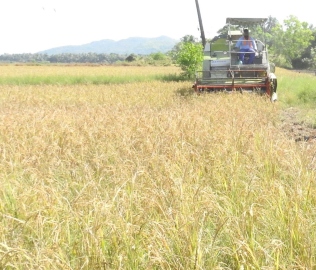
 File photo of rich harvest of paddy at the Digaum Bandh, Chinchinim in November 2022.
MARGAO
When the president of Chinchinim Communidade President Agnelo Furtado teamed up with Goa’s Paddy man, Fr George Quadros to bring hectares and hectares of fallow agriculture fields at Diguam bandh under cultivation, many termed the initiative as a revolution in the making.
For, Chinchinim was once known as the granary of Salcete along with Curtorim, before the village lost the title after the agricultural fields were left fallow and uncultivated over a host of reasons, including rising labour cost and stray cattle menace.
Digaum Bandh’s success story has now spurred Furtado and his team to take the initiative to revive agriculture in Chinchinim forward. Come Monday, and an ambitious project to revive the fallow agricultural fields at Patto, adjoining the St Sebastian Chapel, Chinchinim along the NH66 is set for a launch, which is expected to bring additional three lakh square metres of fallow agricultural fields under cultivation.
The ambitious project to bring around three lakh square metres of agricultural land under cultivation comes at a time when harvesting of the second paddy crop at Digaum bandh is all set to take place.
Says Chinchinim Communidade President, Agnelo Furtado: “What has prompted us to take up the revival of the Patto fields is the success at Digaum bandh. Our initiative to bring the fields under cultivation has met with success though we have a long way to go at Digaum bandh. Around 17 lakh hectares of paddy fields are spread across Digaum bandh, of which we have so far managed to bring under cultivation around 2.5 lakh square metres to three lakh square metres of fields”.
He added: “Since the experiment at Digaum bandh has ended in a success, with the first attempt at revival giving us a moderate harvest, we have gone for a second crop, which is now ready for harvesting. Hence, we thought of carrying forward the experiment from Digaum bandh to Patto, just across the NH66”.
As the Patto fields are owned by around 50-60 individual owners and tenants, Furtado and his team had a task cut out “ to get the farmers together and explain the importance of reviving the fallow fields. Accordingly, a meeting was held with the farmers in the month of February in a bid to motivate the farmers and seek their nod to bring the fallow farms under cultivation.
“Since most of the fields had remained fallow for long now, we explained Digaum Bandh’s success story and how the experiment holds the hope to review the fields at Patto. Many a farmer has accorded their consent and we expect many others to join the initiative as the mechanized tractors enter the fields on Monday”, he said.
Furtado has acknowledged the support promised by Water Resources Department (WRD) Minister Subhash Shirodkar towards the revival of the Patto fields.
“Since the Digaum bandh nallah extends towards the Patto fields, we have requested the WRD Minister to desilt the nallah. Once desilted, the nallah will act as a natural barrier for the stray cattle to enter the fields and we will save the cost on fencing”, he added.
Around half-a-dozen mechanized tractors, both owned by the government and Fr George Quadros will enter the Patto fields on Monday, to set in motion the process in a bid to revive the fallow fields.
“Mechanization is an answer to the high labour costs. At Digaum bandh, Fr Quadros has played the role of a service provider, while the Chinchinim Communidade has acted as a facilitator to convince and persuade the farmers to return back to agriculture. We have somewhat managed to convince the land owners as well as the tenants that the ownership status of the land will not change at all. They will continue to enjoy the right over their fields”, he added.