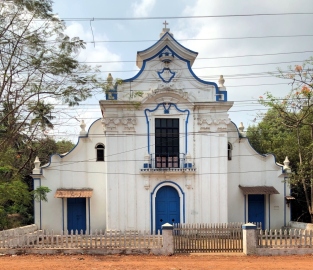
The chapel dedicated to Our Lady of Piety, Nossa Senhora da Piedade, is located by the roadside, a few metres away from St Peter’s Church (Sao Pedro). The Chapel had once gained prominence and fervour for possessing a miraculous statue of Our Lady of Miracles, which was sculpted in Jaffna (Sri Lanka), then taken to Jakarta (Indonesia) and finally brought to Goa. The feast of Our Lady of Miracles is celebrated on the first Sunday of May, which this year falls on May 7.
There is a dispute among historians about the origin of this chapel. According to some, it was constructed in 1661, while according to others in 1770 and its façade changed in the late 18th century.
Mgr Gomes Catão states that in 1776, the chapel was awarded a papal brief granting full indulgence to whoever took part in the Mass in honour of Our Lady of Piety. A confraternity influential person linked to the chapel must have been behind it.
The chapel has two staircases in the side porticos, one leads to the choir loft which is just above the main entrance of the chapel, while the other to the pulpit.
In 1614, Friar Francisco de Antonio, the Rector of Our Lady of Victory Church, Jaffnapatâo (Nossa Senhora da Vitória, Jafanapatão) in Sri Lanka, required a statue for the church and asked Annacutti, a local sculptor, to carve one from a piece of wood he had brought with him from Cochin.
It is said that as the statue of the Virgin Mary, holding her infant son in her arms, was nearing completion, it showed signs of its miraculous powers. People went to Annacutti's house to pray before the statue and many were reported to have been cured. Annacutti who personally witnessed these miracles was both amazed and frightened and dared not to proceed with the work and requested the friar to take the unfinished statue to the church.
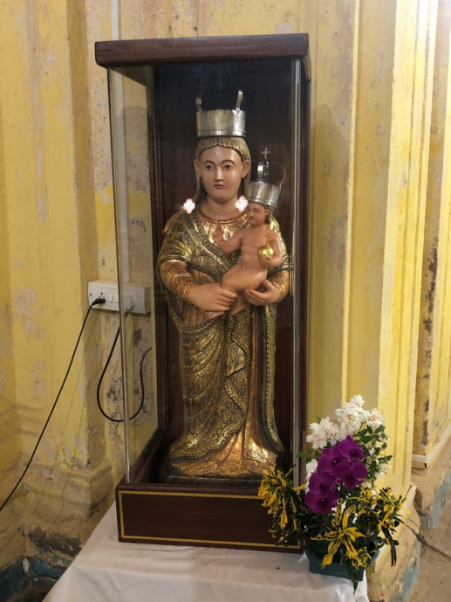
On July 24, 1614, the statue was taken in a public procession from the sculptor’s house to the Church and it was placed on an altar in the middle of the church. Due to numerous miracles attributed to it, she was called Our Lady of Miracles (Puthumai Matha), Jaffnapatâo.
Then, people from other parts of Ceylon came on pilgrimages to Our Lady of Miracles. Through her powerful intercession, many were healed of their illness, the region too was protected from natural calamities and also battles were won.
A new church dedicated to Our Lady of Miracles, Jaffnapatâo was constructed here. Much later, a fortress named after Our Lady of Miracles was built and Jaffna was established as the capital of the new kingdom. Our Lady of Miracles Jaffnapatâo was solemnly proclaimed the Protectress of the kingdom.
However, when the Dutch East India Company captured the island, they began to persecute the Catholics, some of them who were taken as prisoners smuggled the statue of Our Lady of Miracles to Batavia (capital of the Dutch East Indies and the area corresponds to present-day Jakarta, Indonesia).
In 1661, the statue of Our Lady of Miracles Jaffnapatâo was taken to the Portuguese Goa in India, she was carried in a public procession to the convent of St Francis of Assisi and kept in one of the chapels. The statue was later taken to the Our Lady of Piety Chapel in Sao Pedro. It is now preserved in the Church of Sao Pedro, Bainguinim.
THE ALTARS
The chapel has three carved altars. The main altar is dedicated to the patroness, Our Lady of Piety, whose statue is high above the altar in a glass case. On the right side of the main altar is a big crucifix (which at the moment is not there) and on the left side is a large painting of the image of Our Lady of Miracles. The statue is kept in the Church, probably for safety reasons.
THE FEAST
The faithful celebrate the Feast of Our Lady of Miracles on the first Sunday of May, preceded by the Maddi and the nine-day thematic Novena, which are held in the evenings. During these days, the statue is kept in the chapel. The Feast Day Mass will be in the morning, after which is the blessing and the veneration of the statue. There is a three-day evening programme called Festaza 2.0 in the church compound organised by Sao Pedro parishioners.
(The writer is Superior at Casa Professa, Basilica of Bom Jesus in Old Goa)