


PANAJI
A week after the High Court of Bombay at Goa directed the filing of a consolidated set of recommendations in a Public Interest Litigation on dust pollution and road safety at Porvorim, the petitioner has flagged continued and serious violations of court directions and central safety norms at the elevated corridor construction site.
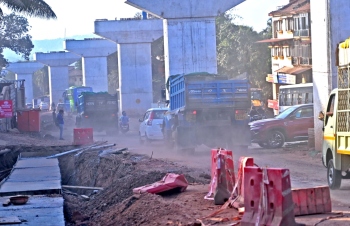
Air quality has emerged as a major concern with the petitioner-in-person, Advocate Moses Pinto, warning in his consolidated report that uncontrolled construction dust has led to a sustained deterioration in ambient air quality along the corridor.
Citing medical reports and media accounts, the petitioner pointed to a rise in respiratory complaints among residents and daily commuters, with doctors advising the use of masks. The report recorded visible dust deposition on vegetation, houses and commercial structures, indicating prolonged exposure rather than isolated disturbance.
On road safety, the report submitted on Monday stated that exposed construction zones remain inadequately barricaded, warning signage is missing or insufficient, and traffic is being diverted onto uneven, non-motorable surfaces. The petitioner cautioned that these conditions pose an acute risk to commuters, particularly two-wheeler riders and pedestrians.
The report also highlighted a dangerous incident near the Hyundai showroom at Porvorim, where a heavy concrete or metal water pipe was transported and handled on a live carriageway without traffic isolation, escort vehicles, marshals or hazard signage. This, he apprehended, poses an imminent risk of a catastrophic accident.
The petitioner further warned that intermittent water sprinkling without prior surface compaction has aggravated risks by increasing road slipperiness and surface damage, raising the likelihood of skidding and falls.
The High Court, during the hearing on December 8, had noted that an earlier report submitted on November 3 reflected considerable effort but had recommendations scattered across different sections. The Division Bench of Justices Sarang Kotwal and Ashish Chavan had therefore directed the petitioner to submit a consolidated report.
In his present report, the petitioner recommended continuous crash-rated barricading, reflective signage at graded distances, deployment of trained traffic marshals, prohibition of overhead work during live traffic, and the creation of segregated corridors for pedestrians and two-wheelers.
He also sought mandatory Air Quality Index monitoring along the corridor, public disclosure of data, and verification of compliance by executing agencies under the Air and Water Acts, cautioning that continued inaction could push Goa towards long-term urban air-quality degradation.


