


MARGAO
Guess the connection between the bumper catch of fish at the start of the new fishing season and the rising agitation among the people of Cuncolim?
It’s no coincidence that as the new fishing season kicked off on August 1; the residents of Cuncolim”who have long been protesting against pollution”gear up for yet another round of agitation. The reason isn’t hard to find.
The Cuncolim Industrial Estate is home to a fish meal plant and about half a dozen fish processing units, some of which export their products overseas.
This situation raises several troubling questions: How are these fish processing units disposing of their effluents? Is there an effective mechanism put in place by agencies such as the Goa State Pollution Control Board (GSPCB) to treat the waste generated? Are the effluent treatment plants set up by individual units adequate to handle their daily output? And perhaps most critically, why does the Cuncolim Industrial Estate still lack a Common Effluent Treatment Plant (CETP), despite repeated promises made both inside and outside the Goa Legislative Assembly over the years?
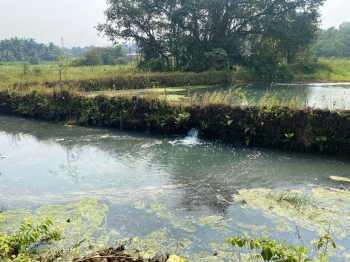
Just last week, a group led by social activist Aviraj Desai staged a protest outside the Cuncolim IDC. Their concern was that water had been seen flowing from the estate into a nearby plot, and a JCB machine was reportedly used to cover it up with mud mixed with industrial waste.
What’s more alarming is that neither officials of the GSPCB nor the Goa Industrial Development Corporation (GIDC) was present around to find out how contaminated water made its way outside the estate. This incident raises yet another pressing question: Is there no daily monitoring mechanism in place to track water and effluent discharge from the estate?
Aviraj Desai put it plainly: “Just imagine if people hadn’t raised concerns about this discharge. The polluted water would have flowed unchecked into private properties. Why haven’t authorities implemented a permanent system to monitor and prevent violations by these units?”
Unfortunately, this is not an isolated incident. Last year, too, residents marched to the industrial estate to protest the discharge of untreated effluents into surrounding water bodies. Their actions forced the GSPCB to intervene and temporarily suspend operations of the offending units.
Questions over mechanism to check foul odour

One of the major concerns raised by Cuncolkars in their ongoing battle against pollution at the Cuncolim Industrial Estate (IDC) is whether the Goa State Pollution Control Board (GSPCB) is adequately equipped to monitor and control the foul odour emanating from the estate.
Residents living in and around the IDC have, for over a decade, complained of being forced to endure a persistent, foul stench”often described as the smell of rotting fish. While the GSPCB has been seen monitoring water pollution parameters, typically when public protests erupt, there is growing skepticism in local circles about whether any mechanism exists within the estate to specifically check odour levels.
A key point of opposition to the proposed establishment of a second fish meal plant in Cuncolim”this one outside the industrial estate”is the bitter experience locals have already endured due to the existing fish meal plant and several fish processing units operating within the IDC.
This brings us to the crucial questions: Is the GSPCB equipped with the technology and resources to monitor odour levels at the Cuncolim IDC? Is there ongoing, consistent monitoring in place? And, more importantly, has the Board taken any punitive or corrective action against erring units over the past decade?
New GSPCB chief orders closer monitoring at Cuncolim, Verna estates after protests
Taking cognisance of the public protest at the Cuncolim IDC earlier last week, newly-appointed GSPCB Levinson Martins has put a mechanism in place, wherein certain officials of the Board have been entrusted with the responsibility to monitor pollution levels at the industrial estates of Cuncolim and Verna playing host to red and orange category industries.
Besides, he deputed officials of the Board to check and verify the points raised by the agitating people. He told The Goan that the team of officials after an inspection has submitted a report on the ground reality at the Cuncolim IDC. “Certain observations have been made by the team after the inspection. The Board will issue necessary directions to the units to comply with the directions,” he said.
Martins, however, admitted that there was no fool proof mechanism in place to closely monitor discharge of effluents at the industrial estate. To tide over the situation and plug the loopholes, Martins said directions have been issued to designate certain officials to the Cuncolim and Verna industrial estates playing host to red and orange category units for constant and close monitoring of pollution norms by the units.


