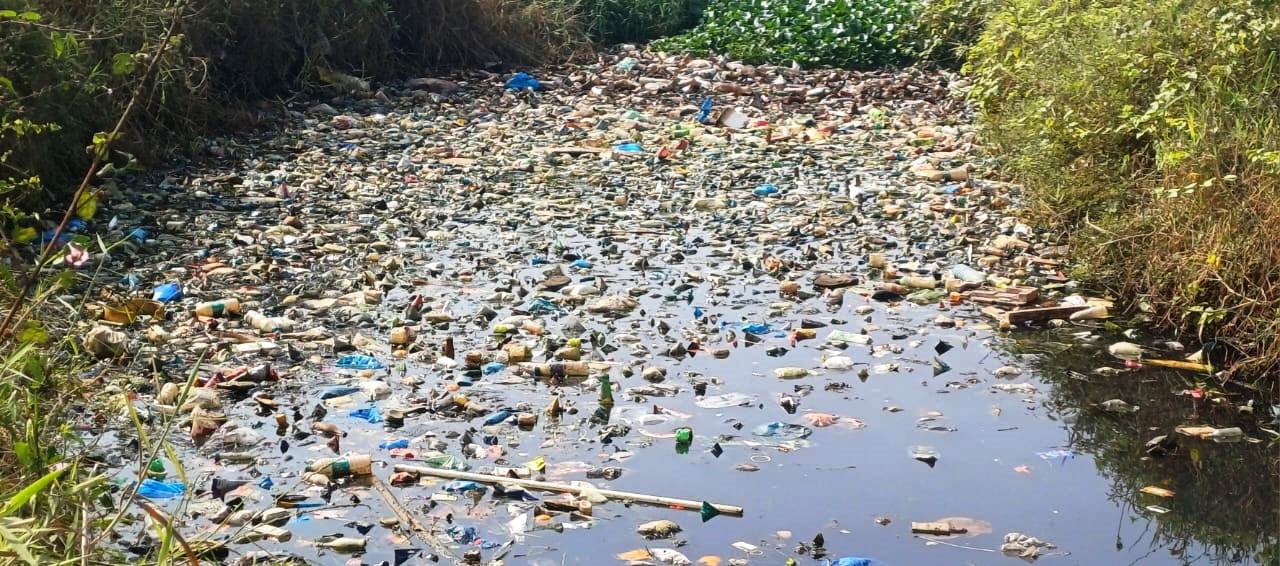
Black-coloured water with strong sewage odour flows through the nullah; Lack of desilting has led to accumulation of huge amounts of plastic waste
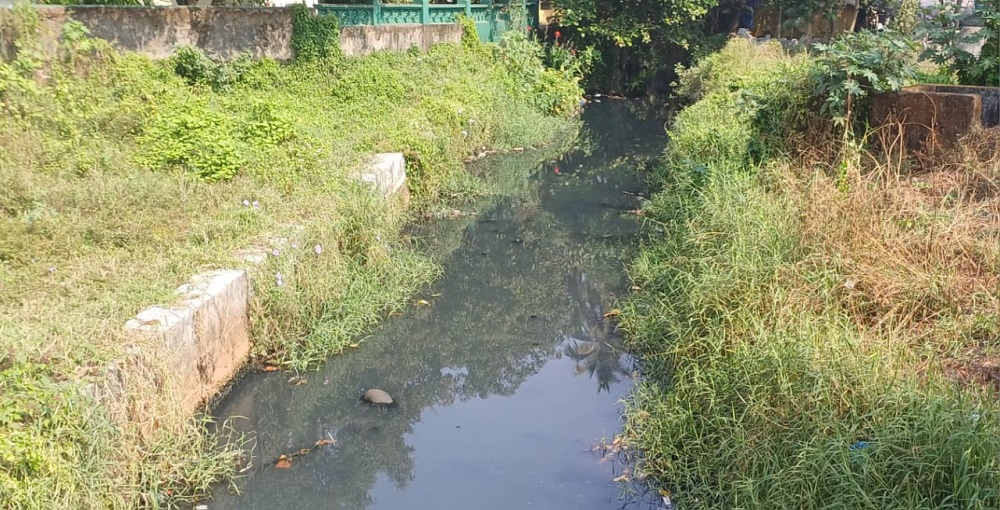
Black-coloured water emitting a sewage odour flows through the nullah.
MARGAO
Has the High Court’s host of directions to government agencies to cap the rampant discharge of sewage and waste water in the storm water nullahs in any way brought about a turnaround in the ground reality in the commercial capital?
Consider the Kudchadkar hospital storm water nullah, carrying the city’s waste and sewage water before it either empties into the Salpem Lake or was in the past pumped into the sewage treatment plant at Sirvodem.
A visit on the banks of the storm water nullah shows that black coloured water, emitting sewage odour, was flowing into the water body. A walk further down the nullah towards Sirvodem side brought out what has been feared the worst – the nullah choked with sewage water and plastic waste.
In fact, leave alone capping the sewage and waste water flowing into the storm water nullah from Margao, the water channel has been left to choke with huge amount of plastic waste for want of any desilting by the authorities.
Take note, the storm water nullah was desilted a year ago after the media had highlighted that the water channel was choked with tons of plastic mixed waste.
The situation seemed to have come full circle a year later. Plastic and mixed waste has choked the storm water, blocking the flow of the water, indicating that the nullah has not been desilted in recent months.
That’s not all. The flow of sewage and waste water in the Kudchadkar hospital storm water nullah seemed to have not stopped either. Amongst the host of storm water nullahs in the commercial capital, the Kudchadkar nullah has come under the High Court scanner in the public interest litigation (PIL) filed by Navelim citizen Prof Antonio Alvares. In the petition, Alvares had pointed out that the Kudchadkar storm water nullah carries the sewage and waste from the commercial capital, contaminating the once picturesque Salpem Lake.
Incidentally, despite High Court directions issued from time to time, prompting the Goa State Pollution Control Board (GSPCB) to seal business establishments operating sans consent to operate, the issue plaguing the city seemed far from over.
SIDCGL defends KT Weir system, rejects Phytorid Bed plan
MARGAO: The Sewerage Infrastructure Development Corporation of Goa Ltd (SIDCGL) has submitted to the High Court that the installation of the Phyrotid Bed treatment system along the storm water nullah flowing in the Salpem Lake is not feasible.
In fact, in its reply filed in the High Court, the SIDCGL has submitted that it has already installed a system KT Weir for interception and diversion of the water flowing into the nullah during the non-monsoon season.
The SIDCGL was directed by the High Court on the recommendation of the GSPCB to install Phyrotid Bed treatment system along the nullah flowing into the Salpem Lake, and, establish in stream treatment with Phyrotid Bed.
“The KT Weir intercepts and diverts the water flowing in the nullah to the STP for treatment during non-monsoon period. During the monsoon period due to the heavy flow of storm water, the diversion gates of the KT Weir are opened and the flow is not taken in the STP as STP’s are designed only for domestic sewerage treatment and therefore is unable to take in the rain/ storm water for treatment in the STP,” the reply stated.
As far as the Phytorid Bed treatment is concerned, SIDCGL submitted that the treatment requires a civil tank structure with filtration media and plants/ vegetation grown on it. “This structure will block the natural flow of nullah. Continuous treatment of nullah flow is not feasible. In addition, the flow in nullah increases substantially during monsoon and the surrounding field areas around nullah gets flooded. Treating such huge quantum of water (including rain water) is practically not possible as Goa receives heavy monsoon,” the reply stated.