GOAN TRADITIONS, FESTIVALS
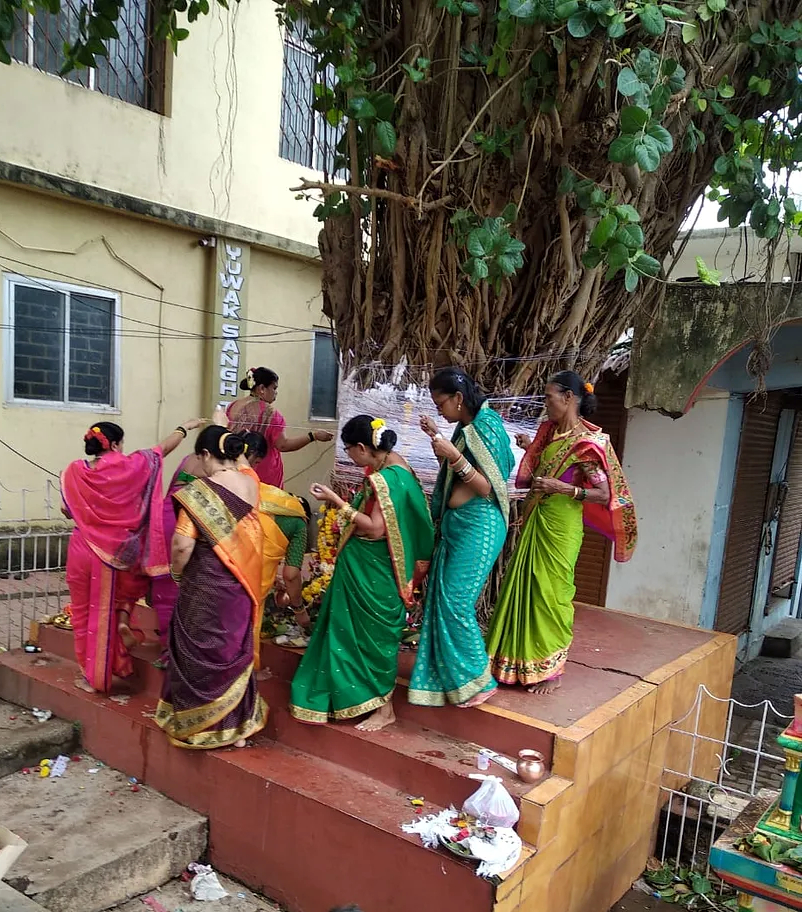
Savashins (married women) performing the ritual of winding the white-coloured raw thread around the trunk of the Banyan tree near Laxmi Narayan temple at Sada-Mormugao.
PANAJI
With the onset of monsoons in Goa in the month of June, Hindu married women look forward to celebrating the festival of Vadachi Punav or Vatt Poornima. This festival of Vatt Poornima is also celebrated by the Savashins (married women) in Maharashtra and a few other states in India.
Vadachi Punav is celebrated on the auspicious day of the full moon in the month of Jyeshta according to the Hindu Shaka calendar, which coincides with the month of June.
This year, Vadachi Punav is celebrated on the full moon day of June 21 by all Hindu married women while the newly married women received gifts in the form of Voze from their parents to celebrate this festival.
THE RITUALS
On this day, the Savashins fast the entire day. Adorning themselves in the finest of their sarees (either in the traditional nine-yard style or the six-yard style) and gold ornaments along with flowers decked in their hair, they worship the Vad (Banyan tree). They perform a Puja (religious ritual) by offering flowers, Kumkum (vermilion) and other items. They also perform seven Parikramas (rounds) around the Banyan tree and wind a sacred white-coloured raw thread around its trunk. All of them pray to this tree for the good health and longevity of their husband’s life. Hence this festival is known as the Vadachi Punav.
After religious rituals near the Banyan tree, the Savashins distribute a Donno (a bowl made from the banyan leaf) as a Prasad (offering) to others. This Donno contains slices/slivers of five different types of fruits namely mango, jackfruit, banana, pineapple, and papaya or guava along with a few fresh green peas or groundnuts. It also contains a bunch of five black beads threaded together by an Anshicho Dor (a string of natural fibre of a specific tree). This special string with black beads threaded in it is a symbol of a Suhagan/Savashin (a married woman whose husband is still living) and is tied to the Mangalsutra (a gold necklace with black beads).
THE ORIGIN
The practice of celebrating the Vadachi Punav is supposed to have started because of the belief in an ancient tale in the Hindu scriptures. According to an offshoot story in the Mahabharata, it is mentioned that a princess named Savitri lived like an ascetic with her husband Satyavan. Satyavan was an exiled prince who lived in a jungle. One day he died while cutting a Banyan tree. Savitri who was a wise woman, won back his life with her wisdom in a debate with Yama, God of Death, as he was taking away Satyavan’s soul. Since then, this day is believed to be celebrated in the memory of Savitri.
Some historians opine that this festival is a kind of tradition of nature worship observed by our ancestors since ancient times. With the arrival of monsoons, Mother Earth blooms back with greenery and life after the scorching summer in India. Hence, historians believe that the colossal Banyan tree with its vast foliage and hanging roots, symbolising immortality and sturdiness was chosen to be worshipped as a tree of life.
THE GIFT
In Goa, there exists a special tradition wherein the parents of a new bride have to gift a Voze to her, at every major Hindu festival which is celebrated in her first year of marriage. This Voze consists of the items for the new bride, her husband and her family to celebrate that particular festival. The celebration of the first Vadachi Punav holds a special significance in the life of a newly married Hindu woman.
Therefore, on this day per tradition, she and her husband’s family receive the Voze (special gift) from her parents. The Voze of the Vadachi Punav, is gifted in a big wicker basket filled with all items needed by the young bride for performing the rituals and customs of the festival.
It is filled with a large number of five different types of fruits, namely mangoes, bananas, jackfruit, pineapples, and papaya. Also, a set of green bangles, Kumkum (vermilion), several sets of black beads wound on the Anshiche Dorre (natural fibre of a tree), and a skein or a ball of raw thread (to wrap around the Banyan tree) are packed in the basket.
The new bride is gifted a saree by her parents and at times the son-in-law is also gifted a shirt. Thus, it is seen that the newlywed bride celebrates her first Vaddachi Punav with pomp and gaiety. Every year on Vaddachi Punav, she continues with the tradition of worshipping the Banyan tree praying to remain a Savashin in her lifetime.
[The writer is an architect by profession and is passionate about festivals and traditions in Goa]