Official says crisis due to topographical challenges and seasonal demand
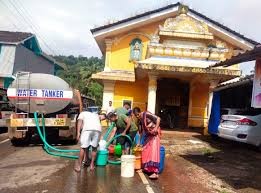
File photo of tanker supplying water to households in Sattari.
MAPUSA
A day after The Goan highlighted the acute water shortage affecting 11 villages in Sattari taluka, the Department of Drinking Water has acknowledged a supply deficit of 5-6 million litres per day (MLD), attributing the crisis to topographical challenges and seasonal demand.
Executive Engineer Rashmi Shirodkar said that several affected villages are located at the tail-end of the distribution network and at higher altitudes, making it difficult for water to reach households through the existing system.
“These villages are at the tail-end and at a higher elevation, which affects the flow and pressure of water. During peak summer months, the demand rises sharply and this leads to shortages,” Shirodkar said.
She added that the situation typically worsens during April and May due to increased consumption driven by high temperatures.
“At present, we are facing a shortfall of around 5 to 6 MLD in the area. To manage this, we are supplying water through tankers to six to seven villages,” she said.
However, residents have complained that tanker supply remains irregular and insufficient, forcing many to depend on alternative sources or ration water for daily use.
Long-term solution underway
The department has pinned its hopes on a new 50 MLD water treatment plant being constructed at Morlem–Honda, which is expected to significantly ease the crisis in the region.
“The government is setting up a 50 MLD treatment plant at Morlem–Honda, which will address the water needs of most of the affected villages,” Shirodkar said, adding that nearly seven to eight villages will benefit directly from the project.
According to the department, work on the plant began about a year ago and is currently around 60 per cent complete.
“We expect the plant to be operational by the end of December this year,” she said.
Zarme still outside
main grid
One village likely to remain outside the immediate coverage of the new facility is Zarme. For this, the department has proposed a separate plan involving infrastructure upgrades.
“For Zarme, we are planning to construct three to four storage tanks along with new pipelines to ensure adequate water supply,” Shirodkar said.
Recurring summer distress
The water shortage in Sattari has been a recurring issue, particularly during summer, with residents often raising concerns over the lack of a reliable and sustainable supply system.
Despite temporary relief through tanker services, villagers have consistently demanded improved water management, better infrastructure and timely government intervention.