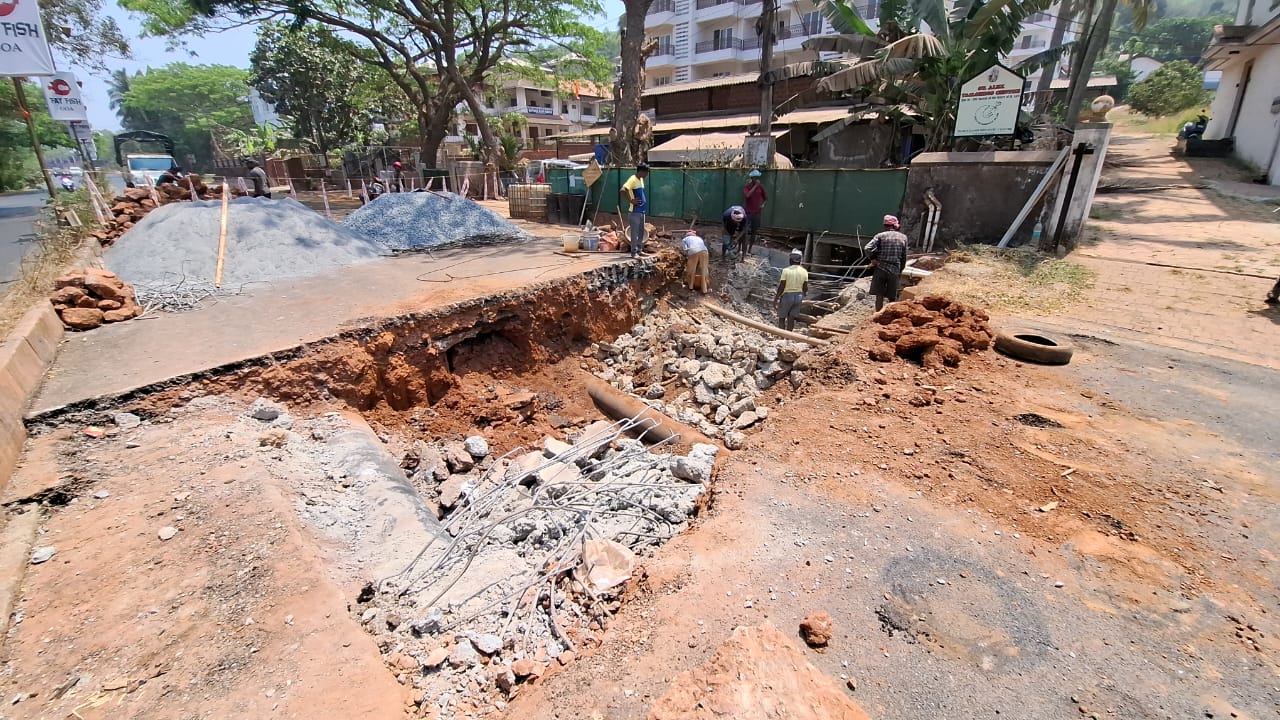
INFRA PUZZLE: The main Calangute road from the police station to Dolphin Circle being excavated barely three days after it was freshly hotmixed.
MAPUSA
The tar had barely settled on several newly resurfaced roads in Bardez when the rumble of excavators returned – slicing through the fresh asphalt as if the work had never been done.
What was meant to signal improved infrastructure has instead exposed a troubling reality: a cycle of hotmixing and hurried excavation that reflects deeper failures of planning and coordination within the government machinery.
In Calangute, Mapusa and Assagao, roads that had been freshly carpeted with hotmix were dug up again within days – turning the government’s recent directive regulating road excavation into an example of how policy announcements often fail to translate into action on the ground.
The developments come at a time when Public Works Department (PWD) Minister Digambar Kamat had publicly declared that no government department or private agency would be allowed to dig up roads without prior clearance from the Principal Chief Engineer (PCE).
But the events in Bardez have instead highlighted the absence of precisely such coordination.
A road dug repeatedly
Nowhere is this more evident than in Calangute.
The busy stretch from the Calangute Police Station to Dolphin Circle was hotmixed only last week, with Calangute MLA Michael Lobo and Sarpanch Joseph Sequeira present for the inauguration of the work.
Barely three days later, the same road was excavated again.
PWD officials said the road had sunk because of a culvert passing beneath the stretch that had not been identified earlier, forcing the department to reopen the road and repair the structure.
Yet the explanation has left residents baffled.
For nearly a year, the same road had been repeatedly dug up by different departments – first by the Water Resources Department to lay a pipeline, then by the PWD for another pipeline, and later by the Electricity Department for cable works.
Despite multiple rounds of excavation by three different departments, the culvert somehow escaped notice.
To residents, the incident has become a stark illustration of how departments operate in isolation, often undoing each other’s work while public money is spent again and again on the same stretch of road.
“It is difficult to understand how so many departments could work on the same road for months and none of them realised that there was a culvert underneath,” said Calangute resident Ranjan Naik.
A pattern across Bardez
The problem is not confined to Calangute.
In Mapusa, the main road leading into the town from Bodgeshwar Temple to Hutatma Chowk was recently resurfaced. Within days, a private agency cut open the newly hotmixed road to lay cables.
Another stretch in the Housing Board area of Mapusa met the same fate when a private telecom company cut open a road after it had been resurfaced just months ago.
Mapusa MLA Joshua D’Souza said a police complaint had been filed against the private agency responsible for digging the road. However, residents say the incident reflects a larger pattern where rules exist on paper but enforcement remains weak.
“If roads can be dug up immediately after being repaired, then clearly the system meant to regulate these works is not functioning. It raises a simple question – who is accountable for the waste of public funds,” said Mapusa resident Santosh Pednekar.
In Assagao too, a newly carpeted road did not remain intact for long. Barely ten days after hotmixing, the Electricity Department excavated a portion of the road for cable-related work.
For motorists and residents who endure the disruptions caused by such repeated digging, the issue is not merely administrative – it affects everyday life.
Traffic snarls, uneven surfaces and damaged stretches quickly reappear on roads that were supposed to provide relief.
A failure of coordination
A senior PWD official acknowledged that such situations underline the need for stronger coordination between departments.
“The government has proposed an inter-departmental mechanism so that all utilities and infrastructure works are planned in advance before the road is resurfaced. The objective is to ensure that freshly hotmixed roads are not disturbed,” the official said.
But residents say such mechanisms have been promised before, while the cycle continues.