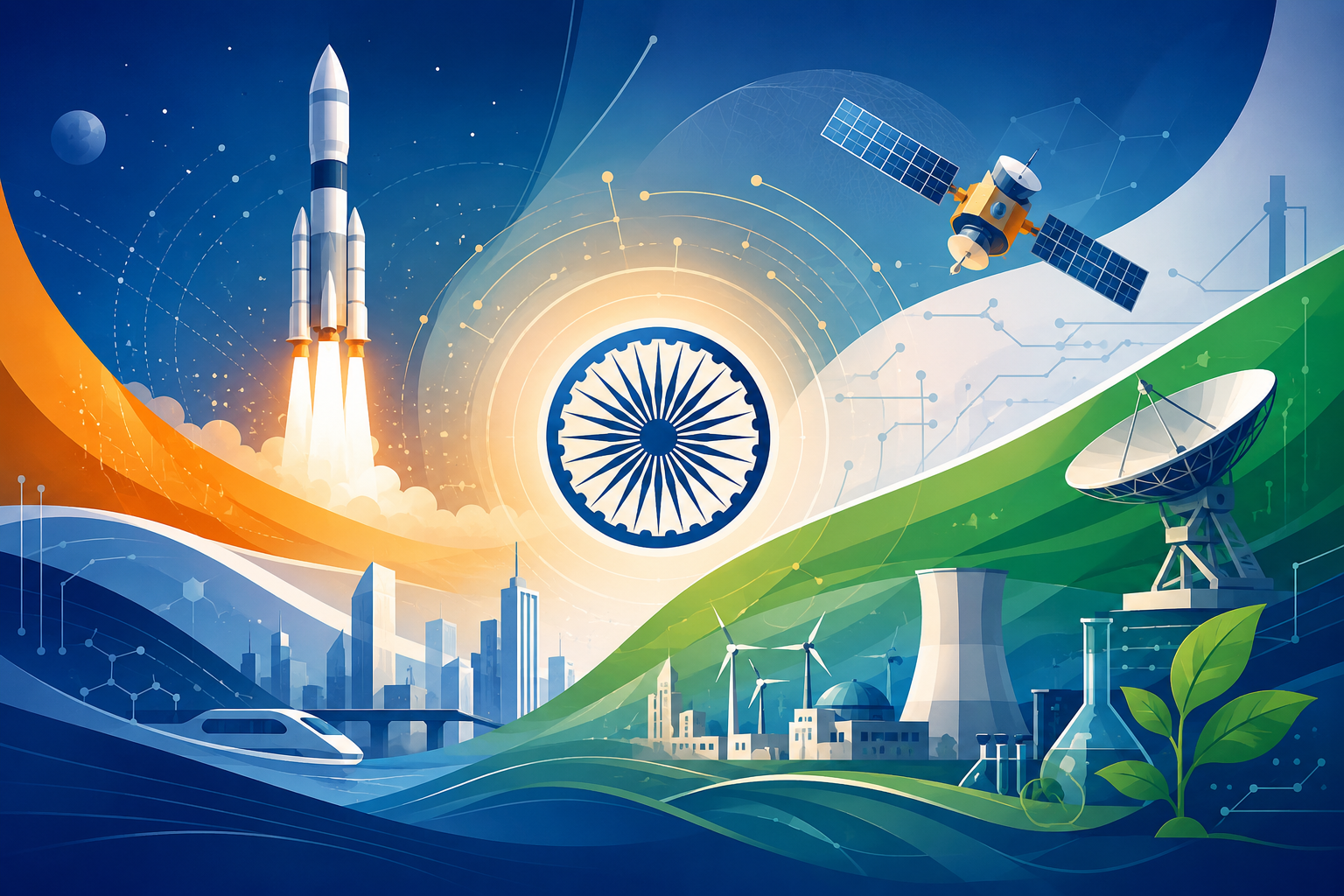
National Technology Day (NTD) is observed annually on May 11 to commemorate India’s remarkable achievements in science and technology. The day marks the successful nuclear tests conducted at Pokhran-II in 1998 under Operation Shakti, after which India officially emerged as a nuclear-capable nation. It also commemorates the successful test flight of the indigenously developed Hansa-3 aircraft and the successful test of the Trishul missile, symbolising India’s growing technological self-reliance and scientific strength.
The observance was officially declared in 1999 by former Prime Minister Atal Bihari Vajpayee. NTD recognises the contributions of scientists, engineers, researchers, and innovators in advancing India’s technological capabilities and technology-driven development. It highlights progress in innovation, indigenous research, space science, nuclear technology, and digital transformation while inspiring youth towards scientific excellence.
The theme for NTD 2026 focuses on responsible innovation and inclusive growth, emphasising how emerging technologies such as artificial intelligence, space science, digital tools, and sustainable technologies can benefit every section of society. The theme underlines the importance of ethical and sustainable technological development while promoting inclusive access to innovation and bridging rural-urban and economic disparities.
Significance of National Technology Day
NTD is not merely a remembrance of a historic scientific achievement, but a celebration of India’s remarkable journey towards becoming a global leader in science, innovation, and technology. The day honours the invaluable contributions of scientists, engineers, researchers, innovators, and entrepreneurs who have strengthened the nation through technological advancement and self-reliance.
It highlights India’s achievements in strategic sectors such as defence, space research, information technology, biotechnology, nuclear science, digital communication, healthcare, and renewable energy. The observance also promotes indigenous, affordable, and cost-effective technologies that address the needs of society while encouraging innovation-driven entrepreneurship and the growing startup ecosystem under initiatives like Make in India and Atmanirbhar Bharat.
NTD reflects India’s transformation from basic “jugaad” innovation to the development of high-quality, scalable, sustainable, and globally competitive technological solutions. It inspires young minds to pursue scientific research and innovation while reaffirming the nation’s commitment to using technology for inclusive growth, national progress, and improving the quality of life for all citizens.
India’s technological growth journey
India has witnessed extraordinary growth in science and technology over the last decade, emerging as one of the world’s leading centres of innovation, research, and technological advancement. The nation made remarkable progress in strategic fields such as space exploration and atomic energy, laying a strong scientific foundation through premier institutions like the Indian Space Research Organisation (ISRO), which has strengthened India’s position as a major global space power.
ISRO has achieved significant milestones in launch vehicle technology through the successful development and operation of PSLV, GSLV, and LVM3 rockets, commercial satellite launches for several countries, reusable launch vehicle experiments, and small satellite launch vehicles. One of India’s greatest accomplishments came in 2023 when Chandrayaan-3 successfully landed near the Moon’s south pole, making India the first nation to achieve this historic feat. ISRO also launched Aditya-L1, India’s first solar mission to study the Sun, while the Gaganyaan programme made notable progress through successful crew escape system tests. In 2025, ISRO demonstrated indigenous spacecraft docking capability through the SpaDeX mission. India has further strengthened international cooperation through Earth observation, communication, and satellite missions supporting weather forecasting, agriculture, navigation, and disaster management.
India has also recorded major advancements in nuclear technology over the past five years, reinforcing its capabilities in clean energy, scientific research, and technological self-reliance. The country operationalised indigenous 700 MW nuclear reactors at Kakrapar in Gujarat and expanded its nuclear power generation capacity. A major milestone was achieved in 2026 when the indigenously developed Prototype Fast Breeder Reactor (PFBR) at Kalpakkam attained criticality, marking India’s entry into the second stage of its ambitious three-stage nuclear programme based on thorium utilisation.
Progress has also been made in Small Modular Reactor (SMR) technology, nuclear medicine, radiopharmaceutical production, and advanced reactor systems. Indigenous nuclear systems, equipment, and fuel technologies have strengthened the vision of Atmanirbhar Bharat in the nuclear sector. Nuclear applications today play a crucial role in healthcare, cancer treatment, agriculture, food preservation, industrial research, and scientific innovation.
(The writer is a scientist by profession and a freelance writer from Taleigao)