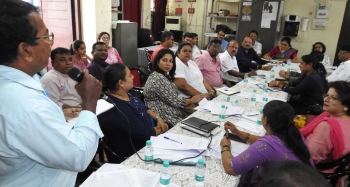
 File photo of South Goa ZP members who functioned without powers and functions as per the Panchayat Raj Act. Captured by : The Goan
MARGAO
As the two Zilla Panchayat bodies prepare to elect their new chairpersons for the next five-year term, public attention is less focused on these district panchayats themselves and more on the BJP-led State government.
The reason is simple. Twenty-five years after the Zilla Panchayats were constituted in 2000, the same unresolved question continues to haunt newly elected members and Panchayat Raj activists alike: will the government of the day finally devolve powers and functions to the Zilla Panchayats as mandated by the Constitutional Amendment, or at least initiate the process in line with the provisions of the Goa Panchayat Raj Act?
Or will these district-level bodies remain confined to executing minor works such as laying interlocking pavers, erecting shades near places of worship, carrying out small road repairs, or supplying water coolers to institutions?
These questions are likely to dominate discussions as the two Zilla Panchayats elect their chairpersons and vice-chairpersons, marking the beginning of a new term envisaged under the Constitutional framework.
Since their inception in 2000, successive governments have either offered assurances about empowering the Zilla Panchayats or have maintained a studied silence on the issue of devolving the powers legally due to them.
In the initial years, the South Goa Zilla Panchayat was entrusted with responsibilities such as repair works related to government primary schools, primary health centres, and minor irrigation projects ” the subjects envisaged in the Panchayat Raj Act. However, even these limited functions ” which effectively reduced the Zilla Panchayats to a repair wing of the Public Works Department ” were gradually withdrawn by successive governments. As a result, the district panchayat bodies have been left virtually stripped of meaningful powers and functions.
Will the government devolve any of these functions and subjects in Schedule II to the Zilla Panchayats set to elect their chairpersons on Tuesday?
These include agriculture; land improvement, implementation of land reforms, land consolidation and soil conservation; minor irrigation, water management and watershed development; animal husbandry, dairying and poultry; fisheries; social forestry and farm forestry; minor forest produce; small-scale industries, including food processing industries
khadi, village and cottage industries; rural housing; drinking water; fuel and fodder; rural electrification, including distribution of electricity; non-conventional energy sources; poverty alleviation programmes; education, including primary and secondary schools; technical training and vocational education; adult and non-formal education; libraries; cultural activities; markets and fairs; health and sanitation, including hospitals, primary health centres and dispensaries; family welfare; women and child development; social welfare, including welfare of the handicapped and mentally retarded; welfare of the weaker sections and, in particular, of the scheduled castes and scheduled tribes; public distribution system; maintenance of community assets.
---
No word on powers, but grants may rise for zilla panchayats
MARGAO: With the government remaining silent on the contentious issue of devolving powers and functions mandated under the Constitution, questions are being raised in panchayat circles over whether it will further enhance development grants to the Zilla Panchayats in the next five-year term.
In an apparent bid to keep Zilla Panchayat members in good humour and to cap any resentment over the failure to devolve powers, the government had, during the previous five-year term, provided a total development grant of Rs 84.35 crore ” Rs 84,35,81,000 to be precise.
With the BJP set to retain control of the Zilla Panchayats and the government remaining non-committal on devolving any of the 29 subjects envisaged under the Goa Panchayat Raj Act, sources say the government may opt for a further enhancement of development grants to the two district Panchayat bodies to keep members satisfied and content.
---
Why DPCs have failed to take off
MARGAO: The newly elected chairpersons of the Zilla Panchayats have a clear task ahead, as mandated under the provisions of the Goa Panchayat Raj Act: convening a meeting to constitute the District Planning Committee (DPC), the constitutionally mandated planning body in each of the State’s two districts.
Traditionally, Zilla Panchayat chairpersons have complied with this requirement by convening meetings to elect members to the DPC. However, the more contentious and unresolved question remains: will the newly constituted DPCs be able to carry the planning process to its logical conclusion, as envisaged under the Constitutional Amendment, or will the draft district plans once again meet the same fate as in the past ” consigned to the government’s dusty records?
These and other questions are likely to take centre stage in the coming days after the election of the new ZP chairpersons, once the incumbents settle down to discharge their constitutional responsibilities.
Consider this: In the 25-year history of the South Goa Zilla Panchayat, the District Planning Committee prepared a draft Development Plan only once. Headed by then ZP chairperson Suvarna Tendulkar, with Florina Colaco serving as member secretary, the DPC prepared a draft Development Plan for the financial year 2024-25 and submitted it to the government for implementation.
The draft plan was compiled after consolidating nearly 3,400 development proposals received from Panchayat bodies and the South Goa Zilla Panchayat, with the total cost of the proposed works estimated at around Rs 148 crore.
To date, the fate of this draft Development Plan remains unknown. The immediate fallout of the government’s failure to act on the plan was that the DPC refrained from undertaking a similar exercise for the financial year 2025-26, apprehensive that it would meet the same fate at the hands of the government.
Article 243ZD in the Constitution of India provides for district planning through the District Planning Committees. However, the DPCs have been rendered defunct by successive governments by not extending support to the planning panels over the last 25 years. Will the DPCs headed by the Zilla chairpersons be anything different in the next five years after the election of new chairpersons for the five-year term?
---
Explained: Why DPCs matter
The Constitution mandates that every State set up a District Planning Committee at the district level to bring together development plans prepared by panchayats and municipalities and combine them into a single, comprehensive draft plan for the entire district.
While preparing this draft development plan, the DPC must consider issues of common interest between rural and urban local bodies. These include spatial planning, sharing and management of water and other natural resources, integrated infrastructure development, and environmental conservation. The Committee is also required to assess the availability of resources ” financial and otherwise ” and consult institutions or organisations identified by the Governor.
Once finalised, the draft development plan is to be forwarded by the DPC chairperson to the State government for consideration and implementation.