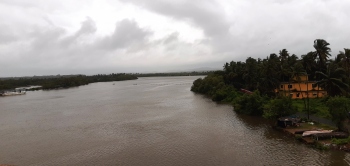
 A panoramic view of the River Sal near the Assolna-Cavelossim bridge.
MARGAO
Exactly a week ago, when the SGPDA parking played host to the public hearing on the Coastal Zone Management Plan (CZMP), a little over a 100 fisherwomen seemed anxiously waiting inside the pandal to convey a simple message: Do not displace the fishing communities from their habitat and leave the River Sal for the fishermen inhabiting the banks along the Assolna, Ambelim, Velim river stretch.
They could not voice their concerns to the authorities in the din and chaos that followed, but a local fisherman Cruz Silva, a resident of Ambelim village, managed to put across to the CZMP panel in clear terms that the CZMP plan prepared by the NCSCM will displace fishermen from their habitat along the river banks from the Orlim bridge to the river mouth at Betul, a stretch spanning over 10 kms.
In fact, if river Sal is called the lifeline of Salcete, the river has been the source of livelihood for the fishing communities of these riverine villages over the years.
Take note, even today, fish lovers flock to the Asssolna market to lay their hands on the fresh mordoshes (sole fish) or shell fish such as mussels or oysters plucked from the rich marine habitat around the Betul-Sukhoband-Colleadongor belt.
Reason: The river Sal stretch, from the Orlim bridge till the river mouth at Betul is the habitat of different fish species, including variety of shell fish and the much-sought after mordoshes and shevttes.
If the Betul-Cutbona belt is known for Khubes, the Sukhoband-Zug-Colleadongor stretch is known for oysters and mussels. The stretch of the river between Assolna and Chinchinim, right up to the Orlim bridge is known for the presence of mordoshes, especially during the monsoons.
Says Cruz Silva: “I am a fisherman. Our parents toiled hard to eke a living on the river. In fact, we can call the River Sal our parent. We get fish from the river all throughout the year. Even today, our women go for fishing in the river, be it at Sokhoband-Ambelim or Colleadongor-Assolna to collect shell fish. How can the authorities now say the MPT Port limits extend right up to the river Sal”.
Suspecting that the decision to show the port limits and nationalise the rivers as part of a large game plan to bring in corporates in the future, Cruz wondered why the plan does not even show the structures of the fishermen. “The coastal plan ought to have reserved spaces for the expansion of the fishing communities, but the plan has blanked out the existing structures of the fishermen”, he said.
Cruz added: “The local fishing communities are only demanding that the plan make a mention of the fishing zones in the river Sal. The NCSCM plan is silent on the fishing zones and areas, including the fishing stakes allotted by the fisheries department”.
The River Sal is rich breeding grounds for various kinds of shell fish including Tisreo, Kunnoyo, Kalvan, Khube, Zob, Shinanneo, etc, as well as numerous fish species of commercial and ecological value.
In the draft submitted by the Assolna villagers, the plan makes a mention of the fact that Assolna is a fishing village where traditional fishing activities, paddy cultivation and coconut farming are carried out by the local communities in the entire CRZ area, including the rivers, bandhs, water bodies, fields and khazans lands.
“The fisher folk of Assolna fish intensively in the entire Sal River from Betul to Orlim bridge. Bunds, sluice gates, fields, water bodies & khazans have been created and are maintained by the local communities, who are the owners of these man-made features and economic assets”, the plan says, adding “The riverine vegetation and eco-systems of the village are recognized by MOEF to be among the four unique habitats of Western Ghats having exceptional flora & fauna which must be protected as Ecologically Sensitive Areas”.