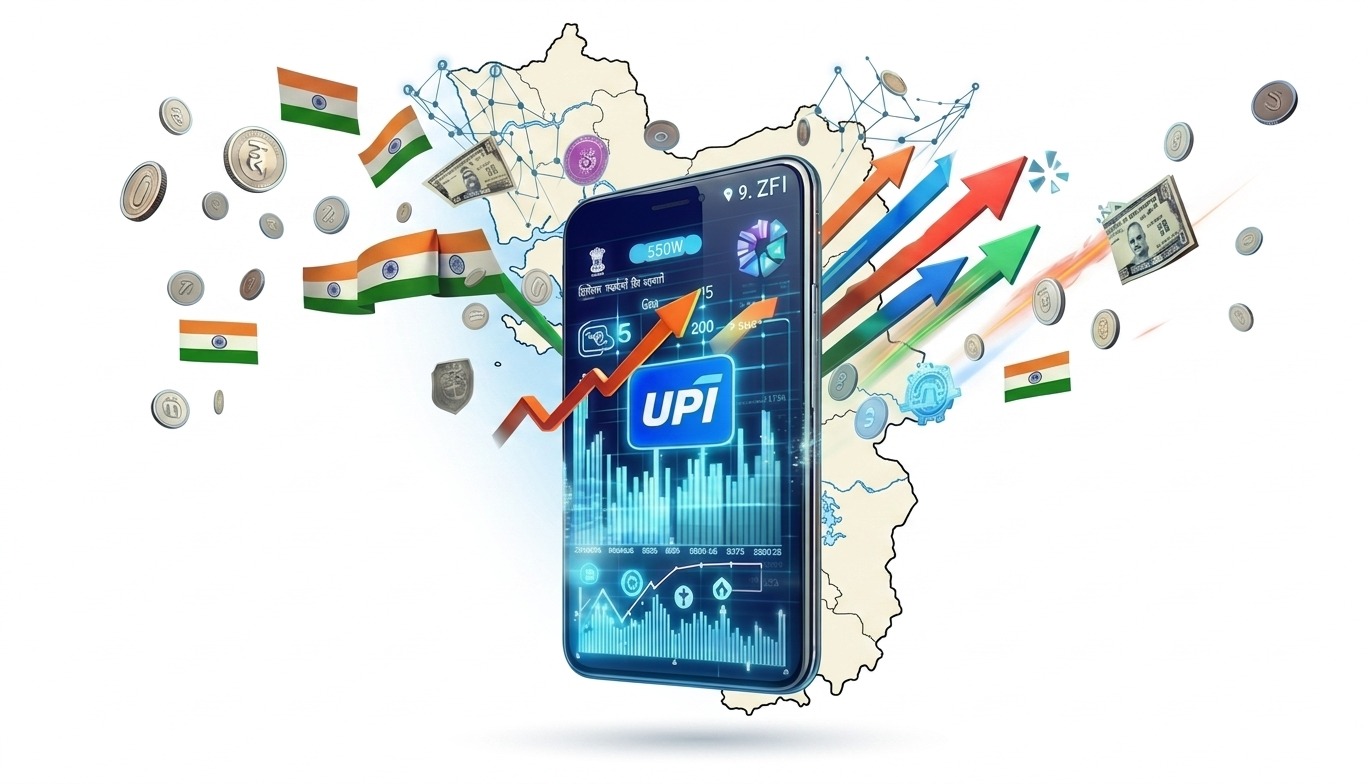
Between offering exact change and dealing with poor connectivity, Unified Payment Interface (UPI) has completed 10 years in the country this year. Gone are the days of shopkeepers handing out extra toffees in place of change, as today, payments are completed instantly with a quick scan.
FROM TOFFEES
TO QR CODES
Right from roadside food stalls and cobblers, to large multiplexes and shopping malls, UPI’s journey is a long one indeed. Although it began with scepticism, the UPI scanner has now found a permanent place in the nustekann’s basket (fisherwomen), the phoolkann’s table (flower vendor), and the kirana shops.
UPI was officially launched on April 11, 2016, by the National Payments Corporation of India (NPCI), under the regulatory oversight of the Reserve Bank of India (RBI). It was officially unveiled by Dr Raghuram G Rajan, who was the Governor of the RBI at the time. This payment system aimed to simplify mobile banking and significantly boost digital transactions across the country.
THE DIGITAL BOOM
What once seemed unfamiliar has today become second nature for most Goans. As the UPI marks its 10-year milestone, digital transactions in Goa have continued to skyrocket. In January alone, the State recorded over 4 crore transactions amounting to Rs 6,064 crore. This massive adoption is fuelled by expanding 5G networks, smartphone penetration, and near-universal acceptance among Goan businesses, from beach shacks to local markets.
Vrinda Naik sits at her stall in the Panaji market, braiding flowers. She calls the UPI system a blessing. “It is less of a hassle for me, the transactions are easy, and UPI makes it simpler as long as there is money already in the account,” she mentions. Nikhil Nair, who runs a food stall at the Panaji bus stand, mentions how UPI has reduced the trouble of finding change. “Sometimes customers do not have exact change, and neither do we. That is when UPI payments are the most helpful. They let the customer pay the exact change, even if it is an odd rupee or two.”
CONVENIENCE & CONECTIVITY
For Vrinda, it is also about the quick process. She mentions how there was a situation that required her to make payments late at night, and UPI made that effortless. “UPI has been helpful when I have to make some urgent payments at night. Usually, one does not know what to do. UPI makes sending money very simple,” she remarks. “It makes transferring money from one bank to another and payment of EMIs much easier,” she adds.
However, not everyone is happy with the UPI systems. While it has indeed made payments easier and transactions simpler, the network issue has indirectly caused a significant loss to many shops and retail outlets. Many shop owners said customers buy something, but under the pretext of a weak internet connection, they walk away without paying. Yet another setback for them is not getting the notification of successful or failed payments from the UPI systems. “It is a loss for me when the system gets delayed, and I do not receive the notification on time. By the time I get the message of transaction failed, the customer has already gone. Now if I tell the customer, they feel angry,” says Clanny Fernandes, poultry shopkeeper.
The troubles don’t cease. “It was one of my regulars, he bought the items, scanned, and told me that he had paid. After a while, I realised that the payment was not successful, so I messaged him. Well, he has not come after that! I lost the money, and I lost a regular customer as well,” he notes. So, should the blame be put only on the bad network? Fernandes disagrees. “Other than being able to give exact change, I don’t see any good that has come out of it. We try so hard to copy the West, but we forget that they first built the infrastructure for it and then rolled out the features; for us, it is the opposite. We first see things like UPI being rolled out first without any proper infrastructure in place,” he reckons.
A ROUTINE AFFAIR
In spite of all the challenges and setbacks surrounding UPI payments, its success story is hard to ignore. After its introduction, COVID was a major boost as people preferred contactless payments. A QR code has become the replacement for the toffees thrown in instead of change. A decade later, paperless payments in Goa are not a thing of the future but have simply become a routine.