


Remember the hall of mirrors at the carnival where we regaled as kids? We stared at our reflections -- some magnifying, others minimising. Feels a bit like that nowadays, except it’s not a funfair anymore but a redefining reflection of humanity as AI opens a new portal into the future. McKinsey projects that 57% of US manhours will get automated and by 2030 most professions will undergo skill shifts. Jamie Dimon, JPMorgan CEO said “While AI will eliminate jobs, young people should lean into soft skills. If they get those right, you’ll have plenty of jobs”.
Last week, we discussed how schools can integrate AI. Top technology and B-schools have assimilated AI in their curricula. While emerging skills-based technical fluency is easier to switch, it is high time to look within and reckon -- which human competencies will illuminate our future in the age of AI? It’s a pursuit grounded in the understanding that AI is human led. It is not a threat to our self-efficacy but an amplifier of it.
It is a product of human intelligence, in fact, an algorithmic manifestation of it. This means shifting our mindset from the Human-in-the-Loop Paradigm to thought leadership.
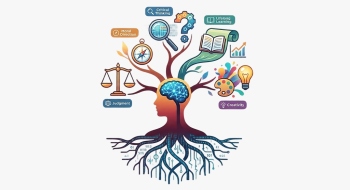
Ethical judgement and Ethics-by-design approach
Pope Leo XIV recently signed the Magnifica Humanitas, concerned with preserving morality.
He questioned the weaponisation of AI for destruction and appealed to our human capacity for making moral choices. Our principles are based on conscience and morality, not algorithmics. We can weigh what makes life valuable beyond metrics- representation, culture and authenticity, human rights and social equity, economic inclusion and sustainability.
With AI, our roles have become even more instrumental in shaping the determinants of life quality.
We need to focus on questions that matter -- the impact of intellectual property, racial profiling, predictive policing, surveillance and facial recognition. We must shift positioning as AI users to become designer- regulators, who co-create with AI. Invoke your ethical reasoning to discern which technological solutions encroach upon our values and rights; and which ones can improve lives across the planet. Ultimately it is we, who are accountable for solidifying the civic values of transparency, protecting privacy, countering bias and invasive regulation.
Critical thinking
What make us grow is not just gathering experience but interpreting it to apply purposefully.
Reflect on your thought process critically and use AI to challenge and extend it. People often take it personally if another person does this for us, so harness AI to do it without the emotional traps. If prompted correctly, you can engage with AI to sharpen your reasoning skills. This is foundational; to purposefully partner with AI as students, consumers and creators. However, the operative word is ‘sharpen your reasoning’, not delegate it or fall prey to echo chambers. Students need to be supported with ethical guidance and knowhow for teaming up with AI, not be shielded from it. Dependence on automation for decision-making will invariably lead to cognitive surrender. Reflect on the current contentions around AI and assess your relationship with it in terms of human versus machine agency. Use your refined judgement based on lived experiences. As for data crunching, there’s always AI.
Lifelong learning and experiential intelligence
The true aim of education is mastery, not literacy. This requires learning agility -- to learn, unlearn and relearn on an ongoing basis. Learning agility is marked by an adaptive intellectual curiosity and the desire to stay relevant. Be like a Hermit crab, discard the old shell that will restrict your growth and seek a new one. Those who learn continuously let go of outdated assumptions, leave their comfort zone and build new shelters to sustain their development.
In this era of mass intelligence, knowledge is no more an elite or scarce resource. Learn to leverage AI for your self-realisation by building capacity to do more things, more efficiently. Read up on various future skills reports that identify the latest technical skills required for the alliance with agents and robots -- get certified. Simulate scenarios and master new subjects, as learning has no limits. Team up with AI and solve bigger issues for community development.
Creativity and Innovation
Creative expression is fuelled by emotions, experiences, cultural immersion and our natural inquisitiveness. While AI can compose music and poetry or create art; it is derivative and not inspired. It can though, substantially augment the creative process through rapid prototyping, juggling statistical combinations, scenario generation and cross-domain pattern recognition. As humans, that leaves us free to focus on expression and purpose of innovation. Great art connects our lives and great inventions advance it -- this remains our gift, to ourselves.
IBM CEO Ginni Rometty said that once AGI fully integrates into the workforce, abilities like collaboration, judgment, and critical thinking will hold premium. Which are the others? Our discussion continues next week.
(The writer is a Human Capital Strategist and Educator; meaning she invests in humans like blue chip stocks and teaches them how not to crash the market.)


