


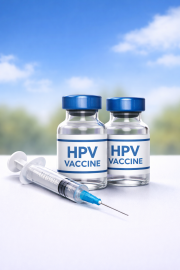
The government of India is launching a major nationwide free Human Papillomavirus (HPV) vaccination drive aimed at preventing cervical cancer in adolescent girls. The campaign is scheduled to start in the first week of March across all the States, including Goa, featuring a single-dose of HPV vaccine to be administered to 14-year-old girls for prevention of cervical cancer “ the second most common cancer among women in India.
Cancer burden
According to Global Epidemiology, Volume 10, December 2025 issue, the Southeast Asia Region ranks second, contributing 29.59 % of global cervical cancer cases and 34.12 % of deaths, with India alone reporting 127,526 new cases and 79,906 deaths in 2022. India accounts for nearly one-third of global cervical cancer deaths. Out of these around 60-70 % cases are diagnosed at advanced stages. Hence to prevent cervical cancer in women in the later stages, the HPV vaccine is given to girls before sexual activity starts, so that it can protect them against the main HPV types that cause most cervical cancer cases, and also against two types of other infections.
Govt backing
“In private practice sector, the HPV vaccine has been administered in India for many years and not for the first time. The vaccine is listed in the Indian Academy of Paediatrics, Indian Medical Association, Obstetrics and Gynaecology Society etc. All these years these organisations were trying for government support since the vaccine is expensive. It is a welcome step by the government to come up with this plan of free HPV vaccination drive,” observes Dr Purnima Usgaonker, paediatrician from Usgaonker Children’s Hospital, Ponda.
Infection cancers
Cancers occur due to a variety of causes ” including genetic factors, lifestyle influences, environmental exposures, and infections. Among infectious causes, certain viruses are known to directly contribute to the development of cancer. Two well-established viruses are: 1- Human Papillomavirus (HPV) “ linked to cervical cancer and several other cancers and 2- Hepatitis B Virus (HBV) “ linked to liver cancer. In fact, globally, nearly 15“20% of cancers are attributable to infections, and many of these are preventable.
Public health measure
“Adopted as public health prevention strategy, the vaccination is most effective when given before exposure to HPV, which is why it is recommended for adolescent girls (and in many countries, boys as well),” explains Dr Amit Dias, assistant professor at the department of Preventive and Social Medicine, Goa Medical College, adding, “It is a preventive health measure “ similar in principle to the Hepatitis B vaccine that prevents liver cancer and is given at birth.”
Treatment burden
Treating cervical cancer involves surgery, chemotherapy, and radiation ” treatments that are physically, emotionally, and financially taxing. Prevention through vaccination is far safer, simpler, and more cost-effective. Protecting young lives today ensures healthier futures tomorrow. “Prevention is better than cure,” remarks Dr Dias.
HPV explained
Noted paediatrician from Panaji, Dr Sushma Kirtani, maintains, “HPV is human papilloma virus. It is transmitted sexually, not through food, genes or other stuff. It causes health problems like genital warts, penile cancers in males, and cervical cancers in females. It is one of the most sexually transmitted viral infections. Data suggests almost 80 % of unvaccinated adults will have an HPV infection at some point in their life. Therefore protection against HPV is very important.”
Early vaccination
Dr Kirtani observes that nutrition, health advice does not work for Gen Z which is a digital generation, “They are ‘screenagers’ in their teenage age. The exposure to sexual information on media, porn sites is high. They want experimentation. They are on dating apps and have a high chance of sexual contacts not only with one but with multiple partners. Early vaccination before the first sexual debut is very effective. Indian Academy of Paediatrics recommends it from 9-14 years two doses six months apart in boys and girls. The Gardasil covers virus subtypes 6, 11, 16, 18 causing genital warts and cervical cancer. It is a quadrivalent vaccine.”
Safety assured
Pointing out towards the safety, effectiveness and essentiality of the HPV vaccine, noted paediatrician from Porvorim Dr Dhanesh Volvoikar, says that many countries have been giving it and the results are very good and he himself has been giving this vaccine for over 10 years, ever since it is available, to whosoever wanted it. “This vaccine is absolutely essential for each and every girl child. There are some other types of vaccines given for the boys as well. It is recommended for preteens (ages 9“12), but can be given through age 45 “ two doses for ages 9“14 and three doses for ages 15“45. It prevents HPV-associated cancers (cervical, anal, vaginal, vulvar) and precancerous lesions. It is highly effective, especially when given before exposure to the virus,” vouches Dr Volvoikar.
Goa scenario
Though cervical cancer is the 2nd most common cancer in the world for women, in India it will be number one followed by breast cancer. In Goa breast cancer numbers are more than cervical cancer cases, claims Dr Volvoikar who feels that if the immunity of the girls is increased by giving the vaccine much before the virus enters, the child is protected.
Cost factor
“Almost 98-99 % protection is there and thus many children can be saved from cancer deaths or to other debilitating diseases and the treatment that goes into it. Since the cost of the HPV vaccine is high, it is heart-warming that the government is offering it free. No false propaganda should be made about the vaccine’s effectiveness or its side effects. Everything has side effects. If a mild reaction occurs, it is negligible compared to the cancer treatment later,” says the doctor.
Global evidence
“Vaccines have saved lives. If the vaccination programmes are removed, we will see high mortality in children. The HPV vaccine will decrease the number of cervical cancers, for sure. It should offer 95 % protection; however, as no vaccine can give 100 % guarantee, we should look at the proven results in other countries. Globally, over 90 countries are implementing single-dose HPV vaccination schedules, improving coverage and affordability. The countries that have been giving this vaccine for 10-15 years have seen that the ratio of this particular disease has gone down considerably. Several countries have already demonstrated substantial reductions in HPV infection, precancerous lesions, and cervical cancer incidence following widespread vaccination,” points out Dr Volvoikar.


