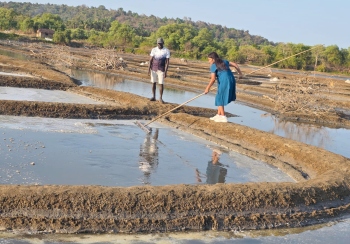
In the quiet, shimmering salt pans of Batim and Pernem, a centuries-old tradition is fighting for survival. Goa’s traditional salt makers, once the backbone of a thriving coastal economy, are facing an increasingly uncertain future this year due to erratic weather and mounting environmental challenges.
Season setback
The 2025“26 salt-making season began on a difficult note. Unseasonal rains persisted well into November, delaying the preparation of salt pans and shortening an already fragile production cycle. Just as the salt makers began to recover lost time, heavy dew formation in recent weeks further disrupted the crystallisation process, damaging yields and reducing the quality of the harvest.
“Every day matters in this work,” said a local salt pan worker in Batim. “When the rains don’t stop on time or dew settles heavily, the salt simply doesn’t form as it should. Our efforts go to waste.”
Cultural legacy
Salt making in Goa is not merely an occupation”it is a cultural legacy passed down through generations. Using traditional techniques, seawater is carefully channelled into shallow pans, where it evaporates under the sun to leave behind crystalline salt. This delicate process depends entirely on precise climatic conditions, making it highly vulnerable to changing weather patterns.
Changing workforce
In Batim, the traditional system of salt production has undergone a significant transformation. Historically managed by local tenants known as "mittkars", the sector was largely sustained by Goan Christian salt-making families. Today, however, a majority of these families have migrated and settled abroad, particularly in the United Kingdom and Paris. In their absence, migrant workers from Karnataka have taken over the day-to-day operations of the salt pans. This shift has altered the traditional labour structure, with changing terms and conditions of work and a weakening of community-based management systems that once defined the industry.
Signs of recovery
Despite these structural changes and environmental setbacks, the salt pans of Batim are now slowly coming alive. In some areas, salt is finally ready for harvest, glistening under the sun”a symbol of resilience and perseverance. The quality, where successful, remains commendable, reflecting the skill and dedication of the workers.
Pernem struggles
However, in Pernem, the situation remains more precarious. In addition to weather-related challenges, salt making continues to be carried out primarily by Hindu salt makers, locally known as "mithgaudas", who largely manage the work themselves. The occupation is highly labour-intensive, demanding long hours of physical effort under harsh conditions. Workers are often exposed to intense heat, having to literally toil under the scorching sun for prolonged periods. The absence of basic protective gear or personal protective equipment (PPE) further exacerbates the difficulty and health risks associated with this traditional livelihood.
Infrastructure issues
Furthermore, infrastructural failures have added to their challenges. The traditional bandharas (embankments) and sluice gates, crucial for regulating the flow of seawater into the salt pans, have given way in several areas. This has severely disrupted the delicate water management system, leading to flooding of pans, loss of prepared beds, and further decline in production.
Many salt makers in Pernem report reduced output and growing financial strain, compounded by a steady decline in manpower. Younger generations are increasingly reluctant to take up this labour-intensive occupation, seeking more stable and lucrative employment elsewhere.
Uncertain future
Experts warn that without timely intervention and support, Goa’s traditional salt-making industry could face irreversible decline. Rising environmental pressures, irregular weather patterns, and lack of institutional backing continue to erode the sustainability of this heritage livelihood.
The salt pans, once bustling with activity, now stand as both a testament to human endurance and a silent plea for recognition. As Goa moves rapidly towards modernisation, the survival of its salt makers hangs in the balance”calling for urgent attention from policymakers, communities, and consumers alike.
Enduring grit
For now, in Batim and Pernem, the story of salt is one of grit against the odds”where each grain harvested carries with it the weight of tradition, struggle, and hope.
[The writer, an Associate Professor of Sociology, Government College of Arts, Science and Commerce, Quepem, has conducted research on salt pans across the State.]