


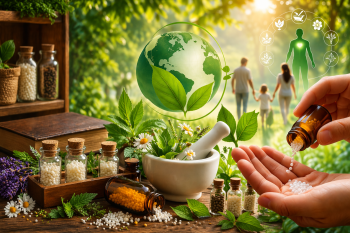
Every year on April 10, World Homoeopathy Day is celebrated on the birth anniversary of Dr Christian Friedrich Samuel Hahnemann, a German physician, great scholar, researcher, linguist, and eminent scientist, regarded as the founder of homoeopathy. The credit for developing an entire system of medicine based on the principles of homoeopathy goes to Dr Hahnemann. That is why his birth anniversary is observed as World Homoeopathy Day. The objective of celebrating this day is to create awareness among people about this distinct system of medicine and to improve its accessibility and success rate for every individual. Born on April 10, 1755, Dr Hahnemann held an MD degree but later left his medical practice to work as a translator. He studied medical and scientific texts in several languages, including English, French, Italian, Greek, and Latin.
Homoeopathy is a medical system based on medicines and their application. In India, the Ministry of AYUSH determines the theme of Homoeopathy Day each year, and the day is celebrated nationwide. This year, the theme is “Homoeopathy for Sustainable Health.” On this occasion, the 271st birth anniversary of Dr Hahnemann is being observed. The main objectives of celebrating this day include strengthening the safety, quality, and efficacy of homoeopathic medicines globally; understanding the challenges and future strategies for advancing homoeopathy; developing national policies; promoting interdisciplinary and international research collaboration; ensuring high-quality medical education; encouraging evidence-based medical practice; and securing an appropriate place for homoeopathy in healthcare systems worldwide to achieve the goal of universal health coverage.
The World Health Organization also recognises that universal health goals cannot be achieved without promoting traditional and alternative systems of medicine, and homoeopathy holds a prominent place among such systems worldwide. Due to its unique characteristics, homoeopathy is practised in more than 100 countries, and India is a leading nation in this field. Homoeopathic medicines are considered effective in treating both infectious and non-infectious diseases, as well as ailments related to children and women. Although it is often believed that homoeopathic medicines act slowly, one of their key features is that they aim to cure diseases from the root, with minimal or no side effects. These medicines work differently on each individual, and their effects may vary from person to person.
According to homoeopathic practitioners, in conditions like diarrhoea, cold, cough, and fever, homoeopathic medicines can act as quickly as allopathic medicines. However, in chronic conditions such as asthma, arthritis, and skin diseases, they may take more time but are believed to address the root cause of the disease. Sardar Vallabhbhai Patel once described homoeopathy as a kind of miracle. According to the Central Council for Research in Homoeopathy, homoeopathy is an alternative system of medicine based on the principle of “Similia Similibus Curentur” (like cures like). It is a method of treatment in which a substance that produces symptoms in a healthy person is used in highly diluted form to treat similar symptoms in a diseased person.
In India, homoeopathy is one of the most popular systems of medicine. There are over 210 homoeopathic hospitals, more than 8,000 dispensaries, and nearly 300,000 practitioners across the country. Under the aegis of the Ministry of AYUSH, the Government of India organises World Homoeopathy Day. Although homoeopathic medicines may appear similar, there are more than 4,000 types of remedies used worldwide. Hahnemann believed that the highest ideal of cure is the rapid, gentle, and permanent restoration of health in the most reliable and least harmful way. Since homoeopathic medicines often act more slowly compared to allopathic medicines, which are known for providing quick relief, comparisons between the two systems are common. Nevertheless, homoeopathy continues to be one of the most widely practised alternative medical systems globally. This is not only due to its affordability and accessibility but also because of its unique approach that encourages the body to restore its own balance and health.
Homoeopathic treatment focuses on addressing the root cause of disease rather than merely suppressing symptoms, thereby reducing the chances of recurrence. It considers the physical, mental, and emotional aspects of an individual, making the treatment more holistic and effective. Moreover, as these medicines are derived from natural sources and administered in extremely small doses, they are generally considered safe, with minimal risk of adverse reactions or interactions with other medications. This is why, in today’s complex and side-effect-prone medical environment, homoeopathy is emerging as a safe, balanced, and long-term solution for health.
(The Author is a senior journalist with 36 years of experience & has authored several books, including “Sagar se Antariksh Tak: Bharat ki Raksha Kranti”)


