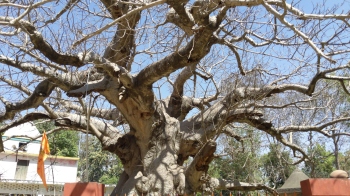
Just as the gods and asuras (demons) are believed to have obtained amrit (the nectar of immortality) by churning the ocean during the great mythological event of Samudra Manthan”an episode linked to the origin of the Kumbh Mela, the world’s largest spiritual gathering”it is also believed that either Lord Krishna or Arjuna brought the Parijaat tree from heaven.
The Parijaat is considered a sacred baobab tree. Modern science traces its origin to sub-Saharan Africa, suggesting it may have been brought to India by ancient travelers moving between the two regions. Today, the tree stands in the village of Kintoor in the Barabanki district of Uttar Pradesh. It is protected by official order, and any form of damage to it is strictly prohibited.
Botanically known as Adansonia digitata, the Parijaat holds a unique status. It reportedly does not bear fruit or seeds, nor can it be propagated through branch cuttings, placing it in a special category. Also called “the tree from paradise,” its age remains uncertain, though estimates range from 1,000 to 5,000 years. The tree stands about 45 feet tall, with a trunk circumference of around 50 feet.
Its leaves vary intriguingly: those on the lower branches have five lobes, resembling the fingers of a hand, while those higher up have seven. The tree produces delicate, fragrant flowers with five snow-white petals and a red stalk. These flowers bloom only at night and fall before sunrise, often turning golden as they dry. They are also believed to possess medicinal properties.
The Parijaat blossoms sparingly, but more noticeably after Ganga Dussehra, the festival marking the descent of Goddess Ganga to Earth to purify the souls of King Bhagiratha’s ancestors. During this time, its fragrance spreads widely, drawing visitors and devotees alike.
Kintoor village is believed to be named after Kunti, the mother of the Pandavas. Located about 38 km east of Barabanki, the area is rich in ancient temples and ruins. Near a temple said to have been established by Kunti stands the Parijaat tree, which, according to one legend, grew from her ashes.
Numerous myths surround this extraordinary tree. One belief holds that Arjuna brought it from heaven, and Kunti offered its flowers to Lord Shiva. Another poignant tale speaks of Princess Parijataka, who fell in love with the Sun God. When her love went unreturned, she ended her life, and from her ashes emerged the Parijaat tree. Unable to face her beloved during the day, the tree blooms only at night and sheds its flowers like tears before sunrise.
Another popular legend associates the tree with Lord Krishna and his queens, Satyabhama and Rukmini. According to the Harivansh Purana, the Parijaat is a Kalpavriksha, a divine wish-fulfilling tree found only in heaven. It is said that Sage Narada once brought Parijaat flowers from Indralok and gave them to Krishna, waiting to see which queen would receive them. Krishna gave the flowers to Rukmini, which stirred jealousy in Satyabhama.
Advised by Narada, Satyabhama insisted that Krishna bring the entire tree from heaven. When Krishna fulfilled her wish, Indra, the king of the devas, tried to stop them, leading to a battle in which he was defeated. However, Indra cursed the tree, declaring that it would never bear fruit again.
When Krishna planted the tree in Dwarka, he did so in a way that fulfilled both his queens’ desires: the tree stood in Satyabhama’s courtyard, but its flowers fell into Rukmini’s home.
Some traditions also claim that the Parijaat originally emerged during the Samudra Manthan and was planted in Indralok as a celestial treasure. Others say that Arjuna brought it to Earth for his mother Kunti, who later offered it to Lord Shiva.
Today, the Parijaat tree remains a site of deep faith and cultural significance. Newlyweds visit it to seek blessings, and a weekly fair is held every Tuesday, where locals gather to worship. Its mysterious origin, sacred associations, and enduring presence continue to inspire devotion and wonder.