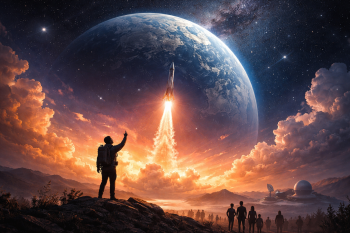
There is a specific kind of silence that exists just before a rocket ignites”a collective holding of breath that spans continents. We felt it again just days ago, on April 1, as the Artemis II mission finally cleared the tower at Kennedy Space Center, carrying four brave souls towards the Moon for the first time in over half a century. It is a fitting prelude to today, April 12: the International Day of Human Space Flight. While today’s headlines are dominated by the sophisticated roar of the Space Launch System (SLS) and the diverse crew of Artemis”including Christina Koch and Victor Glover”the roots of this celebration reach back 65 years to a much humbler, yet equally terrifying, beginning.
On April 12, 1961, a 27-year-old Soviet pilot named Yuri Gagarin climbed into a cramped, spherical capsule called Vostok 1. He didn’t have a computer he could programme or a touchscreen interface; he had a manual override code in a sealed envelope and a view of the horizon that no human had ever seen. It was just one orbit, 108 minutes, and a world transformed. When he uttered his famous “Poyekhali!” (Let’s go!), he wasn’t just launching a mission; he was launching an era. His flight lasted only 108 minutes”roughly the length of a modern feature film”but in those 108 minutes, the “ceiling” of human potential was shattered forever. In 2011, the United Nations officially declared April 12 as the International Day of Human Space Flight. It wasn’t just to celebrate a Cold War milestone, but to reaffirm a powerful idea: that space is the “province of all mankind.”
A LEGACY OF FIRSTS
Today, we look back at a timeline of “firsts” that define our species:
1963: Valentina Tereshkova becomes the first woman in space.
1969: Neil Armstrong and Buzz Aldrin leave the first human footprints in lunar dust.
2000: The International Space Station (ISS) receives its first long-term residents.
2024“2026: The rise of commercial spaceflight and the Gaganyaan programme in India, preparing for independent crewed missions.
It is easy to view space exploration as a billionaire’s playground or a high-stakes game of geopolitical chess. But look closer at your daily life, and you’ll find fingerprints of human space flight everywhere. Water purification systems used in remote villages were developed for ISS. Lightweight materials in running shoes evolved from spacesuit design. GPS is a direct result of our need to navigate the void. When we send humans into space, we aren’t just “leaving” Earth; we are learning how to save it. Satellites monitor our changing climate with precision, and space forces us to be efficient, to recycle resources, and to cooperate across borders that look invisible from 400 kilometres up. Therefore, space is beyond one’s flag and footprints, uniting all borders beyond Earth.
ARTEMIS ERA BEGINS
As we celebrate today, the eyes of the world are fixed on the Artemis II crew”Reid Wiseman, Victor Glover, Christina Koch, and Jeremy Hansen. They are deep into their ten-day journey, testing the life-support systems of the Orion spacecraft as they loop around the far side of the Moon. This mission is different from the Apollo era. We aren’t just going back to visit; we are going back to stay. The goal is a permanent base on the Moon, a “Gateway” station in lunar orbit, and eventually, the first footprints on Mars.
If you step outside tonight, you might find a “Yuri’s Night” event in astronomy clubs in your city. Started in 2001, these gatherings blend science with art and music. From Los Angeles to Tokyo, people celebrate Gagarin and look to the future. In schools, children build model rockets; in museums, visitors observe the same Moon that Artemis is circling. It is a day that bridges the gap between the “then” and the “what if.”
OVERVIEW EFFECT
Every astronaut who returns from space speaks of the “Overview Effect””the shift that occurs when you see Earth as a fragile marble in a vast vacuum. They don’t see countries; they see a home. On this International Day of Human Space Flight, perhaps that is the most important lesson. In a world often divided by borders and beliefs, the stars offer a common language, reminding us that we are a single species on a single planet. As a mechanical engineer, I spend my days thinking about how things are built and how they endure under pressure. But when the sun sets, my focus shifts to the sky. For me, space isn’t just a professional interest; it’s a personal calling. Whether hunting for asteroids or explaining the solar system to students, the goal remains the same: to bridge the gap between our world and the vast “out there.”
NEXT DREAMER
We are all part of this mission. Spaceflight isn’t just about astronauts; it’s about the engineers, teachers, and curious minds on Earth who refuse to believe the sky is our limit. So tonight, take a moment to look up. Somewhere out there, humans are looking back at us”and somewhere down here, the next dreamer is just beginning.
(The writer is a Mechanical Engineer/NASA Citizen Scientist based in Mapusa)