The Konkani press faces a shrinking readership base. This is happening also due to competition from English, and Marathi faces the same as we
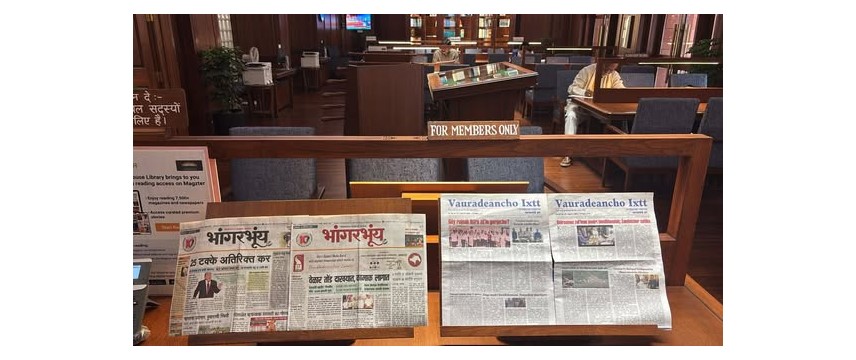
There is a major conundrum here: tonnes of material related to Goa's past is stored in the printed word of the yesteryear. It is waiting to be read, studied and understood. But the skills to read it are limited, almost non-existent.
This is true about much of Goa's books, magazines and newspapers. In general, we suffer from a lack of enough scholars, journalists, or students, who are interested in such issues, and willing to spend time on them. Go to any library, including major ones like the Central Library at Patto and Navelim's, and the empty spaces tell you a story.
This is generally true of smaller languages, which have fallen into disuse, or have lesser official support on the whole. This is definitely the situation in the world of Konkani (both Romi and Nagari); it's true of languages like Portuguese in Goa, or scripts like Modi (in which our history was once written).
Goa marked Konkani journalism day on February 2 (Monday, this week). It marks the day on which the first Konkani newspaper, Udentechem Sallok, or The Lotus of the East, was published in Poona (now Pune). That was way back in the year 1889.
Eduardo José Bruno de Souza, mostly forgotten in history texts today, launched a publication rather early in the day. The first Indian-languages newspapers appeared some decades earlier (the Bengali weekly Samachar Darpan in 1818, and the Gujarati Bombay Samachar in 1822).
Samachar Darpan was in fact published by the Serampore Mission Press (run by William Carey, Joshua Marshman and William Ward). It is considered the first Bengali paper but was a missionary initiative which also developed vernacular literacy. The Bombay Samarchar was, on the other hand, published in Gujarati by a Parsi-owned enterprise. This reflects that community's mercantile and cosmopolitan orientation.
Yet, tiny Konkani's own journalism was pioneering enough to come out within the first century of vernacular press history in India. Not bad at all.
At Monday's function in Margao, which was available live on YouTube too thanks to a video capture by Cicero, there were the usual concerns voiced. Pressures faced by the Konkani press. Lack of journalists with language skills (both Konkani and Marathi too). Online media cannibalising print. Limited government support...
The importance of journalism in this language--or any language, for that matter--cannot be emphasised too much.
For one, it opens knowledge to wider segments of the people, who find it easier to read in a language (and script) of their choice. Secondly, the language has so much of Goa's past already encoded in it; jettisoning that would be a huge loss.
Thirdly, linguistic diversity is important in itself. It preserves people's cultural identity. Diversity promotes cognitive and social richness and allows knowledge, perspectives and heritage to stay accessible across different communities.
Once we accept that, we are unlikely to play favourites between languages. Or act as if it's alright if part of our body dies, and as if we can continue living without it.
Konkani journalism had an early start and speedy spread especially among expat communities. But it was not just in the Poonas and the Bombays that it spread; even Goa had its early starters. Of these, publications like the century-old Rotti and the getting-there Vauraddeancho Ixtt still get published to this day.
But, since its fairly early birth and credible growth, it has faced major challenges over the last few decades. More papers were born in the diaspora. Konkani journalism saw some growth between the 1960s and the 1980s in Goa itself.
Some see the Sunaparant era (1987-2015) as the peak period. The Sunaparant came soon after Konkani became the official language of Goa (but only after the demise of the idealistic Novem Goem, set up via an early model of crowd-funding and padyatra or foot-march throughout Goa).
Today, the Konkani press faces a shrinking readership base. This is happening also due to competition from English, and Marathi faces the same as well. Then there's financial fragility; a limited number of publications; a script divide; and its limited digital presence.
As if this was not enough, there's also the dependence on official patronage, an aging readership, shortage of trained journalists, distribution constraints, and cultural marginalisation. Konkani can expect little support from growing tourism, recent settlers and even from most expat Goans.
So what could be the way forward?
It is anyone's guess as to where solutions could lie. At the Margao meeting, some suggested the need for a digital transformation. Where is Konkani in the world of websites, mobile apps, social media, podcasts? No doubt it's doing extremely well in music, films and video (entertainment and news). But clearly, there's a huge gap between the seniors who have the language skills, and young people who know tech.
Journalism courses and internships in Konkani reporting and editing could make a big difference to the field. Multimedia storytelling skills are needed as well.
Goa needs more translations too; Konkani could surely gain from this. Content can go beyond mainly a news-and-politics diet, and move into culture, literature, science and more. Easier said than done, agreed.
Konkani can only gain from accepting both Nagari and Romi in Goa, and not seeking to exclude the latter. It's time for us to accept that we are a linguistically-diverse society.
Most important could be to build community engagement. Konkani journalism needs sustainable models for growth. How do we convince more people to subscribe and read Konkani publications in today's day and age? Let's not throw up our hands, thinking that all is lost.
This is no doubt a tough battle. But sometimes, solutions can come up when we least expect them. Let's keep fingers crossed, and a mind opened for any potential solution that could work.