The question is no longer whether Goa is ready for the fourth year—but who benefits from its absence
The recent decision by the Goa government's Directorate of Higher Education to place the rollout of the four-year undergraduate programme under the National Education Policy 2020 on hold is being framed as a cautious, consultative pause. Officially, the concerns include academic alignment, infrastructure readiness, and institutional capacity; all appearing to be reasonable at first glance. Yet beneath this administrative language lies a more consequential shift: the steady marginalisation of undergraduate colleges within Goa’s higher education ecosystem.
Politics of delay
& unpreparedness
At the heart of the issue is workload, both academic and institutional. The introduction of a fourth year in undergraduate programmes was not merely a curricular expansion; it represented a structural recalibration that would have significantly increased teaching hours, course offerings, and, crucially, the need for permanent faculty appointments across affiliated colleges. By delaying this transition, the state effectively suspends the expansion of academic labour demand in these institutions. This is not a neutral pause; it is a contraction by deferral.
For years, colleges have operated under conditions of constrained recruitment, with temporary appointments, delayed regularisation, and stagnant salary structures for contractual and lecture-basis staff. The fourth year under NEP promised a partial correction, including an institutional justification for hiring, promotion, and departmental expansion. Its postponement now prolongs a system where academic precarity is normalised. In this context, the argument that financial liabilities necessitate caution rings hollow. Public spending priorities in Goa—and indeed across India—have rarely been governed by strict austerity when it comes to subsidies, infrastructure projects, or politically visible expenditures. To suddenly invoke fiscal prudence in the domain of higher education suggests not constraint, but choice.
Myth of academic
alignment
The state’s reliance on “academic alignment” as a justification becomes even harder to sustain when one examines the internal logic of the NEP transition itself. The restructured three-year model has already thinned out disciplinary engagement, redistributing a noticeable portion of credits away from core subject learning.
The fourth year was meant to restore that balance by deepening specialization and integrating research-oriented work. By withholding it, the system effectively freezes students in an academically diluted framework while simultaneously claiming to protect academic standards. What is presented as caution thus begins to resemble a structural inconsistency: the reform is paused at precisely the point where it was meant to correct its own limitations.
Simultaneously, the move by Goa University to expand its integrated five-year BA/MA programmes demands closer scrutiny. Marketed as an innovative alignment with NEP’s multidisciplinary vision, these programmes may in fact represent a strategic consolidation of academic capital at the university level. By offering a seamless five-year pathway, the university effectively insulates itself from the structural uncertainty created by the delayed four-year undergraduate rollout.
Who gains, who waits
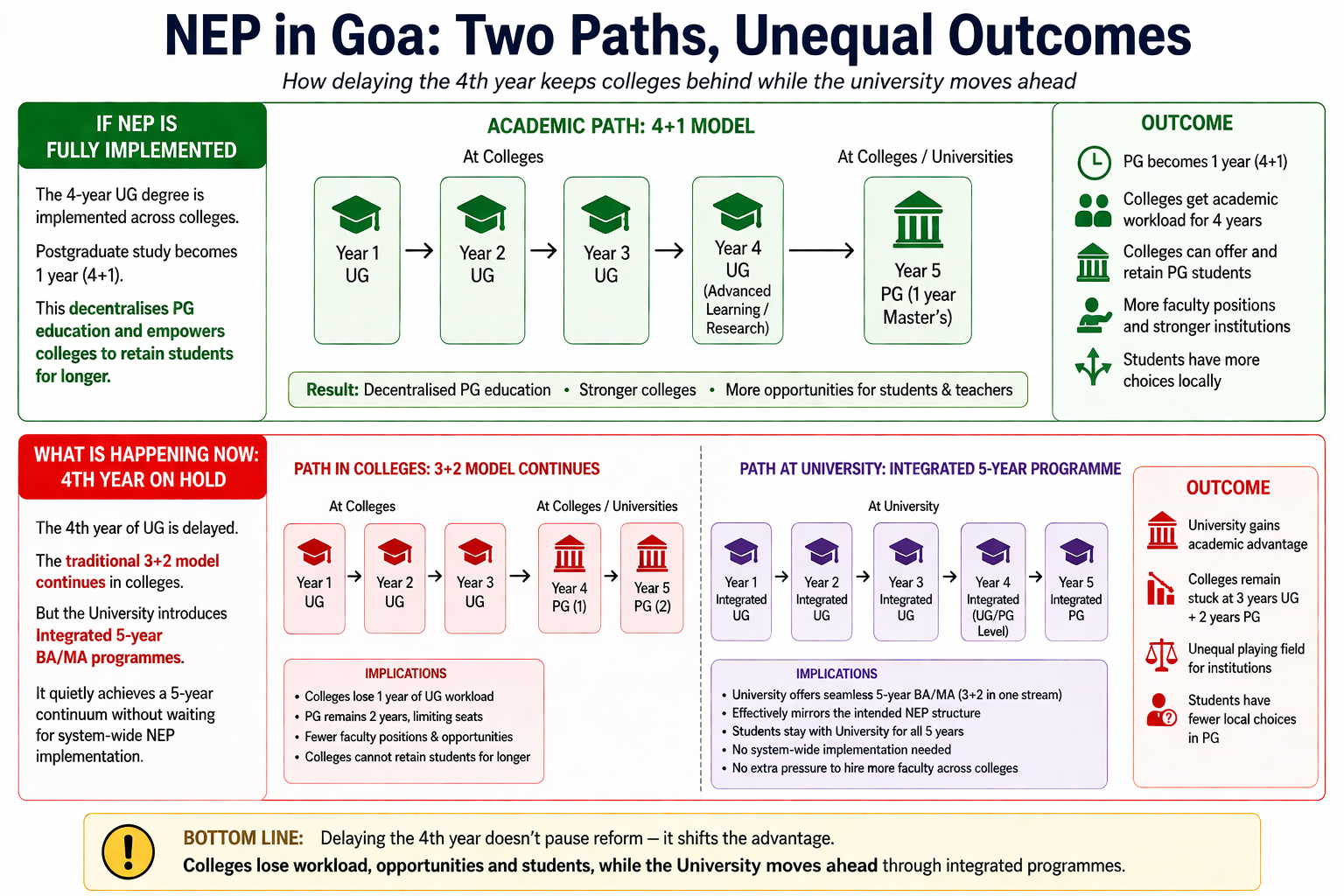
The implications are significant. Under a fully implemented NEP framework, a four-year undergraduate degree would typically compress postgraduate study into a one-year master’s programme (4+1). This would naturally decentralise postgraduate education, potentially empowering colleges to retain students for longer durations.
However, in the absence of the fourth year, the traditional 3+2 model persists—except that the university, through its integrated programmes, can quietly transition to a 5-year continuum that mirrors the intended NEP structure without formally adopting it system-wide.
This creates an uneven playing field. Colleges remain locked in a truncated three-year cycle, while the university captures students earlier (after Standard XII) and retains them longer. The promise of academic mobility and multiple entry-exit points, central to NEP’s philosophy, is selectively operationalised in ways that privilege institutional hierarchies.
Equally troubling is the labour dimension of these integrated programmes. Unlike the expansion of undergraduate teaching across multiple colleges, which would necessitate widespread faculty recruitment, the integrated model centralises teaching within the university.
This reduces the pressure to hire new faculty at scale, thereby limiting employment opportunities for early-career academics. At a time when higher education requires intellectual renewal and generational turnover, such consolidation risks deepening structural stagnation.
Overlaying this is the growing presence of private universities, aggressively marketing their graduate programmes across the state. These institutions, unencumbered by bureaucratic delays, are quick to align with NEP frameworks, offering four-year degrees, interdisciplinary majors, and global exposure.
The result is an increasingly competitive and fragmented higher education landscape in Goa; one where government and aided colleges find themselves squeezed between a strategically expanding state university and a rapidly advancing private sector.
Precarity by design
What emerges, therefore, is not merely a delay in policy implementation, but the formation of a complex web of institutional advantage. The postponement of the four-year undergraduate programme disproportionately affects colleges, constrains faculty growth, and limits student pathways, while simultaneously enabling Goa University and private players to consolidate their positions. If the NEP is to be more than a rhetorical commitment, its implementation must be equitable across institutional tiers. Otherwise, reforms risk becoming instruments of centralisation rather than democratization. The question is no longer whether Goa is ready for the fourth year—but who benefits from its absence.