Goa failed to create sustainable, productive rural systems. Collective management was broken, leading to environmental neglect
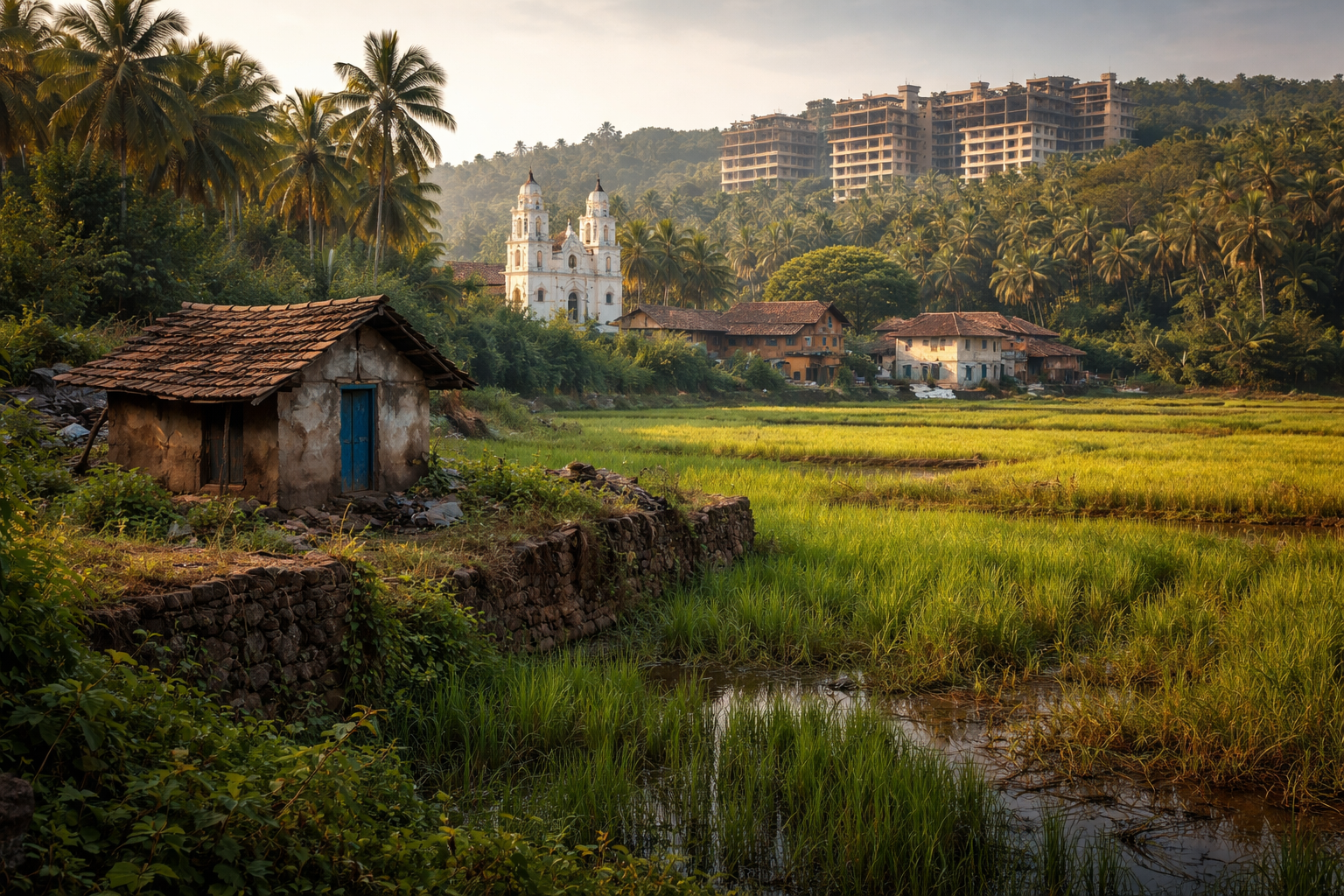
It’s amazing how one-sided the discourse in Goa can oftentimes be. There are so many issues we take for granted, believing what we are told to be true. One among such issues is the tenancy and mundkar laws. No political party is willing to critique the same, to question their logic, or to make a fair evaluation of where such laws have taken us over the years.
That is understandable. The beneficiaries of these laws are many, and cast lakhs of votes. On the other hand, those who have paid the price are fewer, scattered and disorganised. But what is surprising is that even the media, or academia, seems to have come up with few critiques of what are clearly rather controversial laws.
Goa’s post-1961 land reforms---the Goa, Daman and Diu Tenancy Act (1964) and the Mundkar Act (1975)---were supposedly framed to protect tenants and house-dwellers. But, over the years, the distortions these have produced are something we mostly turn a blind eye to.
We can call all this Goa’s land conundrum (a confusing or difficult problem with no obvious solution).
First of all has been the impact on the comunidades, the village-based land-holding corporations.
Tenancy laws have seen the erosion of the comunidades’ very base. Large tracts were transferred to tenants at controlled or ultra-low compensation, weakening the comunidades’ revenue model, if not completely destroying them.
This led to a loss of collective planning power. Without doubt, the comunidades traditionally managed land for agriculture, grazing and village needs. But fragmentation reduced their ability to plan for irrigation, cropping or commons management.
There were times, within living memory, when these institutions unclogged the gutters before the monsoons, planted coconut trees to create scenic roadsides, and made sure the village fields were green and sown. Yet, a historic institution that was meant to manage local land collectively got financially hollowed out and was also administratively sidelined.
But that’s not all. The impact of the tenancy and mundkar laws also affected small landholders too. Landowners were required to sell to tenants or mundkars at formula-based prices, rather than the open market value. Some “tenants” claimed the ownership of huge hillsides, as there were no land ceiling laws.
Weak enforcement of “personal cultivation” rights was also felt. Even when owners wanted to resume land for self-use, there were a series of procedural hurdles and delays which made it difficult to do so.
There was thus a strong disincentive to invest in land. With insecure control and capped returns, many owners stopped investing in irrigation, soil improvement or tree crops. Thus, small and mid-level landholders--often not the “feudal elites”--felt disproportionately penalised.
It led to what one could call intergenerational distortions too. Old occupancy patterns were frozen. Rights were fixed based on who occupied land at a specific historical (and politically-chosen) moment. It was not tied to evolving family needs.
Fragmentation and inheritance issues cropped up as well. Subdivision among heirs only worsened the problem. It created tiny, uneconomic parcels.
Strong tenant protections made land transfers cumbersome. So, younger generations inherited legally protected but economically weak assets, often leading to neglect or sale for non-agricultural use. This is, in part, the root of the destruction of Goa we see too.
Then, let’s not forget the effects on agriculture. These laws actually led to a decline in productivity, despite all the promises made at the time the laws were being enacted.
Security of tenure seldom, if ever, translated into investment or modernisation. Many plots became subsistence-level or fallow. Fragmentation undermined mechanisation and efficient farming. All this spelt a shift away from farming. This situation was only made worse with rising land values and weak agricultural returns. So, many beneficiaries exited agriculture. Yet, nobody focuses on Goa’s fallow lands. Instead of revitalising agriculture, these politicised reforms often coincided with its long-term decline in Goa.
Tenancy and mundkar laws had environmental consequences too. The most obvious is the neglect of common lands and ecosystems. The weakening of comunidades reduced the earlier coordinated care of grazing lands, water channels, bunds and wetlands. Secure mundkar rights unwittingly led to unregulated housing expansion, without ecological planning.
Then, there was the abandonment of traditional systems. Systems like khazan lands (reclaimed, low-lying estuarine fields) require collective upkeep; fragmentation led to salinisation and degradation. Traditional eco-sensitive land management systems were also thus undermined. Likewise, it left behind legal and administrative issues.
Endless disputes over status (tenant or mundkar vs. owner) have clogged courts for decades. In some cases, people allegedly claimed mundkar or tenant status opportunistically, and without really deserving it, leading to conflicts. Laws designed for social justice became inflexible over time. These failed to adapt to urbanisation and economic change. These laws intended to protect vulnerable occupants from eviction. But they also over-corrected against landowners and comunidades, and badly cut into their interests.
Fragmented land and weakened agriculture are another reality we have to live with. Goa failed to create sustainable, productive rural systems. Collective management was broken, leading to environmental neglect. A more balanced approach could have combined tenure security with incentives for cooperative farming, ecological stewardship and flexible land use. As long as land stays politicised, it will continue to be seen as a tool to build vote banks. Thus, the situation is likely to stay badly muddied.
It is time for Goa to think more deeply about this issue, and provide incentives for the productive and ecological use of land. Tax or fee structures could be introduced to discourage long-term vacancy of productive use, while offering grants, credit and technical support for agriculture, agro-forestry, and restoring khazan and irrigation systems.
Goa needs frameworks that encourage leasing and cooperative farming. This would encourage small or absentee landowners to work jointly on land without the risks of losing it. In the same way, local bodies need to be focused to manage common areas, enforce zoning laws, and work with traditional institutions. Lastly, it’s also important to make sure that vulnerable families have access to legal aid and mediation services so that reforms don’t dispossess them. This could all help bring idle or disputed land back into use in a way that is good for the environment too.