Grant it to our politicians. For an institution which has done little or no work, Goa's Zilla Panchayat elections have managed to whip up significant excitement, even frenzy.
This is a story that the media loves to report on. A dog-fight, and a race to the finish line. The turf is clearly set out. Parties and loyalties are marked. Results come within the day-long news cycle itself. This is enough to keep everyone's attention fixated on the issue.
Wider issues of accountability and efficiency of the politicians involved are not taken up. These cannot be. Simply because (i) these aspects take months and years to unfold (ii) the impact can be felt only after long (iii) Goa's political class is quite tightly networked; many key actors are linked through social circles, caste and communal blocs, real-estate interests, long personal ties...
As a society, as intellectuals. For failing to hold our politicians accountable. Our civil society groups (despite the many fire-fighting activities they are incessantly involved in), resident associations, and watchdog NGOs have a role which they have largely been unable to play. This is not for want of trying...
Religious organisations have often got caught up in taking sides, and maybe gaining something for their own institutional growth in the bargain. But, in doing so, they squander a huge opportunity.
Universities and research centres are expected to generate data that puncture vague claims; they haven't. Media and digital platforms (if insulated from government ad dependence) could rebuild a culture of scrutiny. Some do, but not enough.
A more assertive State Election Commission, empowered panchayats and municipalities, and a Lokayukta with real teeth could have pushed our politicians to deliver. Likewise, with an independent Information Commission and proactive use of RTI, which placed fear amidst public servants at one stage, could have forced transparency into everyday decisions.
It is not surprising that citizens feel quite frustrated as there is no link between how efficiently Goa is ruled, and the support our parties in power draw from voters. Those tracking similar issues across the country have done a fair job in understanding this paradox.
After Monday's ZP results, the ruling BJP was quick to point out that these results came through despite there being no EVMs at play. Meanwhile, the SIR (Special Intensive Revision) process is underway, and the electoral rolls are getting significantly changed. (It's not just the Opposition that is worried, but UP chief minister Yogi Adityanath has also voiced concern about the impact of the SIR revisions.)
Then, there is the issue of splitting the Opposition vote. Once the figures come in, it becomes clear about how 'the vote was split'. But, shortly after the election headlines emerge, much of this is forgotten. Nobody cares, and it's business as usual.
For instance, in the just-concluded ZP elections, the Revolutionary Goans was the most active campaigner all round. They were not just ahead of parties like the Congress and AAP, even far ahead of the BJP.
Where does this energy come from? One would like to believe that it was commitment alone.... In the 2022 elections, it was a good 36 hours after the results emerged that political watchers realised that this party took about one-tenth of the vote, and managed to shift some 9-12 (depending on how one counts) Opposition seats to the ruling side.
All is fair in love,
war and elections? (SUB HEAD)
Legal ways of influencing an election are many. Ranging from shaping the environment rather than altering the vote itself; candidates redrawing the narratives; targetted campaigning; selective timing of welfare announcements; mobilising voters through booth-level management; turnout drives; government inaugurations, policy roll outs, and symbolic actions to create favourable sentiment (Mhaje Ghar); alliances stitched or broken to reshape vote banks; parties using legal campaign finance flows (Electoral Bonds); micro-targeting; and data analytics to tilt the field.
Going beyond the legal, there are other strategies which directly undermine the integrity of voting or violate election laws. Buying votes through cash or gifts; intimidating voters, threatening vulnerable groups, impersonating voters, tampering with postal ballots, or ensuring who gets to be polling staff.
We believe that outright capturing booths is a thing of the past; but the EVMs have brought in problems of their own. The opposition to the EVMs by so many parties is an eye-opener. Parties which have been critical of them include Congress (repeatedly), BJP (in 2009), AAP (2017, 2019), BSP (multiple occasions), SP (2017, 2022), TMC (especially 2019), CPI-M (multiple times, especially 2018 in Tripura), NCP (2019), RJD (2010, 2015, 2020), Shiv Sena Uddhav (2019), DMK (2010s, 2019), JD-S (2018), among others.
There's spreading orchestrated misinformation meant to suppress turnout, abusing government machinery (officials, vehicles, state resources for party gain). At a broader level, illegal financing, using black money and coordinating with criminal networks to influence turnout or intimidate opponents all distort the process. One can never be vigilant enough to understand how things work.
Given this mismatch between performance and election results, what does the citizen do? Not many may agree, but there is also a need to show a protest, however small and symbolic.
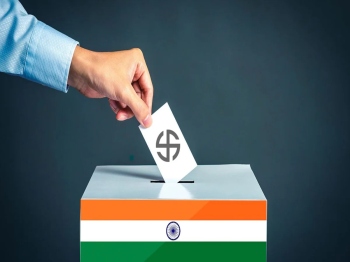
On ZP election day, I quietly queued up before the polling booth, awaited the turn, and followed the line. After my finger was inked and the ballot paper given, I politely refused to vote. It doesn't change the result, and hardly anyone even notices it (apart from the surprised election officials). But it's one's own way of saying: we expect far, far better from those who claim to represent us.