Porvorim’s way of life is being remodelled not around community need, but around construction timelines and profit margins
As Goa prepares to deck its homes with Christmas trees, in many households, given the rarity of fir trees in this latitude ornaments, stars, reindeer, baubles, and tinsel are once again unpacked and arranged with care. In December, even the artificial Chinese fir acquires a certain warmth once it is dressed in lights and memory.
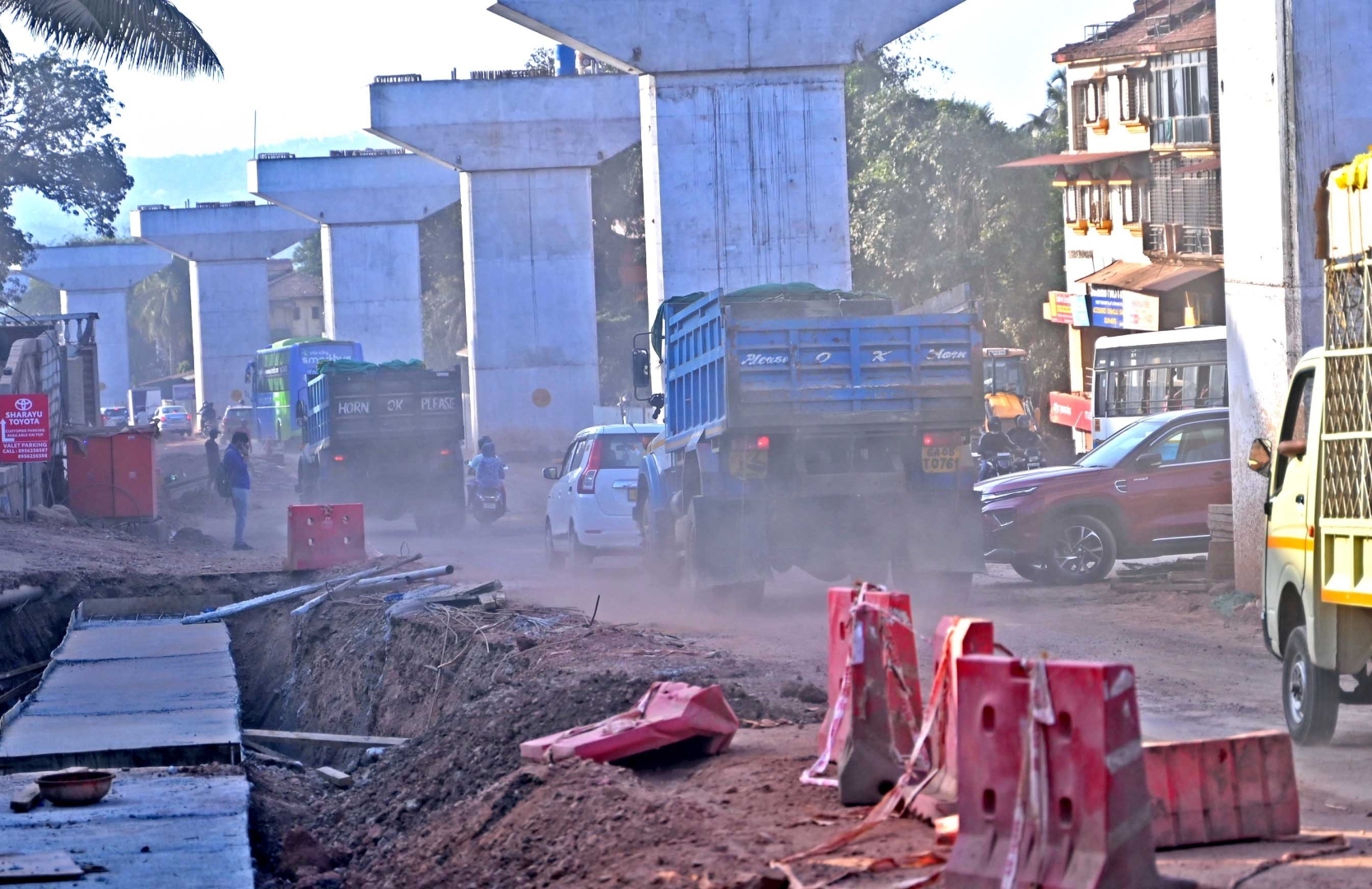
Porvorim, too, has received its share of tinsel this season. But this is not the festive kind. It lies thick on trees, windows, vehicles, balconies, and lungs. It is grey, abrasive, and persistent. This dust has not descended by accident. It has been deliberately scattered, day after day, as a by-product of what is officially described as the “upgradation” of Porvorim through the NH-66 elevated corridor project.
The Santa responsible for this seasonal sprinkling is not mythical. He arrives in excavators, concrete mixers, and open trucks, leaving behind a landscape that now resembles neglect far more than progress.
A corridor through
memory
There was a time when a drive through Porvorim in December carried a certain charm. Childhood memories still recall journeys from Margao, through Porvorim, towards Mapusa for Christmas shopping, and onward to Calangute to visit ancestral homes. One landmark along this route stood out unmistakably -- Damien de Goa, then among the first true furniture malls in the State.
Its glass façade would be meticulously decorated each Christmas: Santas on sleighs, stars strung across multiple storeys, illuminated fir trees lined neatly along spotless windows. What made the spectacle visible from afar was not merely the décor, but the absence of dust. The building and the road in front of it was clean enough for the celebration to announce itself even to passing traffic.
Today, that memory struggles to survive. Damien de Goa still stands, but it is veiled behind a film of construction dust so thick that festive décor, if any exists, is rendered invisible. The Christmas season has not disappeared; it has simply been smothered.
Development that
forgets the present
This transformation is defended under the familiar banner of “future development”. Constituents are assured that temporary hardship will yield long-term benefit. Such assurances are routinely echoed by elected representatives, including the sitting MLA of Porvorim. Yet, sustainable development if it is to mean anything demands equity across generations. The health, safety, and dignity of the present generation cannot be treated as expendable collateral.
Two years have elapsed since construction began. Porvorim continues to exist in a suspended state: no longer a functional suburb, not yet a completed corridor. Roads used daily by commuters are uneven, broken, and hazardous. Temporary service roads are conspicuously absent. Water spraying, when undertaken, converts dust into slippery sludge, worsening potholes and increasing accident risk, particularly for two-wheelers. This is not a transition. It is attrition.
Updation by dilution
What is increasingly being marketed as the “updating” of Porvorim bears the characteristics of something else entirely:- dilapidation.
RTI disclosures now circulating raise uncomfortable questions about environmental clearances, air-quality monitoring, and regulatory oversight. When development proceeds without transparent AQI data, without continuous monitoring of PM₂.₅ and PM₁₀ levels, and without publicly verifiable compliance under the Air and Water Acts, the narrative of responsible infrastructure collapses.
What emerges most starkly from the RTI replies is not confusion, but institutional vacuum. The Goa State Pollution Control Board has categorically stated that no consent has been granted for construction of the flyover itself, only for the operation of an RMC plant supplying concrete. Simultaneously, GSIDC and Imagine Panaji have disowned possession of any permissions on record. In effect, a massive dust-generating construction proceeds without demonstrable environmental clearance, continuous AQI monitoring, or publicly traceable compliance - an omission that goes beyond oversight and borders on regulatory abdication.
Porvorim’s way of life is being remodelled not around community need, but around construction timelines and profit margins. The suburb is being asked to endure environmental stress so that distant urban centres may be better connected. In this equation, Porvorim is not a beneficiary; it is a conduit.
Culture, environment,
and indifference
Environmental neglect is never merely technical. It invariably spills into cultural disregard. A place that is perpetually dusty, noisy, and unsafe cannot host festivals with dignity, nor can it sustain the rhythms of Goan life that revolve around neighbourhoods, walkability, and seasonal celebration.
It is irrelevant where a contractor originates from, although in the present case the registered office of the contractor is incorporated in Jhunjhunu, Rajasthan.
What matters is whether the executing agency respects local conditions, customs, and constraints. When windows remain dust-coated through December, when residents are advised to wear masks not due to a pandemic but because of construction activity, and when delivery agents are injured by falling debris, something fundamental has failed.
Who bears the burden?
If Porvorim must bear the burden of connecting Panaji and Mapusa, an honest question must be asked: what becomes of its original character? Is every suburb destined to be sacrificed at the altar of accelerated connectivity? If this model is accepted, then villages and peri-urban areas across Goa may soon find themselves reclassified not as communities to be preserved, but as obstacles to be overpassed.
Development that erases identity cannot be called progress. Updation that dilutes habitability is merely displacement by another name.
As Christmas lights flicker across Goa, Porvorim remains dimmed beneath a permanent haze. The question is no longer whether infrastructure is required. It is whether the cost being extracted from health, environment, culture, and daily life is one that Porvorim ever consented to pay.
Until that question is answered honestly, the festive dusting over Porvorim will remain what it appears to be: not updation, but slow, methodical dilapidation.