Independent web projects can punch far above their weight when they speak with authenticity
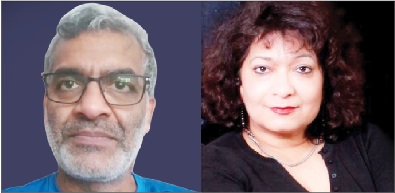
(Left) Marlon Menezes and Milena Marques-Zachariah.
In the past week, I time-travelled back to the past, through the experiences of two friends who made a difference to how Goa was seen by the outside world. Both started with small initiatives, which grew into impressive cyber-oak trees. Over time, these peaked, responded to changing times, and went on to fade away. They live on in our memories, or keep going in different ways.
Marlon Menezes was 27 years old when he did something unusual, and we first got to know him. That was almost exactly 30 years back. At that time, he was a student of UIUC (University of Illinois Urbana-Champaign). His roots are in Divar, has his family home at Miramar, was based in Kuwait (before Saddam) and studied at Mount Abu. Marlon remembers one of his fellow-students at the UIUC at the time, Marc Andreessen. Marc co-authored Mosaic (the first-ever web browser to display inline images on the Net), and is now a venture capitalist and Trump advisor worth a couple of billion dollars. Marlon’s achievements were more modest, but something that hugely made a difference to Goa at the end of the day. He set up the first ever internet website focused entirely on Goa itself. It was called GoaWeb (later, GoaCom).
Together with Herman Carneiro (Goanet) and Ulysses Menezes (Goa-World), these three initiatives from the mid-1990s gave Goa a presence in cyberspace. It came ages before other initiatives in Goa could get going. From it being a student project launched in 1995, Marlon quickly shifted the project to Goa by 1996. His parents, affected by the Iraq-Kuwait war a few years earlier, had spare space on their second floor in Miramar. With other partners (John D’Souza and Tim D’Mello), GoaWeb morphed into GoaCom. It went on to build affordably-priced websites for small (and not so small) players, to host non-profit initiatives in Goa, and to create showcases for villages in a way that didn’t exist prior to this.
Last week, the GoaCom team met up to reminisce over old times, rebuild contacts and share notes. Some expressed a tinge of regret that this unique project could not carry on; after 2007 Marlon move out, and the early website lost its presence in cyberspace perhaps sometime before the pandemic. But, all good things do come to an end. Some present felt things could have been still kept going, if the focus had shifted from creating websites to offering software services. The team had the skills, and with a nudge from the US-based Marlon Menezes was learning fast too. But life is not about regrets alone. If you ask me, GoaCom (and the other projects of those early days) did shape a lot of things when it came to Goa, its perceptions in the outside world, and what it showed was capable here.
For long, some had suspected that expat Goans linking up with their home could create something of value. Using what was very new technologies in those times, these youngsters in their twenties (or less) were showing what was indeed possible. The Goa team too was young. The average age then was perhaps 25. They they struggled with limited bandwidth, a bumpy road to cyberspace, and even more limited knowledge of how to go ahead. Yet, they moved on and did well for themselves. Today, most of these young techies have grown into capable professionals. Each has taken on bigger responsibilities.
GoaCom’s early experiment showed that even a small, resource-thin region could project itself powerfully online if it combined diaspora initiative with local talent: an expat Goan’s vision created the spark, a Goa-based team built the daily craft, and together they produced a site that became a global reference point for news, culture, and identity long before social media existed. The experience revealed how quickly digital visibility can reshape a region’s image, how important consistent content and community engagement are for credibility, and how early, independent web projects can punch far above their weight when they speak with authenticity.
What I liked best was the way the team kept itself viable for much of its journey, while at the same time promoting positive and not-for-profit experiments. Business, anyone can run. But to do so with a social conscience means a lot more, and does leave a trail behind.
Second (in time) was Milena Marques-Zacharias’ Radio Mango experiment, undertaken in Toronto. It first started 13 years ago, and has run since, with a few gaps due to the challenges of keeping alive North America’s first (and only) Konkani community radio station. Elsewhere, Milena has told her story of how she was at a parlour, when she was surprised to listen to Nepali broadcasts come through the local radio. She learnt that this was community broadcasting, and there were maybe 10,000 Nepalis in that part of Canada. Why couldn’t Goans (or Konkani speakers) do it, she thought, when there were far more numerous?
Soon, that idea took root and Milena and her broadcasting partners created Radio Mango. Its name is a portmanteau: a word created by blending parts of two (sometimes more) words to form a new one with combined meaning. Radio Mango functions like a playful portmanteau of Mangloreans + Goans. Milena’s regret is that Goans abroad use their ancestral language less, especially as compared to Mangaloreans. She also feels the community didn’t support this venture as much as it could.
As a fan of radio and also of the small media, I long found this an exciting experiment. Milena would give a little bit of talk -- not too much yak-atty-yak -- and play a wide range of Konkani music. Fortunately, she didn’t run into anyone telling her not to share their music online, as this was a low-returns (if any) venture, like many of the small media organisations. She worked out with volunteers who would send in news from Mangalore and Goa. Tina Costa, a radio professional who happens to be the daughter of the noted radio personality Allen Costa (he pronounced his name as ‘Ahlen’), had her own charming style of sending across the news. You felt someone was talking to you.
Somewhere along the way, Radio Mango shifted from its old style of FM-based broadcasting (over hired transmitters, costing Ca$1000 per month) to Sound Cloud. Last week, they broadcast their last programme in the current format. They hope to reappear in Spring 2026 via YouTube.
Hats off to them for keeping Konkani alive among the Daizpora; and extending its impact. We need to acknowledge such efforts, which can inspire more to come in the time ahead. Goa needs to show gratitude, and not forget the role played by them over long years.