January 24 arrives every year with clockwork precision. So do the banners, the stages, the cultural performances, the carefully worded speeches, and”inevitably”the pledge. The ritual is now predictable. Gather a crowd, raise a slogan, extend a hand, repeat a sentence, take a photograph. Commitment declared. Conscience cleared. Content posted. Move on.
What has changed is not the celebration, but its intent. In Goa and across the country, National Girl Child Day has slowly slipped from reflection into performance. Symbolism has replaced substance. Visibility has replaced vulnerability. And the girl child”ironically”has become secondary to the event organised in her name.
The modern obsession with the pledge deserves scrutiny. Online pledge. Offline pledge. QR-code pledge. Group pledge. Pledge walls and pledge hashtags. Entire programmes now culminate in this ritual, proudly presented as an “outcome.” The pledge has become the cheapest form of social engagement”requiring no policy shift, no budgetary commitment, no institutional reform, and no accountability. It offends no one, demands nothing, and yet allows everyone to feel morally accomplished.
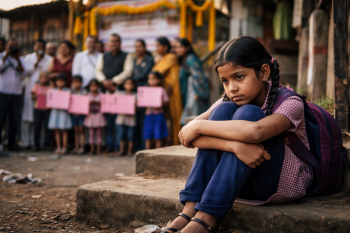
Alongside this has emerged another parallel performance: the social media post. On National Girl Child Day, timelines are flooded with photographs of political leaders”those in office and those aspiring for the next election”holding placards, standing beside children, attending events for precisely the duration required to be photographed. The captions are earnest, the hashtags are trending, and the optics are flawless. What is missing is continuity. What happens to the girl child after the post is uploaded? After the applause fades? After the algorithm moves on?
A social media post is not governance. A reel is not reform. And a photograph with a slogan does not translate into safety for a young girl navigating abuse, coercion, or neglect. Yet the politics of visibility has ensured that performative concern is rewarded far more than quiet, sustained work.
The Beti Bachao Beti Padhao (BBBP) campaign was envisioned as a transformative intervention for the survival, safety, and empowerment of the girl child. However, it has long been criticised for its disproportionate emphasis on publicity. A December 2021 report by the Parliamentary Committee on Empowerment of Women revealed that between 2016 and 2019, nearly 79 per cent of the scheme’s funds were spent on media and publicity. From its inception until 2020“21, over 58 per cent of total expenditure went towards advertising, prompting strong criticism of the scheme’s priorities.
In response, recent years have seen a reduction in publicity spending and a stated shift towards on-ground interventions, with the scheme now integrated under Mission Shakti. On paper, this signals correction. In practice, especially in Goa, the campaign continues to manifest largely through one-off events, award ceremonies, cultural programmes, and symbolic observances. There is little evidence of a sustained strategy or measurable outcomes that reflect the lived realities of girls today.
It must be stated plainly: dance performances do not address violence. Felicitations do not prevent exploitation. Pledges do not dismantle systems of neglect. Empowerment cannot be staged for a day and archived in a folder of event photographs. A girl child’s empowerment is measured by her safety”at home, in school, in public spaces, and increasingly, in digital environments.
This is where the neglect becomes most dangerous. One of the most serious and emerging threats to the girl child today is technology-facilitated gender-based violence. Online grooming, sextortion, circulation of intimate images, deepfake sexual content, cyberstalking, and harassment are no longer marginal issues. They are widespread, fast-moving, and devastating, disproportionately affecting adolescent girls.
This violence does not remain online. It spills into offline trauma”manifesting as anxiety, depression, self-harm, school dropout, fear, and silence. Yet policy conversations in Goa continue to lag behind this reality. While harm has evolved, responses remain outdated. We continue to celebrate girls in auditoriums while failing to protect them in the spaces where they are most vulnerable.
If National Girl Child Day is to mean anything, it must force a shift from optics to outcomes. The critical questions remain unanswered. Are schools equipped with clear reporting and escalation mechanisms for digital abuse? Are teachers and parents trained to recognise early signs of online harm? Are police and child protection systems prepared to respond sensitively and effectively to technology-facilitated violence? Are mental health services accessible to girls in distress? Without addressing these questions, the day risks becoming a collective exercise in self-congratulation.
If pledges are to be taken, let them be uncomfortable and binding. Pledges to allocate budgets, to train systems, to establish accountability, and to measure impact. A pledge without a plan is not empowerment; it is theatre. A social media post without follow-up is not advocacy; it is branding.
National Girl Child Day should not be reduced to a festival of hashtags and hand-holding photographs. It should be a moment of reckoning. Goa does not need more events in the name of social causes. It needs honesty, courage, and course correction.
Because empowerment is not a slogan. Protection is not a performance. And young girls cannot be left paying the price for political and institutional complacency.
(The writer is an Assistant Professor of Social Work, Goa University and Founder, Human Touch Foundation and Former Chairperson of the Goa State Commission for Protection of Child Rights)