Before deciding what children should be kept away from, it may be worth asking what protections we have failed to sustain
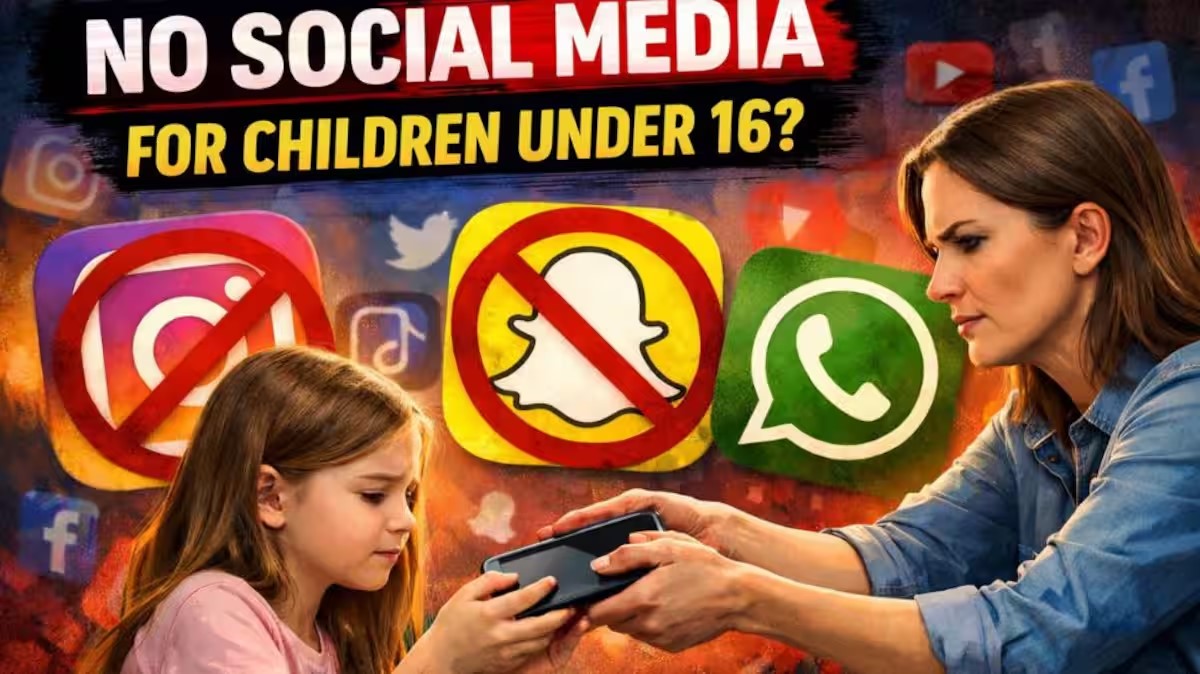
At last, a solution. Concerned about children online? Ban social media. Worried about cyberbullying, grooming, sextortion, exposure to harmful content, or the general sense that screens have taken over childhood?
Ban social media. It sounds decisive. Comforting. Almost efficient. One policy switch flipped in response to a very real anxiety. But child protection has never worked that way.
The appeal of decisive gestures. Bans have a certain appeal. They reassure anxious parents. They suggest control. They create the impression that something complex has been brought under check.
The concern driving the proposal to restrict social media use for children under 16 is not imaginary. Digital harm is real. Parents are struggling. Teachers are exhausted. Adults are often navigating technologies they never grew up with.
But reassurance is not protection. Protection is not defined by what we restrict.
It is defined by what stands ready when restriction fails — because it always does. Goa once led this conversation.
It is important to remember that Goa was once seen as a pioneer in child protection. In the aftermath of the Freddy Peats case, the state enacted the Goa Children’s Act, one of the earliest and most progressive attempts in the country to recognise child abuse, exploitation, and neglect in a comprehensive manner. At the time, it positioned Goa as a state willing to confront uncomfortable realities and build legal safeguards for children. That history matters. It shows that the intent to protect children is not new.
Over the years, while the Goa Children’s Act remained on paper, the systems required to give it life were allowed to weaken. Institutions became understaffed. Preventive mechanisms lost momentum. Coordination between departments thinned.
Child protection does not collapse overnight. It erodes slowly — through delays, vacancies, and the normalisation of “managing somehow.” The result is what we see today: a renewed focus on control measures, while foundational systems remain fragile.
Before banning, a basic systems question. If a child in Goa experiences online harassment, grooming, coercion, or exploitation today, where does that child go? Not in theory. In practice. As of now, Goa has been without a functioning Goa State Commission for Protection of Child Rights (GSCPCR) since May 2024. For over a year and a half, the statutory body meant to independently monitor child rights violations, hear complaints, and intervene in the best interests of children has not existed in operational terms. This is not an administrative gap. It is a structural absence.
For more than five years in the past, District Child Protection Units (DCPUs) — the backbone of implementation under the Juvenile Justice framework — were either non-existent or non-functional. Even now, their capacity remains weak, uneven, and insufficient for the scale of need.
DCPUs are meant to coordinate care, rehabilitation, psychosocial support, family interventions, and follow-up. When they are fragile, child protection becomes reactive rather than preventive.
Alongside this, Special Juvenile Police Units (SJPUs) — mandated to deal sensitively and exclusively with children — remain overstretched, inconsistently trained, and often absorbed into routine policing structures. Expecting such units to suddenly manage digital enforcement or online harm response is unrealistic. This is not a question of intent. It is a question of capacity.
There is another uncomfortable truth: children do not disengage from digital spaces simply because adults instruct them to. They adapt. They borrow phones. They create secondary accounts. They move to quieter, less regulated platforms. When guidance systems and institutional support are weak, restrictions push behaviour underground — into spaces that are harder to monitor and less likely to trigger timely intervention.
Australia is often cited as a justification for restrictive approaches. What is usually left out is the groundwork that preceded those debates. Australia invested for years in a dedicated eSafety Commissioner, nationwide digital literacy programmes, parental guidance frameworks, accessible mental health services, and trusted reporting mechanisms. Even there, restrictions remain contested because of concerns about enforceability and unintended consequences. Australia’s experience does not show that bans work in isolation. It shows that ecosystems matter. Trying to replicate regulation without replicating readiness is not leadership — it is imitation.
What the timing reveals. What is striking is not the concern reflected in the current proposal — that concern is valid. What is striking is the urgency now, after years of institutional neglect. Vacant posts, delayed appointments, under-resourced protection units, and weak preventive programming did not provoke decisive action.
This suggests a response to exposure rather than a correction of root causes. Digital spaces often reveal failures that offline systems have long ignored. When those failures remain unresolved, regulation becomes a substitute for reform. That is policy theatre, not protection.
Children are not problems to be managed. Restriction-based approaches risk framing children as risks rather than rights holders. Today’s adolescents inhabit blended worlds. Learning, friendship, creativity, identity formation, and even help-seeking occur online. Removing access without equipping understanding postpones engagement rather than preparing children for it.
Protection that lasts does not begin with exclusion. It begins with capacity-building — of parents, schools, institutions, and communities. That work is slow. Resource-heavy. Politically inconvenient. And it works.
Beyond the headline, the ban story will pass. The debate will move on. But children will still need systems that respond when harm occurs. Goa once showed leadership in child protection through the Goa Children’s Act. That legacy deserves more than symbolic gestures. Protection cannot be switched on overnight. It cannot be borrowed without context. And it cannot compensate for systems that were allowed to weaken over time. Before deciding what children should be kept away from, it may be worth asking — calmly and honestly — what protections we have failed to sustain. Because when institutions are weak or missing, bans become symbolic. And symbols, however reassuring, do not keep children safe.