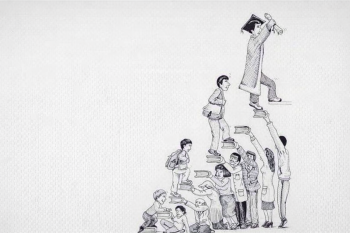
The cartoon alongside (artist not clear) made its appearance in the online world, most recently along with an article titled ‘How to respect yourself’. At other times, it was being shared around Teachers’ Day. It can be interpreted as a tribute to those who helped to build us up, and who offered the stepping-stones to get ahead in life, especially in education. Such gratitude is needed.
But it can also be interpreted differently. We stand on the shoulders of giants, as Newton supposedly said. Or, whatever we see, know or achieve today was made possible due to the work and struggles put in by others before us. Success is not just individual genius, but collective inheritance. This is true in so many fields: science, literature, politics, cuisine, scholarship and daily practice.
On seeing the cartoon, this columnist chose to interpret it differently. It reminded me of the African saying, “it takes a village to raise a child”. It also triggered the feeling that our own success depends on “walking all over” someone else, taking the leg-up they offer, and often failing to pay them back. Or even to acknowledge them.
This is so true in the world of writing, which we in Goa too have seen change rather drastically in recent years.
Till the 1980s, almost nobody wanted to become a journalist. The field didn’t pay. It seemed impossible to earn a living from it. It held out little to no full-time career prospects. You needed to be rather rich to afford the luxury of a career in writing.
Things, however, changed.
After a short while, more competition came into the newspaper world of Goa. Young people were being offered full-time jobs. The number of vacancies grew.
As the papers improved their clout in public life, the situation changed even more dramatically. Newspapers came to play a bigger role in society, both politically and otherwise; such jobs started getting looked up to.
Something parallel happened in the world of writing. It became fashionable to become an author.
Just as young people now call themselves ‘digital creators’, it became the in thing to describe oneself as a journalist, writer or author. Some would carry a ‘Press’ label on their vehicle, as if it was a licence to benefit and privilege on the roads too.
Together with these changes came other, less welcome developments. For one, there was suddenly much more jostling in the field. As the stakes grew higher, the genteel old ways were given the go-by.
Let’s face it, writing can also be an ego trip. There is nothing wrong in enjoying the work one does, but motives are important too. Writers should recognise their social responsibility, and the need to use their skill for the betterment of the wider society.
Those who joined the profession in the late 1960s or 1970s remember how they were encouraged to do so. Editors in Goa itself often traversed from village to village, encouraging young folk there to contribute to the papers. Some of these enjoyed the work they were doing. Over the years, they grew into professionals.
Folks then understood why it was important for every society, including Goa, to have its adequate number of writers and journalists. They safeguard a society’s memory, conscience and vocabulary. Writers help a society think about itself, even to dissent, and build a reality against slogans. Journalists gather, verify and circulate facts so that power is visible rather than opaque.
Both these sections translate people’s lives into shared knowledge. If they work efficiently, they can connect private lives to public issues. Without them (in sufficient numbers), any society can grow informationally poor. History can become fragile, and citizens too would be left navigating the present without reliable maps or mirrors.
If we keep this larger goal in mind, we might not be tempted to fuel our work mainly by ego and aggression. Yes, these are competitive fields. But there is always enough space for hard work here. We need not see each other as rivals.
In another context, someone on YouTube was speaking about the three approaches we can take in dealing with one another. We can see others as collaborators, as competitors (even bitter rivals), or we can simply be parasites on each other.
The third approach suggests we take what exists without giving back. Networks are useful only insofar as these help us. We do nothing to build them. Rivalry can be cut-throat, and often needless.
But as creators of the written word, we can cooperate by treating our crafts as overlapping circles, not rival territories. Some ” if not all ” of our research, sources, archives or insights can be shared. Needless to say, this needs to be duly credited.
Co-bylines, serial essays, public conversations, shared platforms, mentoring networks and collective editorial projects are all other options. When people work together, facts and narratives gain. The public sphere becomes richer and harder to manipulate. Youngsters who think media work is not needed are making a mistake.
But greater cooperation among writers has to be built on trust and generosity. Also, there’s a need for respect for intellectual labour. This means giving clear credit for ideas, leads and even language borrowed from others. Cut-throat competition that treats bylines as trophies can be harmful.
We need to accept that visibility grows when knowledge circulates rather than being hoarded. Openness to collaboration, fair attribution, transparent editorial practices and a willingness to mentor younger writers without gatekeeping or condescension are other approaches that could help. Above all, what could make the difference is integrity, collegiality and accepting that strong writing ecosystems are sustained not by lone stars, but by constellations.