On March 11, Panaji’s electorate will vote to choose their city fathers for the fifth time since the civic body was elevated from the Panjim Municipal Council to the Corporation of the City of Panaji (CCP) in 2003. Over two decades later, the capital city stands at a crossroads, weighed down by unfinished 'Smart City' projects, the overwhelming impact of casino operations on the Mandovi river, other mounting urban pressures, and growing demands from residents and businesses alike. The Corporation, vested with powers to plan, regulate, and deliver civic services, has had a mixed record — marked by a notable success in waste management but also persistent gaps in infrastructure, sanitation and traffic management. As Panaji expands and its urban challenges intensify, the upcoming polls are not just about electing representatives but also assessing whether the CCP has lived up to its promise and what citizens expect from their civic body in the years ahead
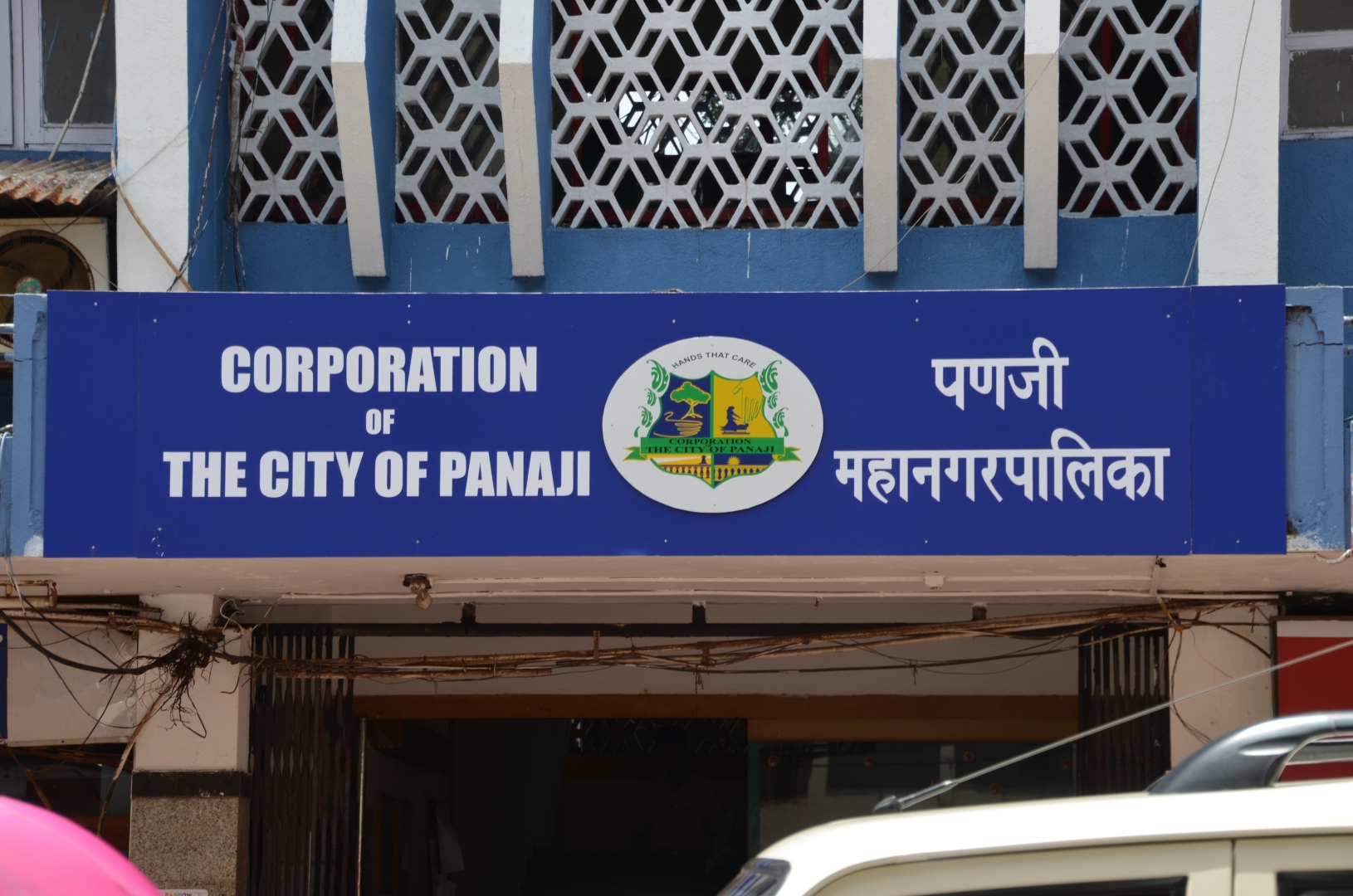
PANAJI
The Corporation of the City of Panaji (CCP) was created via the City of Panaji Corporation Act, 2002, which was passed by the Goa Legislative Assembly in August 2002 and notified in January 2003.
The law gives the CCP the powers to manage civic amenities, regulate trade, levy taxes, and oversee urban planning.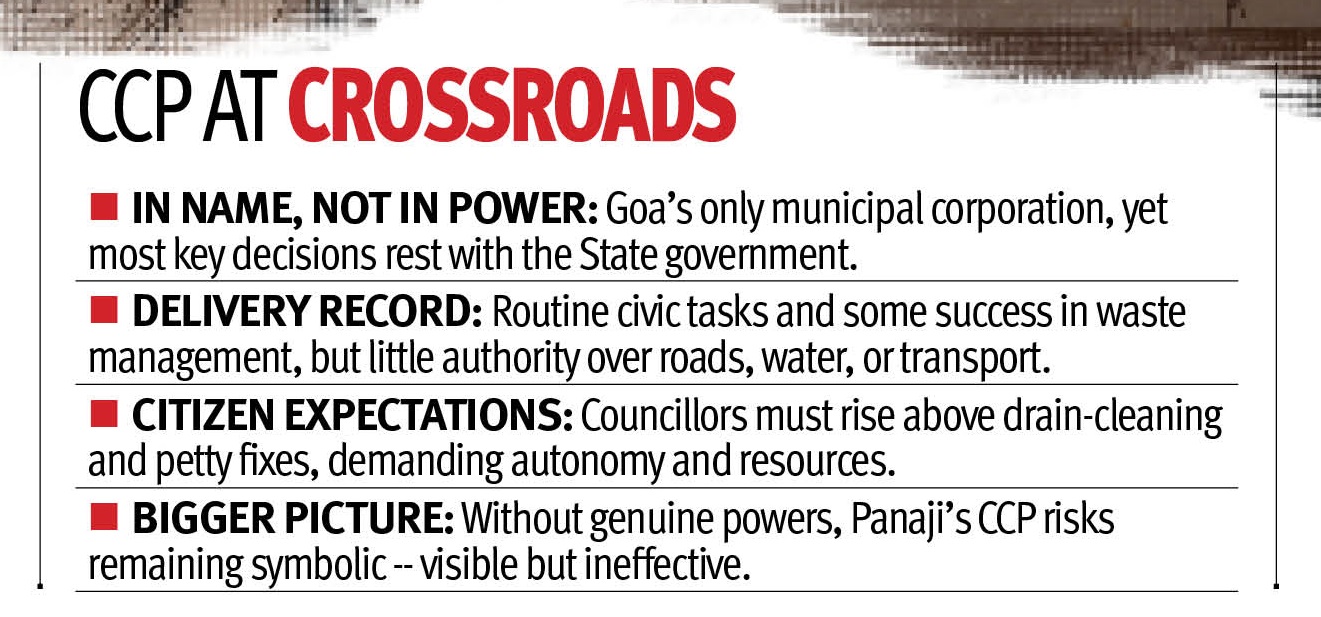 Interestingly, the law was the collaborative brainchild of the late Manohar Parrikar, who was then the Chief Minister and also MLA of Panaji, and current Revenue Minister Atanasio (Babush) Monserrate, who was TCP Minister and also the MLA of Taleigao.
The CCP law, which was hurriedly enacted in the 2003 monsoon session sans any meaningful consultation or debate at the time, gave the capital city's civic body the responsibility and power to manage garbage (solid waste disposal), sanitation of the city, licensing, birth and death records, and maintaining public spaces.
When it was enforced in January 2003, it transformed the capital city's civic body — Panjim Municipal Council — into a 'Corporation', and also simultaneously fulfilled Monserrate's election promise that the Taleigao Panchayat would be restored. The law excluded the entire Taleigao village and, in effect, shrunk the geographical jurisdiction of the CCP.
However, the strength of the council was doubled — from the erstwhile Panjim Municipal Council's 15 councillors to the CCP's 30 — a puzzling arithmetic which has crowded the civic body's 'government' and negatively impacted actual governance.
'Corporation' or glorified municipality?
The law intended to give the capital city a Corporation so that civic governance and infrastructure keep pace with growth, but more than two decades later, although it stands as Goa's only 'municipal corporation', its powers remain strikingly limited.
Far from being an autonomous civic authority, the CCP functions more like a glorified municipality and much of the city's destiny is controlled and governed by the State government.
Take, for example, some of its core functions: granting construction licences for residential and commercial buildings, issuing Occupancy Certificates, and trade licences for businesses. While on paper these powers lie with the CCP, they are not truly independent. The North Goa Planning and Development Authority (NGPDA) and the Town and Country Planning Department dictate most of these decisions, leaving the CCP to merely endorse approvals already decided elsewhere.
This dependence strips the Corporation of any meaningful authority, reducing it to a ceremonial body — a rubber stamp rather than a decision-maker.
The limitations of the CCP become even more apparent when compared to other such corporations in the country, for instance, the Brihanmumbai Municipal Corporation (BMC), India’s largest and most powerful civic body. It not only manages basic infrastructure but also exercises significant and almost exclusive control over urban planning, public health, education, water supply, and transport. It also has the financial muscle to implement large-scale projects and the autonomy to frame policies that directly impact Mumbai’s residents and the city's growth.
In contrast, the CCP lacks both the jurisdiction and the resources to address Panaji’s pressing challenges: traffic congestion, waste management holistically, all the city's roads and water supply (controlled and governed by the PWD), and transport.
This disparity highlights the hollow nature of the CCP’s authority. While most other corporations, like Mumbai’s, actively shape their city’s future, Panaji’s is relegated to clerical approvals and maintenance work. The mismatch between its title and its actual powers underscores a governance failure: a “corporation” in name, but not in function.
For Panaji to evolve into a modern, well-managed capital, its civic body must be empowered with genuine authority over planning, infrastructure, and development. Until then, the CCP will remain a symbolic institution — visible but ineffective, present but powerless, a corporation only on paper.
Task before to-be elected councillors
Against this backdrop, the 30 councillors—colloquially referred to as “corporators”—who will be elected in March face a daunting task. Traditionally, CCP representatives have been confined to attending to petty, menial jobs: clearing drains, fixing potholes, or chasing sanitation complaints. While these are important, they cannot define the role of a civic representative in a capital city aspiring to modernity.
The challenge before the new council is to rise above this limited scope and push for structural reforms. They must demand greater autonomy from the State government, ensuring that the CCP is not reduced to a rubber stamp but becomes a genuine decision-making body. This means lobbying for control over urban planning, transport, water supply, and housing—functions that directly affect the daily lives of Panaji’s residents.
Equally critical is financial empowerment. Without adequate resources, the CCP cannot deliver beyond routine maintenance. The corporators must explore innovative revenue streams, strengthen tax collection, and ensure transparent budgeting. Only then can Panaji aspire to match the standards of other Indian cities with empowered civic bodies.
The elected representatives must also embrace a broader vision of governance. Issues like climate resilience, sustainable mobility, and inclusive housing are no longer optional—they are essential for a capital city under pressure from rapid urbanisation. The corporators must engage with citizens, experts, and institutions to craft policies that look beyond short-term fixes and address long-term growth.
Ultimately, the March election is not just about choosing councillors; it is about redefining the role of the CCP itself. If the new corporators continue to operate within the narrow confines of drain-cleaning and street sweeping, Panaji will remain stuck in the past. But if they seize the opportunity to demand authority, resources, and accountability, they can transform the CCP into the institution it was meant to be: a true corporation capable of shaping the city’s future.
20-year record: promise vs delivery
Over the past four terms, the CCP’s record has been mixed, with the civic body exhibiting tangible results in solid waste management, perhaps a solitary jewel in its crown.
Once a daunting challenge, Panaji has steadily moved toward a zero-landfill model through its multi-layered segregation system.
The city’s dry waste is divided into biodegradable, non-biodegradable, sanitary, and hazardous categories, further refined into 16 types to maximise recycling and resource recovery, says CCP’s waste management head, Sachin Ambe.
Public cooperation — especially from households, hotels, and restaurants — has been crucial, supported by an effective door-to-door collection system.
On a daily basis, the capital city generates about 21 tonnes of waste, of which 14 tonnes of wet waste are sent to the Saligao treatment plant. The remaining 40% is dry waste and is dealt with at the Material Recovery Facility (MRF) near the KTC bus stand, where waste is manually segregated into categories such as plastics, paper, cloth, and e-waste. Since 2021, the system has expanded to 28 fractions, enhancing recycling and resource recovery.
The MRF, also called Swachhta Kendra, was established in 2014 under a UNDP project and is staffed by over two dozen “Safai Sathi” workers operating around the clock.
While waste management stands out as a rare “feather in CCP’s cap,” sustaining success amid rapid urbanisation in Taleigao and the city’s eastern outskirts will require scaling up operations to meet growing demands.
On other civic governance parameters, however, the CCP's record has been patchy and much below par.
Take the case of the redeveloped Panaji market. Twenty years after the authorities blundered in permitting tenant-merchants to occupy spaces sans fresh lease deeds, the civic body is struggling to regularise the fiasco, leaving in all these years scope for scamsters, including allegedly some councillors, to reap illegal gains privately.
Other infrastructure projects which the civic body has taken up, be it the redevelopment of its own headquarters and other property it owns such as the famed National Theatre, are either stuck in bureaucratic red tape, irregularities, and multiple litigations.
Its record in beautifying gardens, streetscapes, and open spaces has also been sporadic, often overshadowed by maintenance lapses.
Experts argue that the CCP must evolve from being a reactive body to a proactive planner, anticipating Panaji’s needs rather than merely firefighting crises. For residents who often complain of service deficiency, the CCP is not an abstract institution — it is the authority that decides whether garbage is cleared, drains are maintained, and public spaces are liveable.
As one resident put it: “We don’t expect miracles. We expect the basics to be done well.”