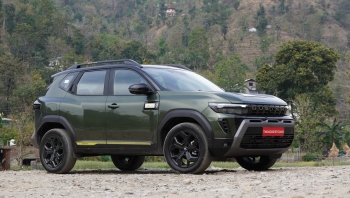
There was a time when the Renault Duster stood as the benchmark for what a practical, rugged SUV should be in India. Long before the segment became crowded with feature-loaded crossovers, the Duster carved its identity through sheer capability and a no-nonsense approach. Fast forward to 2026, and the Duster makes a return with a renewed sense of purpose. Rather than chasing gimmicks or simply adding more features, Renault has chosen to focus on performance, driving engagement and real-world usability. At the heart of this revival is the 1.3-litre turbo-petrol engine paired with a dual-clutch automatic transmission (DCT), positioned as one of the most powerful offerings in its class. With prices ranging from Rs 14.49 lakh to Rs 18.49 lakh (ex-showroom), the new Duster aims to appeal to buyers who prioritise how a car drives as much as how it looks or feels inside.
Exteriors
The new Duster retains its unmistakable SUV stance, staying true to its rugged DNA while incorporating modern design updates. The upright proportions, high ground clearance and muscular wheel arches continue to give it a purposeful appearance. Subtle refinements in the form of updated lighting elements, a reworked grille and sharper detailing help bring the design in line with contemporary expectations. However, unlike some of its more flamboyant rivals, the Duster avoids excessive styling. It looks functional and robust rather than flashy”something that will appeal to buyers who prefer understated design with genuine road presence. The 212 mm ground clearance further reinforces its go-anywhere intent, making it particularly suitable for Indian road conditions.
Interiors
Step inside, and the Duster presents a cabin that is practical and ergonomically sound. The layout is straightforward, with controls placed intuitively and visibility being a strong point. However, the focus here is clearly on durability rather than luxury. Hard plastics dominate the dashboard and door panels, and while everything feels well put together, it lacks the premium appeal seen in some rivals. Space in the front is comfortable, with supportive seats and a commanding driving position. The rear seat, despite a respectable wheelbase of 2,657 mm, offers adequate rather than exceptional comfort. Under-thigh support and seating posture could have been better, especially for longer journeys.
Tech
Where the new Duster makes a noticeable leap is in technology. It now features a 10.1-inch touchscreen infotainment system with built-in Google integration, allowing seamless access to navigation and voice commands without relying entirely on smartphone connectivity. Complementing this is a 10.25-inch digital instrument cluster that presents information clearly and adds a modern touch to the cabin. Other features include wireless Apple CarPlay and Android Auto, wireless charging, and ventilated front seats”ensuring that the Duster stays competitive in terms of everyday usability and convenience.
Safety
Safety has been given due attention, aligning with the car’s performance credentials. The Duster comes equipped with six airbags as standard, along with Level 2 ADAS that includes 17 advanced driver assistance features. Additionally, it offers a 360-degree camera, electronic parking brake with Auto Hold, and disc brakes on all four wheels in DCT variants. This comprehensive package provides reassurance, particularly considering the SUV’s performance potential.
Engine specs and transmission
The highlight of the 2026 Duster is undoubtedly its 1.3-litre turbocharged petrol engine, producing 163 hp and 280 Nm of torque. Enhanced with mild-hybrid technology, the engine delivers strong performance while maintaining reasonable efficiency. What stands out is the way the power is delivered. The torque band, active between 2,000 and 3,500 rpm, ensures quick acceleration and effortless overtaking, whether in city traffic or on highways. Paired with this engine is a 6-speed dual-clutch automatic transmission featuring a wet-clutch setup. This is particularly relevant for Indian driving conditions, as wet-clutch systems are better suited to handle heat and stop-go traffic. The gearbox operates smoothly at low speeds and responds quickly when pushed, making it well-suited for both urban commutes and highway runs. Paddle shifters further enhance driver involvement for those who prefer manual control.
Drive & handling
The Duster continues to uphold its reputation as a driver-focused SUV. The suspension setup feels well-judged, offering a balance between ride comfort and handling stability. At higher speeds, the car remains planted and confidence-inspiring, while its ability to absorb rough roads and uneven surfaces remains a key strength. The steering is predictable, making the car easy to place on the road. Despite being front-wheel drive in this configuration, the Duster retains its rugged character, handling broken roads and challenging terrain with ease. This combination of performance and composure sets it apart from many of its softer, urban-focused competitors.
Competition
In the mid-size SUV segment, the Duster goes up against established players like the Hyundai Creta, Kia Seltos, and others that focus heavily on features and interior quality. While these rivals may offer more premium cabins and additional comfort features, the Duster differentiates itself with its superior performance, robust build and engaging driving dynamics. It appeals to a niche that values substance over sheer feature count.
Verdict
The 2026 Renault Duster is not designed to be the most luxurious or feature-packed SUV in its class. Instead, it focuses on delivering a strong driving experience, backed by a powerful engine and capable dynamics. The 1.3-litre turbo engine is the standout element, offering performance that is unmatched in the segment. The gearbox complements it effectively, and the overall driving experience feels engaging and confidence-inspiring. There are compromises”most notably in interior quality and rear seat comfort”but these appear to be conscious trade-offs rather than oversights. For buyers seeking a mid-size SUV that prioritises performance, ruggedness and real-world usability, the new Duster makes a compelling case.