


MARGAO
With no sign of the authorities setting in motion the process to provide political reservations for the Scheduled Tribes, the Mission Political Reservation for Scheduled Tribes of Goa has on Thursday set a 15-day ultimatum on the Goa government to coordinate with Central government and commence the process of notifying seats for Scheduled Tribes in Goa Assembly.
The NGO, which is waging a sustained battle in support of the demand for political reservations for the ST communities, expressed its deep concern over the continued delay in operationalising ‘The Readjustment of Representation of Scheduled Tribes in Assembly Constituencies of the State of Goa Act, 2025’, despite the Act having received Presidential assent and being notified in the Official Gazette over six months ago.
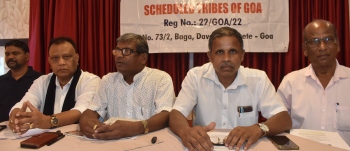
Addressing the media, Mission leaders, including President John Fernandes and Govind Shirodkar said the Legislation represents a historic step towards ensuring fair and constitutional political representation to the Scheduled Tribes community in Goa, in line with the spirit of Article 332 of the Constitution of India. The duo, however, pointed out that as per sub-section (2) of Section 1 of the said Act, it shall come into force only upon issuance of a notification by the Central government in the Official Gazette. The absence of notification of the appointed date by the Central government has effectively stalled the implementation process, they said.
“Once the appointed date is notified, subsequent statutory procedures including the notification of constituencies for STs are expected to require an additional period of approximately three to four months,” he said.
Fernandes further said in view of the forthcoming Goa Legislative Assembly elections scheduled for February 2027, and the likely enforcement of the Model Code of Conduct by January 2027, any further delay may seriously jeopardise the timely realisation of political reservation for Scheduled Tribes in the State.
Govind Shirodkar said the Mission acknowledges the efforts made by leaders of the Scheduled Tribes community, including continuous follow-ups with both the State and Central governments. He, however, hastened to add that the absence of a clear timeline or firm assurance regarding the notification of the appointed date has created growing uncertainty and concern among the community.
“There is a growing and credible apprehension within the Scheduled Tribes community that certain influential political figures within the ruling establishment are deliberately working against the implementation of this Act. It appears that pressure is being exercised directly or indirectly on the State as well as on the Central government to withhold the notification of the appointed date,” he said.


