Few scooters in India evoke the kind of nostalgia that the Kinetic Honda DX once did. Known for introducing hassle-free, gearless mobility to Indian households in the late 1980s and early 1990s, it built a reputation for simplicity and everyday usability. Fast forward to today, and Kinetic Green has revived the iconic DX badge in an all-electric form. But this is a very different market now”one that’s crowded, feature-rich, and highly competitive. The new Kinetic DX EV isn’t just banking on nostalgia; it needs to deliver on performance, range, and practicality. The big question is whether it manages to strike that balance or ends up being more sentimental than substantial.
Looks and features
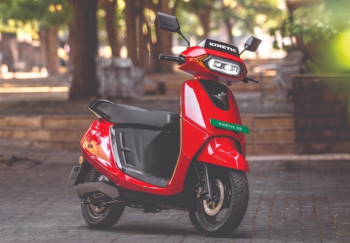
The design of the new DX leans heavily into its heritage, and that’s immediately evident. The upright stance, boxy bodywork, and flat side panels mirror the original closely. Signature elements like the large headlamp topped by a tall visor and the familiar side vents give it a strong visual connection to its predecessor. At the same time, modern touches such as LED lighting, flush-mounted footpegs, and distinctive LED DRLs shaped like the Kinetic logo add freshness to the design. The retro theme continues with a modern twist. The highlight is an 8.8-inch digital display styled to resemble the original console but loaded with contemporary tech. It supports Bluetooth connectivity and even features built-in speakers, which is quite unusual in this segment. Additional features include cruise control, hill hold assist, reverse mode, and keyless operation via a passcode system. However, not everything feels polished. The overall fit and finish leave room for improvement, with inconsistent panel gaps and some rough edges noticeable across the bodywork. Material quality doesn’t quite match up to rivals either. The switchgear layout is another area that could have been better thought out”it feels cluttered and unintuitive, often requiring you to glance down while riding, which isn’t ideal from a safety standpoint.
Tech specs and battery
Powering the Kinetic DX is a hub-mounted BLDC motor producing around 4.7kW. While it doesn’t aim to be a performance leader, the output is adequate for daily city commuting. The scooter offers three riding modes”Range, Power, and Turbo”each altering throttle response and speed characteristics. Energy comes from a 2.6kWh LFP battery pack. The claimed IDC range stands at 102km for the standard DX and 105km for the higher DX+ variant. The top-spec model also benefits from an integrated on-board charger, which can replenish the battery from 0 to 80 percent in about three hours. This charger is neatly housed within the front apron, making it convenient to access without sacrificing storage space. The base variant, on the other hand, relies on a conventional off-board charger. Practicality remains a strong suit. The scooter offers a generous 37-litre under-seat storage compartment, large enough to accommodate two small helmets or daily essentials. While it won’t fit a full-size racing helmet, it still scores well as a family-friendly runabout.
Ride and ergonomics
Out on the road, the Kinetic DX prioritises smoothness over outright performance. Acceleration is progressive, and the throttle response feels predictable, making it easy to ride in city conditions. Each riding mode has a distinct character. Range mode caps the top speed at around 50kmph and dulls throttle response significantly, making it best suited for maximising efficiency rather than keeping up with traffic. Switch to Power mode, and the scooter feels more responsive, offering enough urgency for typical urban riding. Turbo mode is where the DX feels most alive, delivering sharper throttle inputs and enabling it to reach a top speed of around 90kmph. The inclusion of cruise control is a welcome touch, although it can’t be adjusted on the move and disengages as soon as you brake or accelerate.
Handling is user-friendly rather than sporty. The scooter feels light and agile, making it easy to manoeuvre through traffic and tight spaces. It’s not designed for aggressive riding, but it remains composed and predictable in everyday scenarios. The suspension setup, however, is a mixed bag. The front end feels stable and absorbs bumps reasonably well, but the rear suspension is noticeably firm. Over uneven roads, potholes, or expansion joints, the stiffness becomes evident, sending jolts through the chassis. Braking performance is adequate, with the rear brake offering better bite than the front, which could benefit from more stopping power.
Verdict
The new Kinetic DX successfully taps into nostalgia with its familiar design and simple, practical approach. It offers a decent set of features, usable range, and a comfortable riding experience for city commutes. However, it doesn’t quite set new standards in a segment that’s rapidly evolving. Shortcomings in build quality, switchgear usability, and rear ride comfort hold it back from being a complete package. Add to that the uncertainty around long-term reliability and service reach, and it faces a tough battle against more established electric scooters. That said, if you’re drawn to its legacy and want a straightforward, no-nonsense electric scooter with a touch of old-school charm, the Kinetic DX still manages to carve out a niche for itself.