


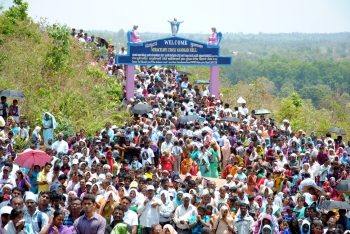
 Goan settlers from Khanapur taluka on a pilgrimage to Nandgad Cross.
BELAGAVI
While thousands participated in the Milagres Feast at the Mapusa Church on April 20, the feast was celebrated with equal fervour at a church about 100 kms away in Karnataka.
Khanapur, an important taluka of Belagavi district, is a vibrant epitome of cultural diversity. While Marathi-speaking communities form a significant presence, particularly in the town and the western parts of the taluka, Khanapur is equally enriched by other linguistic and cultural groups that have shaped its unique identity over centuries.
Among these, the Konkani-speaking Goan settlers form one of the most distinct and culturally rooted communities in the region. Spread across Khanapur town and its surrounding areas, this community has preserved and nurtured its rich Goan heritage with remarkable pride and continuity. Their traditions, customs, cuisine, and religious practices continue to reflect a deep connection to their ancestral roots.
Historical accounts suggest that these settlers began migrating to the Upper Ghats region bordering Goa over four centuries ago. Over time, they established themselves firmly in Khanapur, blending with the local milieu while retaining their distinct cultural identity.
Today, this Konkani-speaking population remains one of the most striking features of Khanapur’s social fabric”serving as a living bridge between Goa’s cultural legacy and the diverse traditions of Belagavi district.
Khanapur has long been a vital centre of Catholic life in the region. Once part of the Archdiocese of Goa, it later became affiliated with the Diocese of Belgaum following its formation in 1953. This transition marked a new chapter in the ecclesiastical administration of the region while preserving its deep-rooted Goan heritage.
Available records dating back to 1882 highlight the dedicated service of several Goan diocesan priests in Khanapur. In 1943, the pastoral care of the deanery was entrusted to the Jesuit priests.
Several Jesuits contributed significantly to the spiritual and social development of the region. Among them, the late Fr Edwin D’Souza stands out for his pioneering efforts in education. In 1958, he established Sarvodaya High School along with a boarding facility, an institution that has since shaped the lives of numerous religious vocations and professionals now serving in Goa and across the globe.
The Christian presence in Khanapur dates back several centuries. Historical accounts indicate that the first church, dedicated to Our Lady of Milagres”on the lines of the revered shrine in Mapusa”was constructed around 1600 to serve the spiritual needs of Goan settlers, many of whom had migrated from Bardez taluka. For a long period, this church catered to the entire Khanapur region until the formation of separate parishes. Today, Khanapur serves as a prominent deanery of the Diocese of Belgaum, comprising eight parishes and hosting one of the largest concentrations of Konkani-speaking Catholics in the area.
The Goan Catholics in Khanapur has been vibrant in the field of education and also play an important role in the politics of the taluka. They also have played a vital role in preserving Goan culture and religious traditions over generations. Beyond the town, Konkani-speaking Catholics are settled in parishes such as Kakkeri, Bidi, Nandgad, Mansapur, Sangargalli, Manturga, and Londa, where they continue to uphold their linguistic and cultural identity. Eucharistic celebrations across the taluka are conducted in Konkani, enriched by traditional Goan hymns. Cultural elements like the Irmaos”integral to feasts, ordinations, funerals, and processions (pursaos)”remain a distinctive feature, reflecting strong continuity with Goan customs. During Lent, the observance of Doglavoillo Pask, a traditional Goan ritual, further underscores this enduring heritage.
The Goan settlers have also affectionately preserved the Ghumots and Yersas, played by certain groups during a feast and weddings respectively.
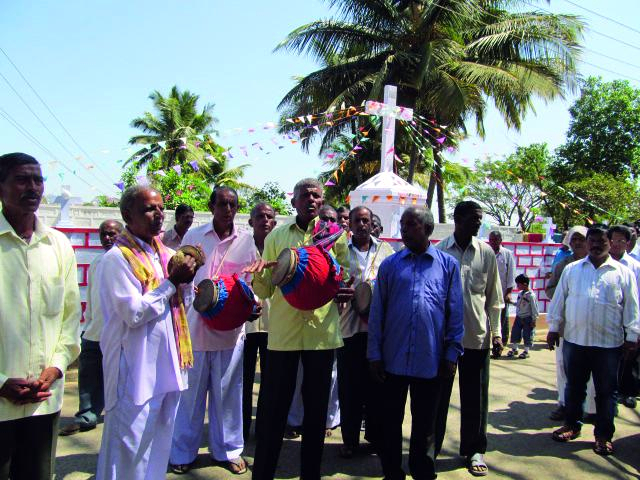
A file photo of a team from Alnavar village in Khanapur performing Ghumots at an annual feast.
Historically, the Goan settlers of Khanapur are also believed to have contributed indirectly to the Goa Liberation movement by supporting freedom fighters with essential supplies. Even today, their ties with Goa remain strong, particularly through the Communidade system. Gauncars originally from Goan villages continue to play a significant role in Communidade affairs, often influencing elections by participating actively in the selection of managing committees.
A symbol of enduring faith among the community is the Miraculous Cross at Nandgad, located about 7 kms from Khanapur town, which was erected in 1888 following a fervent prayer during a deadly bubonic plague outbreak that ravaged the region. The Cross stands atop Nandgad Hill as a testament to resilience and devotion. It continues to attract pilgrims seeking solace, hope, and spiritual strength.
Economically, earlier generations of these Goan settlers were primarily engaged in agriculture and trade, particularly in the wholesale and retail business of fresh and dry fish. This tradition has been sustained over time, with many families continuing the occupation even today. Notably, women from the taluka remain actively involved in the sale of dry fish, preserving both livelihood practices and cultural identity.
In essence, Khanapur represents a unique confluence of history, faith, and culture”where the legacy of Goan settlers continues to thrive, enriching the social and spiritual fabric of the region.


