


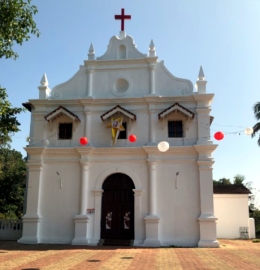
The historical Church dedicated to St Blaise, Sâo Bràs in Portuguese, is located on a small hillock at Gandaulim, on the banks of Cumbarjua canal, about 4 kilometres from Old Goa and caters to the spiritual needs of parishioners of Gandaulim and Cumbarjua.
THE NAMES
The inhabitants of Gandaulim village earlier seem to have been Gauddas (a tribal community); hence the village got its name. Some say that name was derived from Gandhhalli, a composition of two words “ Gandh which means scent and Halli, that means village. It is believed that the place earlier had scented flowers along the ‘Rua das Flores’ (Road of flowers), which passed through the village that originated from Daugim border, the village known as a scented village.
Cumbarjua is a corruption of Kumbhar (potter) and zunvo (island), hence the inhabitants of the village seem to have been potters.
THE ORIGIN
The original Church in Gandaulim was a small chapel built by the Croatian sailors and traders in 1541, who dedicated it to St Blaise. Centuries back, the Croatian city of Dubrovnik was an important trading centre and these traders, in search of textiles and spices, came to Goa and founded their own colony here. Others say that they were brought here by the Portuguese to build ships, since they were great shipbuilders.
This chapel was elevated to the Church in 1563. It was probably rebuilt by Archbishop Dom Frei Alexio de Menezes (1595-1610). The Church building is a replica of a thrice larger church of Sao Braz in Dubrovnik, Croatia. It has a beautiful carved pulpit.
THE VILLAGE
During the days of its glory, says FX Gomes, Sao Bras was a very prosperous colony having a population of around 12,000. Rich Gandaulim women would be taken in palanquins by slaves to the church. In the course of time, the settlers here declined. The reason for this could be that in the 1570s trade between India and Croatia had declined.
In the 17th century, the Portuguese had lost their monopoly over spice trade to the Dutch and the British also favoured other ports, hence Goa was no longer a major trading hub. Consequently, the settlers moved to greener pastures.
The earthquake of 1667 had destroyed Dubrovnik and its prosperity and it no longer had financial nor military power to trade with India. Further, the plague that destroyed Old Goa also had consequences on Gandaulim, since the people fled for their lives to the neighbouring islands of Santo Estevao and Cumbarjua.
THE ALTARS
The Church has three altars; the main altar is dedicated to Sao Bras, the patron against throat sickness. The staff in the hand of the saint is of pure silver and it was offered by Archbishop S Gaidino. On both sides of the main altar are the images of Santa Luzia (patron against eye ailments) and Santa Apolinia (patron against teeth ailment). The side altars are dedicated to Our Lady of Health and Our Lady of Victory.
The Portuguese conquered Cumbarjua Island and after it passing through many hands, Fr Goncalo Martins SJ, brought in on behalf of the Society of Jesus for 26,010 xerafins on July 5, 1655, and they evangelised it and constructed a chapel there and dedicated it to St Francis Xavier. They remained there till their expulsion from Portuguese possession in 1759. Mass is celebrated in this chapel once a month on Mondays.
THE FEAST
In the past, parishioners of Sao Bras would celebrate 4 feasts during the course of the year - Our Lady of Good Health (February 2), the feast of the patron saint Sao Bras (February 3), Our Lady of Victory (December 8) and Santa Luzia (December 13).
On Sunday, only two feasts are celebrated, the feast of the patron, St Blaise, which this year will be celebrated on February 5, preceded by the Maddi and the Novena and the feast of Our Lady of Victory, preceded by the Triduum.
For those who, for various reasons, have moved out of the village and who have their ancestral homes here, it is a homecoming on the occasion of the feast of the patron.
(The writer is Superior at Casa Professa, Basilica of Bom Jesus in Old Goa)


