


VASCO
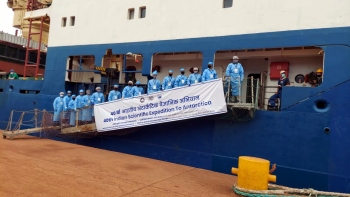
A Russian research ice-class vessel ‘MV Vasiliy Golovnin’ left from Berth 11 at Mormugao Port Trust (MPT) on Monday with a team of 43 Indians for the 40th Indian Scientific Expedition to Antarctica (ISEA) mission.
Five other persons will board the ship from Cape Town in South Africa and will be the helicopter crew.
The ‘MV Vasiliy Golovnin’ has a heli-hangar that accommodates two helicopters used for conveyance in the field and to move cargo between the ship and the Antarctic stations.
Some of the main aims of the expedition taken up by National Centre for Polar and Ocean Research (NCPOR) is to study climate change, sea-level rise and various life sciences in the region
During a programme to flag-off the vessel from MPT, NCPOR Director Dr M Ravichandran informed the media that the 40th ISEA has a 43-member team of scientists, engineers, doctors, and technicians, led by three polar veterans, Dr Yogesh Ray from NCPOR, Atul Kulkarni from Indian Institute of Geomagnetism and Ravindra More from India Meteorological Department.
“We started in 1981 for science and geo-political reasons to keep our Indian flag flying high in Antarctica. We carry out studies on climate change because regions like Antarctica, Arctic and Himalayas are the first place where any minute signature climate change if any can be observed,” said Dr Ravichandran.
“We continuously monitor atmospheric, geological, oceanic, glaciological, life science, DNA structures, biodiversity and geoscience in the region. We also monitor ocean parameters on the way to Antarctica.”
Dr Ravichandran said in the earlier expedition, a team of hundred Indians would undertake the expedition, of which 50 would return immediately after three months of summer and the remaining would remain throughout the year and return after winter.
“But this year, only 43 Indians had left and will return after a year,” he added.
Dr Ravichandran said India has three stations in the polar continent of Antarctica “ Dakshin Gangotri (1984), Maitri (1989) and Bharati (2012), which are being operated under NCPOR, Ministry of Earth Sciences.
“Polar regions are crucially important in answering key questions about global climate change, its contribution towards the global sea-level rise, the background aerosol properties, variability in the sea ice cover and phenomenon like Antarctic haze and ozone concentrations.”
“Attempts to address some of these issues help in mitigating several important problems concerning human life and well-being. The 40th ISEA is a comprehensive programme and shall focus on climate change-related studies, geology, ocean observations, electric and magnetic flux measurements, environmental monitoring, etc,” said Dr Ravichandran.


