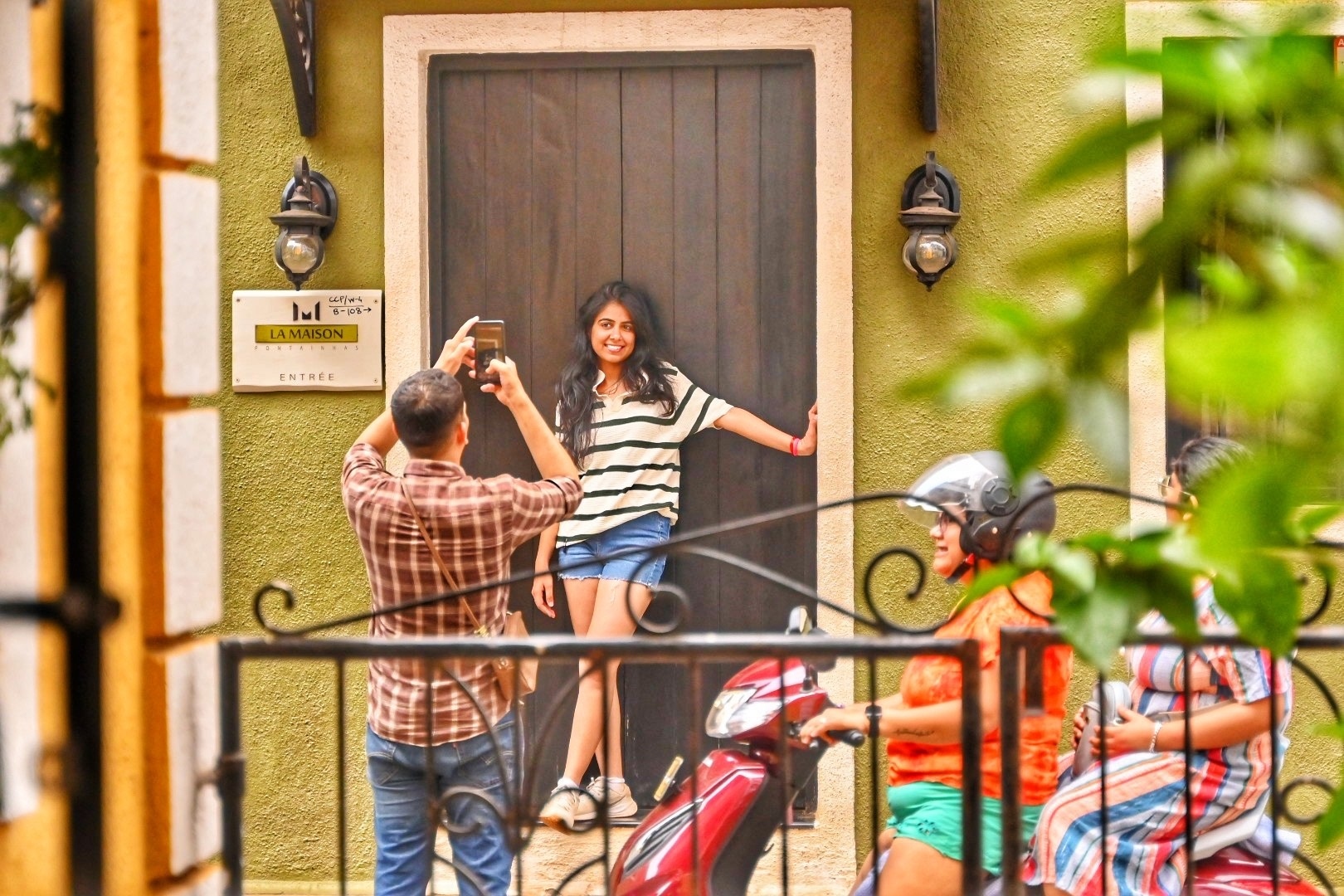
Tourists click photos in Fontainhas, where residents say congestion has become the city’s most pressing civic issue.
PANAJI
Panaji’s residents are losing patience: the capital’s streets are choking under the weight of merchandise delivery trucks, cars, tourists, and casino operations.
Traffic and pedestrian congestion has become the loudest issue, with aspiring candidates, including sitting corporators, being confronted by residents and voters on their campaign trail for the March 11 elections to the Corporation of the City of Panaji (CCP).
In the Latin quarters of São Tomé and Fontainhas, the problem is acute.
Narrow lanes, heritage homes, and crowds of tourists collide daily.
“We can’t even walk out of our homes without dodging cars and tourist groups,” said Maria Fernandes, a Fontainhas resident. “The charm of our neighbourhood is being destroyed,” she said.
Authorities have long acknowledged the crisis. CCP officials, including Mayor Rohit Monserrate, have admitted that parking remains the city’s Achilles’ heel.
“Panaji was never designed for this volume of vehicles,” a former CCP commissioner told The Goan. Police too admit that casino operations along the Mandovi river add a heavy burden.
“Peak hours along the DB Marg are a nightmare,” a traffic police constable often posted in the area said. “We do deploy extra personnel, but it’s not enough,” he said.
Residents recently raised a hue and cry over the reported move by Delta Corp, the BSE-listed company which operates the 'Deltin' brand of casinos, to replace one existing vessel with a much larger 112-metre vessel said to have the capacity to carry 2,000 people. Hundreds of taxis and buses ferry patrons to the floating casinos every evening.
"The riverfront is gridlocked after sunset, with casino company vehicles and patrons teeming in the area. The streets of the heritage ward of Sao Tome are completely overtaken by casino employees and visitors,” complained Chryselle D'Silva Dias, whose home overlooks the Mandovi river.
“Local residents no longer use the public spaces in the area or step out of their homes in the evenings. The government, including the CCP, puts casinos first before its local tax-paying residents,” she added.
Often, cars spill onto sidewalks due to parking shortages, compounding the chaos and forcing pedestrians onto the road. Civic authorities have in the past floated multi-level parking projects, but most, barring a solitary one at Patto, remain stalled.
Politicians on the campaign trail, meanwhile, are hearing the anger firsthand. Candidates promise reforms, but scepticism among residents runs deep. “We’ve heard promises to resolve this traffic congestion problem for years,” said a retired government teacher, even as he lamented that nothing ever changes while city residents suffocate.
Tourism, while vital to Goa’s economy, is seen as a double-edged sword by affected Panaji residents. In Fontainhas, heritage homes attract visitors by the busloads.
“We welcome tourists,” said a resident who lives in the St Sebastian Chapel area. “But when streets are jammed and the noise is unbearable, we get stressed and suffer,” she said.
Heritage activists warn that unchecked congestion could damage the fragile character of the Latin quarters. The police have repeatedly urged civic authorities to act.
“Traffic management cannot be left to enforcement alone,” a senior police officer said, adding that parking infrastructure desperately needs to be planned.
Yet, with elections looming, the issue has become political ammunition rather than policy. For Panaji’s citizens, the stakes are urgent. Every day brings fresh frustration. “It’s not about politics. It’s about whether we can live peacefully in our own city.”
As March 11 approaches, one thing is clear: the battle for Panaji’s civic body will be fought on its gridlocked streets.