


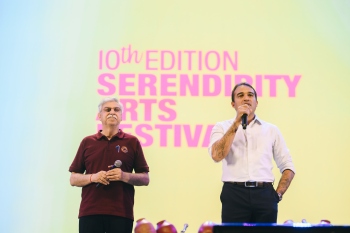
 Sunil Kant Munjal and Rohit Monserrate inaugurating the festival venue - The Arena at Nagalli Hills Ground at the Serendipity Arts Festival 2025.
PANAJI
The landmark 10th edition of Serendipity Arts Festival opened on Friday with a resounding celebration of India's rich artistic traditions and contemporary innovations. Returning to Panaji for ten extraordinary days, the festival's opening showcased the perfect blend of heritage and modernity that has become its hallmark.
The evening commenced with the opening of Serendipity Arts Festival at Barge at the Captain of Ports Jetty in Old Goa as Sunil Kant Munjal, Founder Patron of Serendipity Arts, welcomed everyone to be a part of the milestone edition celebrating art, culture and heritage.
Reflecting on the 10th milestone edition of Serendipity Arts Festival, Sunil Kant Munjal, Founder“Patron of Serendipity Arts, said:
"As we open the 10th edition of Serendipity Arts Festival, we celebrate not just a milestone, but a movement. Over the past decade, this festival has become a living bridge between heritage and innovation, bringing together artists, communities, and audiences in a shared journey of cultural discovery across visual, performing, culinary and performance arts. This year, we choose to create more, listen harder, and open the cultural space wider ” for India, and for the world. We dedicate the festival to Mukta Munjal. She was an early inspiration for the Founders, having started a number of initiatives in the arts, including this festival.”
Embedded in this spirit of Serendipity Arts Festival, Barge, curated by Veeranganakumari Solanki, transformed a floating venue into a space exploring absence and presence. Drawing from three previous exhibitions”Future Landing, Synaesthetic Notations, and A Haptic Score”the installation foregrounds participatory experience, inviting each viewer to activate the space and create memorable imprints. The four Barge artists respond to understanding of absence and presence spatially, architecturally, and sonically.
Speaking about the opening of Barge, Veerangana Solanki said, “A cabin transforms into an illusion of space, while oil palms hunch over histories and fading memories of trade and geographies. A light source sweeps the darkness for signs that reveal remnants of labour and days spent at sea, and a visitor’s movement through the space begins to search for the sounds that travel behind the steel skin of a floating cavity. This is Barge.”
The inauguration was followed by Palette(s)”a performance for 2 artists, 20 pallets and 1 bottle of water at The Arena at Nagalli Hills. Cédric Gagneur and Marc Oosterhoff gave pallets a new life, an ode to falling, in which there is no great difference in the way pallets and artists are treated: they are carried, manipulated, thrown and fall without grace. A piece full of splinters that flirts with dance and circus.
The night concluded with Clay Play, curated by Shubha Mudgal and Aneesh Pradhan. This mesmerizing performance brought together a collection of percussion instruments primarily made from clay, each with its own distinct playing technique.
Alongside these openings, the city also saw the first appearances of Beasts of Reincarnations: Mythical Beings in the City, curated by Diptej Vernekar. Spread across Panjim’s heritage streets and waterfronts, the project reimagines Goa’s living traditions of effigy-making by introducing large-scale, ephemeral installations inspired by the Narkasur lineage and other ritual forms.
Across multiple venues, exhibitions open their doors to the public from December 14. Not a shore, neither a ship, but the sea itself, curated by Sahil Naik at The Old GMC Complex, will bring together artists from Goa, the Goan diaspora, and those who have engaged with oceanic histories.
OTHERLAND, curated by Ranjit Hoskote at the Old GMC Building, will present the practices of four Indian photographers”Naveen Kishore, Ram Rahman, Samar Jodha, and Ritesh Uttamchandani”who have borne witness to crises and predicaments in other societies.
From December 14, the venues will also welcome visitors to several installations including Multiplay 02: Soft Systems curated by Thukral and Tagra at the Directorate of Accounts, The Culinary Odyssey of Goa by Odette Mascarenhas at Art Park, and What Does Loss Taste Like? curated by Chef Thomas Zacharias and The Locavore at the Directorate of Accounts”an immersive, multisensory installation exploring the slow disappearance of taste, memory, and biodiversity.
Duty Free, curated by Ranjana Dave at the Old GMC Building, will showcase a unique dance installation functioning as both exhibition space and embodied archive. Over eight days, three dance artists will take turns inhabiting a riverfront verandah, making it both studio and stage, offering movement encounters and sensorial discoveries.


