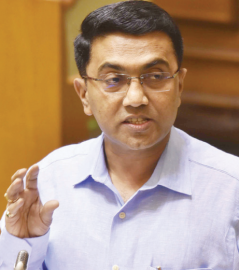
Chief Minister Pramod Sawant has sharply increased excise duty on several categories of alcohol in a bid to mobilise more tax revenue. He said that he was increasing the excise duty and fees, which will generate revenue of around Rs 100 crore.
The increase in excise duty is in the range of around 10% to 50%. However, it doesn’t mean that the alcohol will get expensive by 50% in Goa. It only means that the excise portion will be increased by that percentage.
But, on a relative basis, the alcohol will become expensive in the State compared to earlier. On Indian-Made-Foreign-Liquor (IMFL) made in Goa, whose maximum retail price (MRP) doesn’t exceed Rs 110 per 750 ml, excise duty has been increased from Rs 25 per bulk litre to Rs 30 per bulk litre, which is an increase of 20%.
On beer made in Goa or imported with alcohol strength not more than 5% and whose MRP doesn’t exceed Rs 85 per bottle of 650 ml, excise duty has been increased from Rs 22 per bulk litre to Rs 30 per bulk litre, which is an increase of 36.3%.
Similarly, Sawant also increased the licence fees for several alcohol related businesses. Starting from FY 2020-21, area of a bar/restaurant will be a factor to determine the licence fees.
As of now, bar/bar-cum-restaurant with AC and situated within the limits of Class A municipality/ Corporation of the City of Panaji/coastal village has to pay an yearly licence fee of Rs 30,000.
From FY 2020-21, such an establishment will pay the same fee of Rs 30,000 for an area upto 50 square metre. But, for every additional 10 square metre, it will pay an extra licence fee of Rs 4,400.
Similarly, the State government has also increased the excise duty on all kinds of alcohol, including beer made in a pub/microbrewery, country liquor, licence fees for wholesale of liquor and etc.
boost revenue
The increase in excise duty is in the range of around 10% to 50%. Only the excise portion will be increased by that percentage
On IMFL made in Goa, whose MRP doesn’t exceed Rs 110 per 750 ml, excise duty has been increased from Rs 25 per bulk litre to Rs 30 per bulk litre
On beer made in Goa or imported with alcohol strength not more than 5% and whose MRP doesn’t exceed Rs 85 per bottle of 650 ml, excise duty has been increased from Rs 22 per bulk litre to Rs 30 per bulk litre
From FY 2020-21, an establishment will pay the yearly licence fee of Rs 30,000 for an area upto 50 square metre. But, for every additional 10 square metre, it will pay an extra licence fee of Rs 4,400
Excise duty increased on all kinds of alcohol, including beer made in a pub/microbrewery, country liquor
Each bottle of alcohol to have hologram from next financial year
PANAJI: Chief Minister Pramod Sawant has proposed that each bottle of alcohol being sold in Goa will have a hologram from the next financial year in his Budget.
He said, “I propose to introduce “holograms” on each bottle, which would authenticate the genuineness of liquor and prevent duplication.”
Sawant himself said that he was taking this step because there are apprehensions that “leakages” in excise collections need to be plugged. Hologram is a sign of authenticity. A bottle having it can only mean that excise duty has been paid on it.
On the other hand, if hologram isn’t there on a bottle, it means that some elements are pushing duplicate alcohol in the market and are avoiding payment of excise duty.
Interestingly, Goa is one of the few states of India where holograms on alcohol bottles are not mandatory. Perhaps, it is because hooch tragedies are common in other states of India, which happen when people consume poisonous alcohol.
In Goa, hooch incidents are not common. But, around four years ago, efforts were made in Goa too by the then State government to introduce both holograms and QR codes on liquor bottles.
For some reasons, the government did not bring the rules to carry such authentication then. Now, Sawant has taken upon himself to make holograms on alcohol bottles necessary. It remains to be seen if it will really help in plugging the leakages in excise collections.