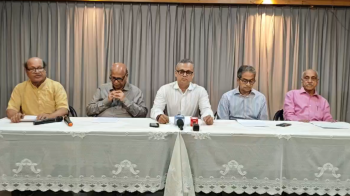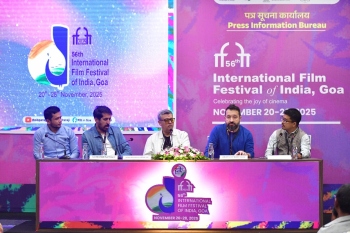
PANAJI: Filmmakers from Iran and Iraq came together at an IFFI press conference today, offering a compelling look at how their latest films confront the emotional and political realities of their nations. Though shaped by different histories, both teams spoke of ordinary people pushed to endure extraordinary circumstances, and of cinema’s role in capturing those truths.
Representing the Iranian debut feature My Daughter’s Hair (Raha), which is competing in IFFI’s Best Debut Feature Film of a Director section, Director Seyed Hesam Farahmand Joo and Producer Saeid Khaninamaghi said the film draws directly from Hesam’s personal experiences. Hesam said, “I wanted to portray the situation of women in my country,” explaining that Raha’s decision to sell her hair for a laptop mirrors the quiet sacrifices many Iranian women make while navigating economic hardship.
Khaninamaghi spoke about the impact of sanctions on everyday life in Iran, saying, “People are going down financially, the middle class is becoming poor.” He added, “In our film, a family’s entire economy collapses because of one laptop. That is exactly what is happening in our society.”
Hesam also pushed back against typical portrayals of poverty, saying, “I wanted the frames to look exactly like life. Poor families also have colourful, happy moments. They laugh, they celebrate, they find colour in their lives.” He said he hopes to bring such socially rooted stories into mainstream commercial cinema and hinted that his next project follows the same philosophy, saying, “Earlier, these films were not considered commercial. I want to change that.”
On the challenges within Iranian cinema, Khaninamaghi said, “Parts of films get cut, and the audience struggles to understand the full story.”
For Iraq’s The President’s Cake, competing for the ICFT UNESCO Gandhi Medal, Editor Alexandru Radu described the film as firmly grounded in the lived reality of Iraq in the 1990s. Speaking about its street cast ensemble, he said, “All the actors are non professionals, selected from everyday life,” a choice intended to give the film its immediacy and authenticity.
Radu explained that the story shows how sanctions and authoritarian rule impact ordinary families, saying, “When such things happen, the people suffer, not the dictators.” The film follows Lamia, a young girl tasked with baking a cake for Saddam Hussein, a storyline he described as teetering between absurdity and lived truth. “Hasan wanted Lamia to be a symbol of Iraq,” he said. “Everything happening to her reflects everything happening to the country.”
Radu also spoke about Iraq’s evolving film landscape, saying, “Unlike Iran, Iraq doesn’t have a rich film tradition. The President’s Cake is the first art house film in Iraq. Directors like Hasan are now building that industry.”
Despite the geographical and cultural distance, both films circle similar truths, including the weight of sanctions, the resilience of ordinary people, and the search for dignity under political pressure. By the end of the session, the conversation formed a cinematic bridge between Tehran and Baghdad, one held together not by politics but by storytelling.