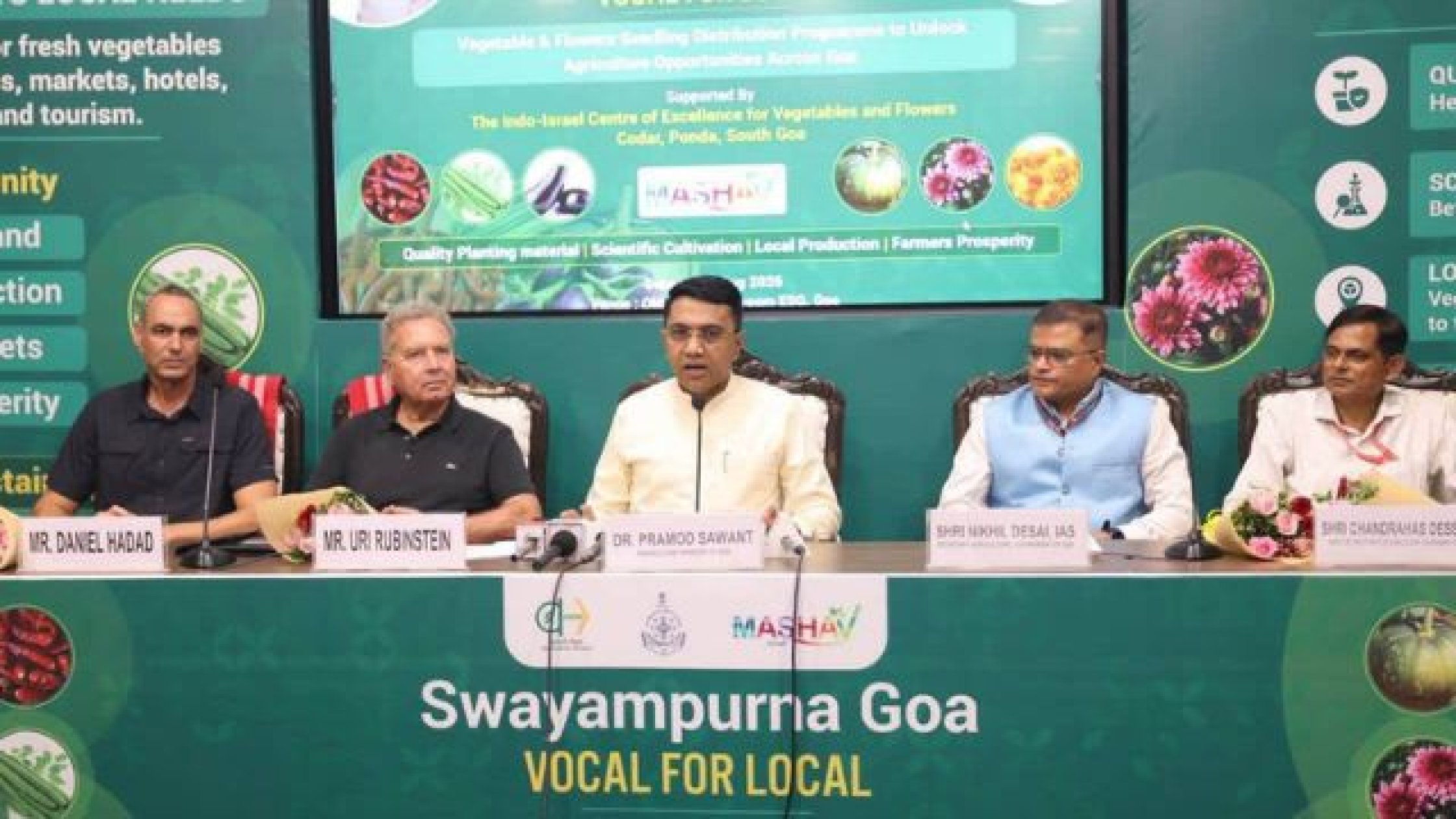
PANAJI: The Indo-Israel Centre of Excellence for Vegetables and Flowers at Codar has completed one year, with Chief Minister Pramod Sawant saying the facility will play a key role in providing Goan farmers with quality seedlings, modern cultivation technology and technical guidance to improve farm production and incomes.
The Centre, established under the Indo-Israel Agriculture Project with support from the governments of India and Goa, has involved an investment of around Rs 12 crore, Sawant said while speaking at the launch of a seedling distribution programme in Panaji on Monday.
The facility is aimed at producing quality seedlings in bulk and promoting protected cultivation. The project includes automated greenhouse infrastructure, irrigation and fertigation systems and technology-based cultivation practices. The broader project is also designed to build the capacity of agriculture officials and farmers through expertise from Israel.
Sawant said the objective was to ensure that farmers do not have to depend on unregulated nurseries or plants brought in from neighbouring states, which could introduce diseases into Goa. “Quality seedlings are essential to improve agricultural production and prevent plant diseases from entering Goa through unregulated nurseries,” he said.
The Chief Minister said farmers often purchase plants without knowing their quality or whether they are carrying diseases, stressing that plant diseases, like diseases affecting humans and animals, can spread rapidly. He added that Israeli experts have been working with the Agriculture Department and sharing technical knowledge with officials and farmers.
The programme saw the distribution of marigold and musk melon seedlings to farmers. Sawant particularly pushed marigold cultivation, saying Goa could substantially reduce its dependence on flowers imported from neighbouring states during Dussehra and Diwali. “If we scale up marigold cultivation in Goa, our farmers can earn at least Rs 1 crore during Dussehra and Diwali,” Sawant said.
He said seedlings worth around Rs 12 lakh had already been distributed and urged farmers to systematically cultivate the crop and take it to market. “We should not view marigolds simply as flowers, but rather see them as a direct source of income,” he said.
Sawant pointed out that Goa sends crores of rupees outside the state for flowers, including supplies that ultimately originate from Bengaluru. He said increasing local production would allow that money to remain with Goan farmers.
The CM also stressed the need to bridge the gap between farmers and buyers. He called for regular Buyer-Seller Meets to connect growers directly with temples, vendors, hotels and other bulk buyers. “The grower often asks, ‘Who will sell my flowers?’ By organising Buyer-Seller Meets, we can connect the growers directly with temple flower vendors,” he said. Citing flower sales at temples as an example, Sawant said flowers sold in places such as Sanquelim may ultimately be sourced from outside Goa, despite strong local demand. Better coordination, he said, could help local farmers tap this market.
Sawant also announced that the Agriculture Department would introduce QR coding under the Goa Fresh brand, allowing consumers to identify the farmer and eventually trace the journey of agricultural produce from the farm to the market. “Under the Goa Fresh brand, QR coding will allow consumers to identify the farmer and trace the journey of the produce from the farm to the market,” he said. He said such traceability would help consumers make informed choices about the quality and source of the food they buy.
The CM urged Goans to support local farmers and avoid bargaining excessively over agricultural produce. “The farmer is our food provider, our Annadata. Supporting them is essential,” he said.
Sawant also appealed to farmers to adopt organic and natural farming practices and protect soil health for future generations. He called for greater use of cow dung and organic manure and said Goa’s naturally grown crops such as cashew and jackfruit could serve as examples.
He urged consumers to buy locally grown produce rather than choosing outside produce simply because it is marginally cheaper. “Every Goan wants us to grow, process and market local products. If we buy from our local farmers, we directly benefit them,” he said.
The Chief Minister also called on women’s self-help groups under the Rural Development Department to make use of fallow agricultural land in villages, particularly for fodder production. He said Goa has large areas of fallow land and that the demand for fodder for livestock remains high. Government departments, he said, could provide the required technology and support.
Sawant said the government’s larger objective was to make farmers entrepreneurs by combining production technology with assured markets. “We want our farmers to become entrepreneurs who run their own businesses like a businessman or an industrialist,” he said.
He pointed to growing demand for fish, milk, flowers and fruits from hotels, five-star properties and major events in Goa, saying the Agriculture Department and its field officers should identify commodities that can be produced locally to meet this demand. He also referred to the government’s Amrit Kaal Agriculture Policy, launched recently, and said various programmes would be implemented over the next 90 days.
Sawant also used the programme to appeal to fishers to release egg-bearing female crabs back into the water. He said a female crab can carry around 10 lakh eggs and that even if a small percentage survive, it could help sustain future crab stocks. “A one-kilogram crab may fetch Rs 1,000 to Rs 1,500, but releasing egg-bearing females will protect the next generation,” he said. He said the response from fishers and even children showed that awareness about conservation could translate into action.
Sawant said the initiatives were aligned with the broader goals of Atmanirbhar Bharat, Swayampurna Goa and Viksit Bharat, and reiterated Goa’s commitment to continuing its agricultural partnership with Israel. He urged farmers receiving seedlings under the programme to cultivate them seriously and report their earnings to the Agriculture Department.
“If the programme is successful, we should see money reaching our farmers. That is my ultimate goal,” Sawant said.