Revives fears that iconic rain trees lining road may be sacrificed
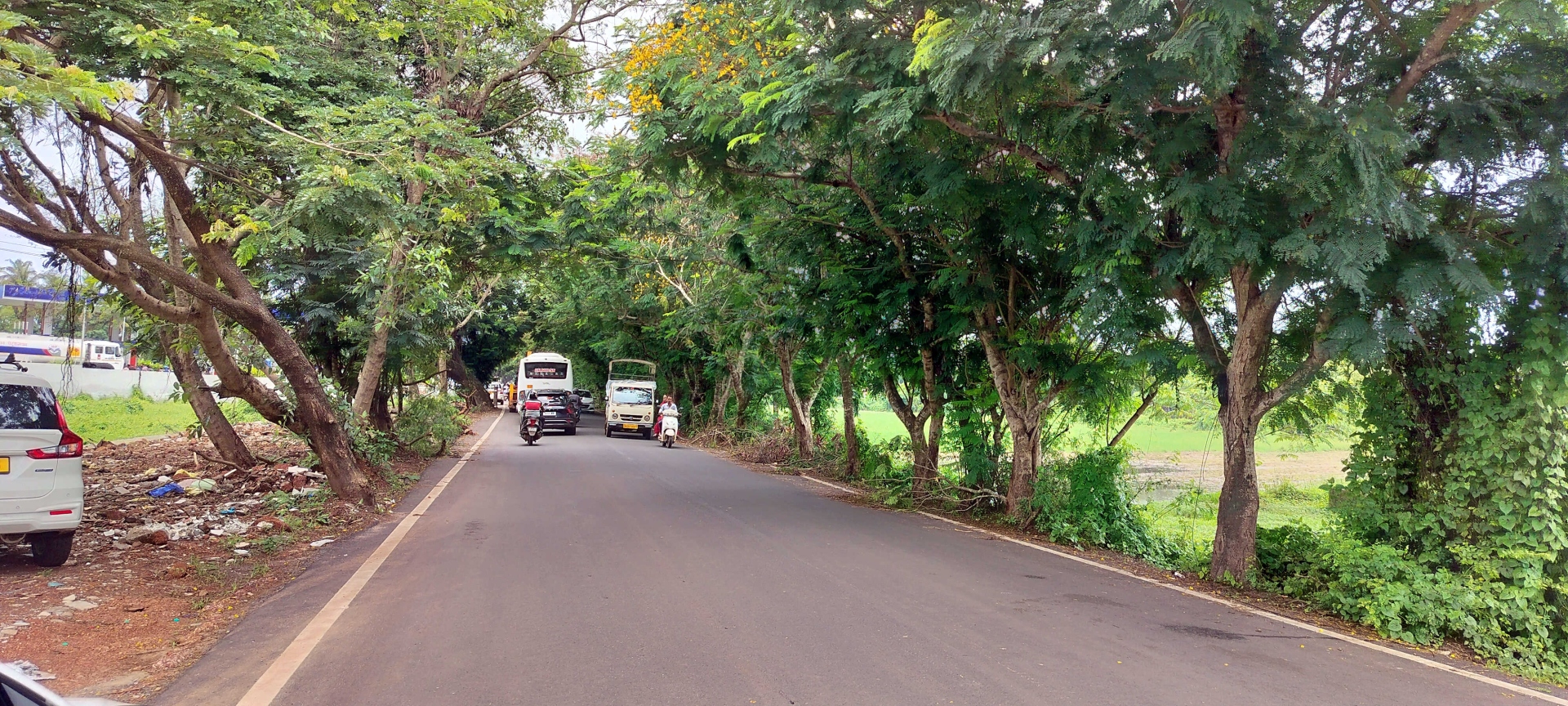
A PICTURE FOR POSTERITY: The picturesque tree-lined road from Dolphin Circle to Bodko Vodd in Calangute, home to age-old trees on either side, now faces the axe in the name of development.
MAPUSA
For decades, the tree-canopied road from St Alex Church to Palmarinha Resort at Bodko Vodd has been one of Calangute’s quieter visual pleasures.
Framed by towering, century-old rain trees on either side, the stretch offers motorists and pedestrians a rare green tunnel in one of Goa’s busiest coastal villages.
That tranquil landscape, however, now stands at the crossroads of development and conservation.
The Goa State Infrastructure Development Corporation (GSIDC) has proposed a Rs 6.42-crore project to widen and improve the road from St Alex Church via Palmarinha Resort up to the Calangute border.
Online bids have been invited, and the plan includes a central median and a footpath on one side of the road.
While the project promises better traffic management and pedestrian safety, it has also revived fears that the iconic rain trees lining the road may be sacrificed to make way for widening.
What troubles residents and environmentalists is the lack of clarity. Officials have stopped short of confirming how many trees will be felled.
A GSIDC official acknowledged that some trees could be affected, stating that trees “coming in the way of the work” would have to be cut, while others may be retained.
That assurance, vague at best, has done little to calm public anxiety.
According to sources, the Calangute panchayat has passed a resolution allowing tree felling along the stretch.
Cutting work reportedly began about two weeks ago but was halted after active citizens raised objections and approached the Forest Department and other authorities.
The sudden pause has only deepened questions about planning and procedure.
The Calangute Constituency Forum (CCF), a vocal civic group, has stepped into the debate, insisting that development cannot bypass due process.
“We are not against development,” said CCF president Agnelo Baretto, “but land acquisition procedures must be completed, detailed road alignment plans should be made public, and consultations must be held to understand the environmental and social impact.”
Baretto also hinted at a larger, project in the vicinity, suggesting that the road widening may be intended to support future commercial development rather than merely ease local traffic.
This is not the first time the stretch has come under pressure.
Earlier, the Public Works Department had initiated widening works and had already felled some trees, prompting strong resistance from residents and activists.
At the time, the CCF accused authorities of executing the project without transparency or a clearly articulated plan.
CCF founder president Premanand Diukar reiterated those concerns.
“The roadside trees are not just greenery; they are part of Calangute’s identity. Development that ignores ecological balance and scientific planning is unacceptable,” he said.
As bids are processed and plans move ahead, Calangute finds itself grappling with a familiar question – whether progress must inevitably come at the cost of its natural heritage, or whether the two can still be reconciled along one of its most scenic roads.