


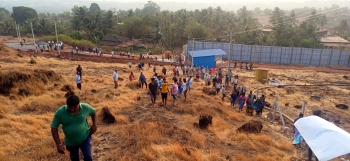
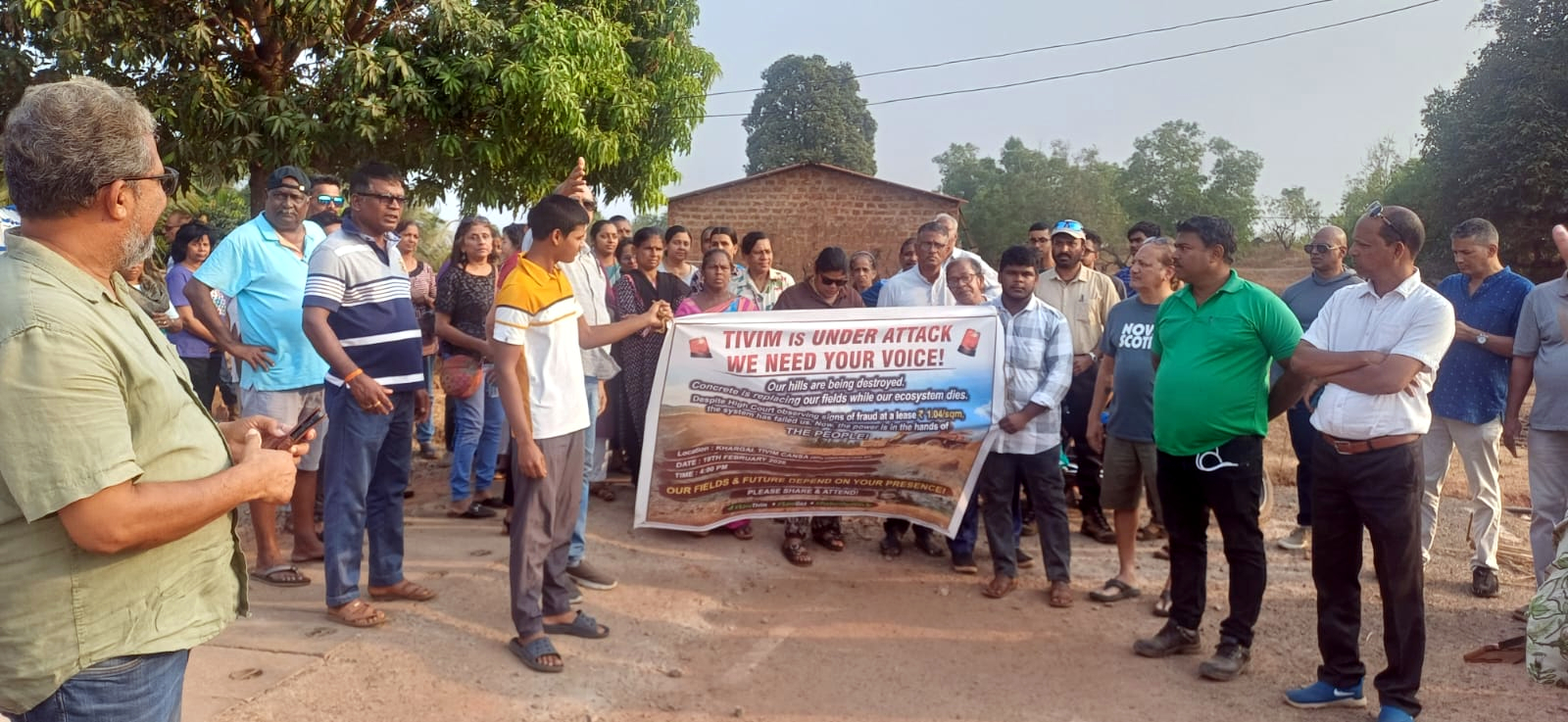
HILL HEAT: Villagers, activists and local residents gather in protest near the site of the upcoming private university in Tivim on Thursday evening.
MAPUSA
Hundreds of villagers, activists and members of the Dhangar community from the foothills of Tivim on Thursday mounted a strong show of resistance against the proposed private university project, accusing the State government and the local comunidade of sacrificing hills and forests for private profit.
Gathering at the project site, the protestors alleged that extensive hill-cutting and excavation were already underway, despite local opposition and environmental concerns.
Villagers climbed up the scarred hillside, pointing to large pits gouged out of the slope and heaps of mud and rocks that have been dug up.
“This is not development. This is destruction,” said local resident Godfrey D’Lima, who organised the protest meet.
“We passed a gram sabha resolution saying we do not want this university. Yet the project is moving ahead. Our hills are under attack.”
Residents fear that large-scale excavation will have serious consequences during the monsoon, with loose soil and debris threatening homes located at the foothills.
“With gravity, everything will come down into our houses “ mud, sewage, runoff. Who will take responsibility then?” asked one villager.
Protestors squarely blamed the government for pushing the project despite public resistance, and accused the comunidade of selling the land “for a song” to private interests.
“The land belongs to the people. It has been handed over cheaply, and now our environment is paying the price,” D’Lima alleged.
Activist Swapnesh Sherlekar questioned the allotment of nearly two lakh square metres of land for the project.
“When such vast tracts are given away, people must ask who benefits. Goans are not naive. We understand how these mega projects operate and who profits from them,” he said, alleging that the deal warrants public scrutiny.
Local Wilbur Ticlo claimed that land originally granted decades ago for industrial purposes was now being converted into a real estate-style venture after the collapse of the earlier industry.
Green activist Avertino Miranda questioned how a university project could be pushed under business-oriented investment frameworks.
“Education cannot become a cover for commercial exploitation. You cannot cut hills, destroy trees and call it progress. This is an environmental disaster in the making,” he warned, demanding that the land be restored to its original condition.
AAP leader Manuel Cardozo praised the Tivim villagers for taking a stand and said the government should instead promote projects that directly benefit Goans, such as agriculture and fisheries.
Villagers also alleged that canal water was being used for construction and that work had expanded beyond the initially indicated flat land to include hill slopes.
As the protest concluded, villagers warned that if the project is not scrapped, they would mobilise a much larger agitation.
“This is about saving Tivim’s hills for future generations. If we don’t act now, it will be too late,” D’Lima said.


