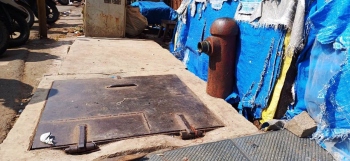
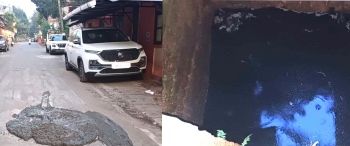
 Overflowing sewage at Comba, and (right) the contamination of well water. Captured by : The Goan
MARGAO
With several low-lying areas of Margao virtually sitting on a sewerage bomb, with overflowing sewage chambers inundating wells, as well as houses, authorities are in a tizzy to give relief to the local inhabitants.
While the Sewerage officials are on the job to replace the four pumps at the Sirvodem Sewerage complex on a war footing, makeshift arrangements have been made by deploying night soil tankers to pump out sewage from the choked underground line.
The affected areas are the low-lying areas of Calconda and Chinchal, both located on the southern side of the railway tracks, as well as Comba, where locals have been complaining of sewage backflow from the underground line, with the waters entering residential houses and contaminating drinking water wells.
The situation has only come to haunt the authorities and has raised a host of questions about the underground sewerage network, given that overflowing sewage chambers have become an annual feature during the monsoons.
Taking cognisance of the emerging situation, which threatens to pose a health hazard to the inhabitants, a high-level meeting was held in the South District Collectorate to review the measures and offer solutions, both temporary and permanent.
After the meeting, attended by South district Collector, Egna Cleetus, Additional Collector, Srinet Kothwale, as well as senior officials of the Sewerage Infrastructure Development Corporation of Goa (SIDCGL), PWD, Margao Municipality, etc., Margao MLA Digambar Kamat told the media that both short- and long-term measures had been deployed to stop overflowing chambers at Calconda, Chinchal, and Comba.
“All four pumps at the Sewerage complex at Sirvodem have failed at one time. Efforts are on to install the new pumps on a war footing. We have scheduled a power shutdown on January 17 to connect the pumps to the panel. In the meantime, night soil tankers have been deployed at both Comba and Calconda-Chinchal areas to stop sewage from overflowing via the chambers,” he said.
Vacuum sewerage tech for low-lying areas
With the densely populated low-lying areas of Malbhat, Gandhi Market, and surrounding areas not connected to the sewerage network, the Margao MLA has informed that vacuum technology will be adopted in these areas, similar to Mala and Fontainhas, in Panaji. The PWD Sewerage has already conducted a survey and a report has been submitted to the government for action.
New 20MLD sewerage treatment plant
With the existing 20MLD and 6.75MLD Sewerage Treatment Plants at Sirvodem reaching saturation point, the government has agreed to install a new 20MLD STP to meet the growing requirements of Margao and surrounding areas.
PWD officials agreed that the existing STPs have been running at full capacity during the monsoons due to rainwater infiltration, adding that the new plant will handle the sewage generated in the city and outskirts.
Why is Margao still not fully connected to the sewerage network?
When this question was posed to Digambar Kamat, the Margao MLA said he cannot force the people to take the connections. He, however, hastened to add that since the issue is now under the High Court's scanner, areas such as Azad Nagar and Maria Bandh are all connected to the sewerage network.
“The authorities are moving ahead step by step. People do not want to take the sewerage connections. The authorities are making attempts to convince the people to take connections. In Margao, out of the 11 wards, around 4-5 wards have 70 per cent connections to the network. The authorities will be left with no option but to crack the whip against both households and commercial establishments by going for water connections,” he warned.
Sewage connection for service stations within 10 days
After the meeting, the Margao MLA issued directions to the authorities to release sewage connections for all the service stations within 10 days. He said any issue relating to the cutting of roads, both state and NH roads, should not come in the way of the release of sewage connections to the service stations.