


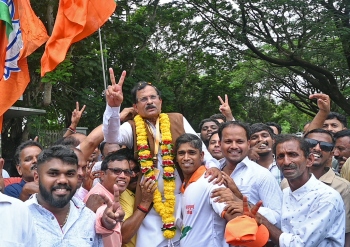
 BJP candidate Shripad Naik celebrating his victory with his supporters after wining the Lok Sabha North Goa seat on Tuesday. Captured by : Narayan Pissurlenkar
MAPUSA
By winning the North Goa seat for a record sixth term with a margin of 1.16 lakh votes, Shripad Naik, fondly known as Bhau, has underscored his enduring popularity in the State despite facing significant anti-incumbency sentiments.
Naik's latest win continues his streak of electoral successes, marking his widest victory margin yet.
In previous elections, he defeated Congress' candidate Ravi Naik by 1.05 lakh votes in 2014 and Girish Chodankar by 80,247 votes in 2019.
His narrowest margin was in 2009, with a 6,353-vote lead over Jitendra Deshprabhu of Congress.
Strategic BJP campaign
Several factors contributed to Naik's landslide victory. The Bharatiya Janata Party (BJP) swiftly announced Naik's candidacy, allowing ample time for a meticulously planned campaign.
The party leveraged its extensive organisational network to reach every corner of the district, ensuring robust voter engagement.
Naik's campaign was further bolstered by the support of 18 out of 20 MLAs in North Goa, who worked tirelessly to secure his victory.
A significant boost came from a massive rally in Mapusa addressed by Home Minister Amit Shah, adding momentum to the campaign.
Congress' flawed strategy
In stark contrast, the Congress campaign was marred by delays and disorganisation.
The party took considerable time to announce Ramakant Khalap as their candidate, leaving a truncated period for campaign activities. This delay contrasted sharply with the BJP's proactive approach.
Moreover, the Congress struggled with internal cohesion. Apart from Aldona MLA Carlos Ferreira, the North Goa coordinator, few senior Congress leaders actively campaigned for Khalap.
The campaign was largely managed by Khalap's family members rather than a united party front. This lack of a cohesive strategy and organizational setup was evident in many constituencies.
Missed opportunities,
lacklustre campaigning
The Congress failed to rally its senior leaders and alliance partners to campaign for Khalap.
Additionally, the party missed opportunities to reconnect with former Congress leaders who had defected before the 2022 assembly elections “ a move BJP executed deftly.
The Congress campaign was notably low-profile, with no significant public meetings in support of Khalap, further diminishing their electoral prospects.
The party's inability to capitalise on the high anti-incumbency sentiment against Naik contributed significantly to their defeat.
Naik's record-breaking victory margin is a testament to the BJP's well-orchestrated campaign and robust organisational strength.
Conversely, the Congress' disjointed and lacklustre campaign efforts underscore the challenges the party faces in mounting a credible challenge in the region.


