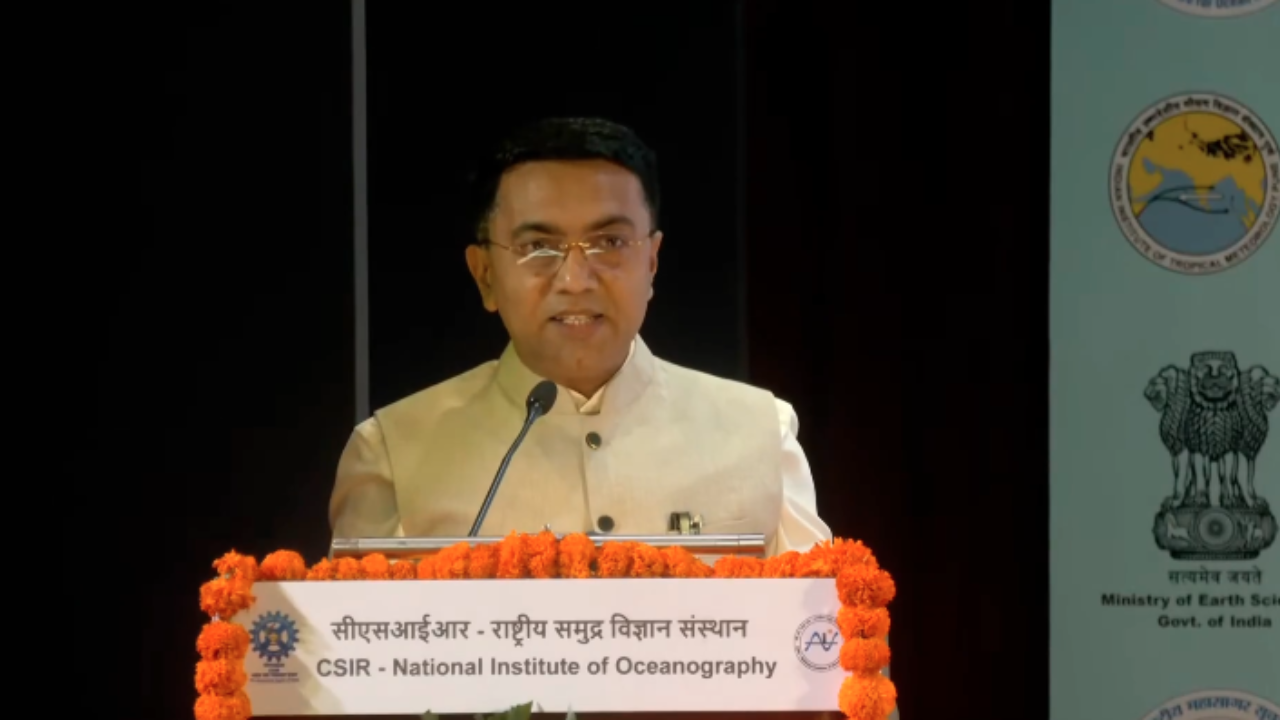
PANAJI: Positioning Goa as an emerging hub of ocean science and maritime research, Chief Minister Pramod Sawant said the state’s identity goes beyond sun, sand, and sea.
Addressing researchers, members of the maritime community, and other delegates today at the inauguration of the fourth edition of the World Ocean Science Congress at the CSIR-National Institute of Oceanography in Dona Paula, Sawant said, “All of you know Goa as the land of sun, sand, and sea. There is one more ‘S’, science. Many people may not be aware of it, but a scientific temperament already exists strongly in our state.”
He listed a series of premier national institutions located in the State, including the National Centre for Polar and Ocean Research, the ICAR-Indian Institute of Agricultural Research in Old Goa, the National Forensic Sciences University campus in Ponda, the National Institute of Water Sports, and the All India Institute of Ayurveda at Dargal near Manohar International Airport.
He also highlighted the role of Goa University, stating that it is among the leading recipients of PM-USHA funds and is undertaking extensive research activities. “We organise science film festivals with the support of Vijnana Bharati every year, and science exhibitions are conducted not just in Panaji but across all talukas to promote scientific temperament,” he said.
Sawant detailed the state’s science-driven governance initiatives, including solid waste management plants at Saligao in North Goa and Kakoda in South Goa, biomedical waste treatment facilities run on a public-private partnership model, and a hazardous waste management treatment plant handling industrial waste scientifically. He added that the Goa Waste Management Corporation serves as a technical partner to central ministries, including those dealing with housing and finance.
The Chief Minister also referred to prominent Goan scientists such as Dr Raghunath Mashelkar and Dr Anil Kakodkar as examples of the state’s scientific legacy.
Turning to the theme of the event, Sawant said, “Seventy-one per cent of the world is water. That simple fact should make all of us pause. The ocean is not somewhere far away from our daily life.” He noted that Goa’s 193-km coastline shapes its economy, climate, fisheries, tourism, and livelihoods, with thousands of families directly or indirectly dependent on marine resources.
He said the World Ocean Science Congress, a flagship initiative of Vijnana Bharati, is rooted in the national reality that nearly one-fourth of India’s population lives in coastal regions and depends significantly on the ocean. “What makes this Congress valuable is its inclusive approach. It brings together traditional fishermen, scientists, policymakers, maritime industries, students, and coastal communities on one platform. This cross-sector dialogue is exactly what the ocean sector needs,” he said.
After earlier editions in Kochi, Visakhapatnam, and Chennai, the fourth edition is being hosted in Goa with the CSIR-National Institute of Oceanography, National Centre for Polar and Ocean Research, and Goa University as co-hosts.
Emphasising India’s long maritime history, Sawant said the country’s engagement with the sea dates back millennia, from ancient port cities such as Lothal and Dwarka to the maritime networks of the Kalingas and Cholas. Referring to the Samudra Manthan, he said it symbolises the balanced and careful use of ocean resources.
Citing the vision of Prime Minister Narendra Modi, Sawant said the push towards Viksit Bharat has given renewed momentum to the blue economy, maritime infrastructure, and ocean science. “Technology is a key driver, from ocean observation and modelling to AI-based systems. We must combine heritage knowledge with modern science and move forward with confidence,” he said.
He noted that the agenda of the World Ocean Science Congress 2026 focuses on ocean health, climate change, marine ecosystems, ocean hazard resilience, and the sustainable blue economy. The programme includes plenary and keynote lectures, oral and poster sessions, roundtable discussions, workshops, and exhibitions.
Special initiatives such as a fishermen’s meet, a women oceanographers’ meet, and student interaction programmes involving around 600 high school students are part of the event. “The conversation should not remain limited to experts alone,” he said.
Sawant stressed that the ocean is central to climate regulation, environmental stability, and economic growth, but is under increasing pressure from pollution, changing weather patterns, and unsustainable practices. “The growth of the blue economy must move with responsibility and scientific guidance,” he said, adding that ocean research is also closely linked to national security and maritime defence.
He also referred to the commissioning of ICGS Samudra Pratap, described as the first indigenously designed pollution control vessel built by Goa Shipyard Limited, saying it significantly enhances India’s capabilities in pollution response, maritime safety, firefighting, and long-range surveillance across maritime zones.
Congratulating the organisers, scientific community, and stakeholders, the Chief Minister said Goa remains committed to supporting ocean science and contributing to the national goals of Viksit Bharat 2047 and Viksit Goa 2037. He expressed confidence that the deliberations over the next few days would generate meaningful partnerships and forward-looking solutions in the ocean sector.