Last week we discussed the impact of AI on employment and how industry forums, companies and policymakers can prepare. This feature discusses how educational institutions can lead the charge to thrive in the era of the intelligence revolution. UNESCO surveyed 190 countries and found just 15 working on AI curricula in schools. AI promises to resolve some of the biggest questions educators have historically grappled with; about customising and pacing learning for different development needs, maximising outreach so no learner is left behind, making classroom learning immersive and promoting student agency. It sounds like a panacea for a country with a diverse demographic and population strength, like ours. India’s Education Ministry has mandated AI from grade 3 this year. Presently 18,000 CBSE schools have a “Skilling for AI Readiness” module for grades 6-8. The Goa Board offers AI as a subject from grade 9. Around 20 NITI Aayog Atal Tinkering Labs(ATLs), function as hubs to support Goan schools. All programmes are in various stages of roll out, owing to infrastructure readiness and teacher training. International schools in Goa offer robotics, innovation and coding in their curricula. A start in the right direction, it will require substantial speed, depth and scale, for our youngsters to ride the wave of AI domination meaningfully.
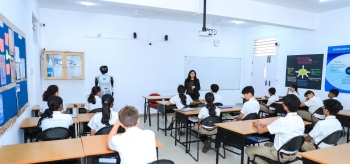
The crucial question is - how do we harvest the AI dividend, while retaining not just thought leadership, but the very essence of what makes us human? The answer lies in embracing a human-centred approach to AI. A school in our country- Indus International, has set the benchmark of human and machine partnership in classrooms, with its Collaborative Learning Model (CLM). Recognised by the OECD and the IBO, it upends the traditional lecture-centric template to develop an innovative intelligence framework to launch students into the new world order. The school devoted their chief design officer and a team of 17 faculty comprising subject teachers, engineers and programmers to build Indus’ patented Eagle Humanoid robots. Through the CLM, educators and robots unify AI and teacher competence into a synergistic learning experience. 21 of these robots are deployed as teaching partners with educators; across 4 campuses located in Hyderabad, Bangalore, Pune and Belagavi. They teach Biology, Physics, Chemistry, Geography and History from grades 7 to 9, in 30 languages. At one click from the teacher, the robot broadcasts a presentation, screens a video or rolls out automated assessments for knowledge checks. Capable of humanlike two-way interaction, it clarifies doubts and seeks discussion. This provides the educator with precious bandwidth to focus on student engagement and comprehension, providing emotional support, and mentoring for critical thinking and innovation. The robot provides the educator and the student with real-time AI-driven analytics on engagement and performance, thus enabling the creation of a personalised learning pathway.
This trinity of the educator, AI companion and student, amplifies academic growth by harnessing collective intelligence and makes learning a dynamic process. Students access assessments and subject content in real time through laptops, eliminating lag in asessing their performance. This continuous feedback loop helps the students to self-direct learning, introspect, and pace themselves on identified improvement areas. For the educator, this model enhances pedagogical effectiveness. Instead of repetition, they can focus on inquiry enrichment, incorporate the latest developments in the subject, and invest time and effort in building future world competencies. By optimising workload for the educator, it allows time for reflection, providing socio-emotional support and guidance, advanced lesson planning, experiential teaching and innovative project work. For parents, it opens up a portal of feedback, enriching development discussions with teachers.
So, while AI substitutes some of what educators do (such as lecture delivery and assessments), it principally refocuses them on the student and upgrades an educator’s role in the classroom- steering the intellectual development and capacity empowerment of their learners. In tandem, this called for scaling the capabilities of educators threefold: Firstly, to develop a transformative AI-enhanced pedagogical practice. Secondly, inculcating ethical principles and ensuring responsible usage by students for the development of their unique human potential. Lastly, by supporting educators to cultivate motivation for lifelong learning and build the emergent competencies for continuous professional development.
J Krishnamurti propounded that the intelligence of an educator is far more important than knowledge. That very intelligence lies in the consideration, of what awakens wisdom in their student and makes them an integrated human being. This is brought about by learning engagement and mining our unmatched human competencies. Next week, we shall discuss what these are and how to foster them. The question is no more whether AI can change our direction as a race, but whether we can direct ourselves meaningfully in order to remain the masters of our own destiny.
(The writer is a Human Capital Strategist and Educator; meaning she invests in humans like blue chip stocks and teaches them how not to crash the market)