


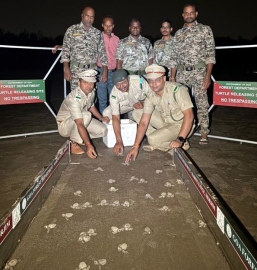
As we observe World Turtle Day, a global initiative dedicated to raising awareness about protecting vulnerable marine species, the shores of Goa highlight a complex challenge. The delicate balance between safeguarding endangered Olive Ridley sea turtles and sustaining local livelihoods has brought wildlife protection efforts and the tourism industry into sharp focus.
Tourism stakeholders warn that conservation plans for the endangered Olive Ridley may harm those depending heavily on tourism, fearing restrictions could negatively impact their livelihoods.
“Protecting the Olive Ridley sea turtle is important, but conservation should not threaten people's livelihoods. Instead of restricting the entire beach, the government should earmark a specific stretch for turtle reserves, balancing conservation with tourism operations,” said social worker Shubham Komarpant.
Agonda vs. Galgibaga coastlines
The Forest Department's Wildlife Wing, South Goa Marine Range, operates two Turtle Recreation Centres (TRCs) with nurseries at Galgibaga and Agonda beaches in Canacona taluka.
While the Galgibaga-Talpona coast has limited tourism-related activities located primarily on private properties, Agonda presents a stark contrast. The entire 2.9 km stretch of Agonda beach is heavily lined with tourism operators. The beachside is fully occupied by tourist shacks and establishments on private property, leaving practically no distance between the beach sands and private land.
A decline in nesting and relocation controversies
Last year saw around 160 mother turtles laying eggs on these twin beaches. Agonda recorded 119 turtle pits and Galgibaga had 41, collectively protecting 16,095 eggs.
However, the current nesting season has seen a sharp decline. Galgibaga recorded about 19 pits and released 1,719 hatchlings. Agonda, the state's prominent TRC, protected only 51 pits, less than half of last year's figure, releasing 6,173 hatchlings. With pre-monsoon rains lashing the state, forest sources note there is very little chance of hatchlings emerging from Agonda's single remaining pit.
While the Galgibaga TRC nursery has remained stationary for years, the Agonda TRC has frequently been shifted. Historically, relocation occurred within 200 metres southwards. Recently, however, a new TRC shed was suddenly erected about 400 metres away towards the central coast, raising locals' eyebrows.
“The presence of a turtle nursery close to the shacks automatically creates restrictions on tourism activities. It hinders business growth. Turtle protection is required, but certainly not at the cost of our livelihood,” stated an anonymous Agonda shack operator.
Many allege the TRC was shifted to accommodate certain shack operators' demands, drawing objections from those operating at the original site. The new location, right behind the village church, is frequently hit by sea waves and prone to flooding. Critics argue this move, allegedly driven by political considerations, puts turtle eggs at high risk of damage and mortality due to rising sea waves striking the church compound wall.
Consequently, the Forest Department placed some pits near the original site and assured locals that future pits would return closer to the original nursery. Villagers claim this reversal happened under pressure from shack operators near the new TRC.
The Forest department's stance
Denying these allegations, South Goa Marine Range in-charge RFO Rajesh Naik maintained there is no conflict between shack operators' livelihoods and turtle conservation. Operators actively cooperate by switching off lights, removing beach furniture, and reporting nesting turtles so guards can safely relocate the eggs away from poachers and animals.
Naik defended the periodic shifting of the nursery, explaining that continuous use of the exact same location leads to higher egg mortality. “To obtain better results, it is a regular practice to shift nursery sites by at least 70 to 100 metres,” he stated.
He further clarified that the overall decline in nesting is unrelated to the nursery's placement. “A lower number of turtle nestings have been observed across the country, including Karnataka. It depends on various factors, including sea conditions and whether a mother turtle lays eggs in a particular year,” Naik explained
The call for a dedicated protection site
In previous Gram Sabhas, residents have passed resolutions demanding the government earmark a specific part of the beach for nurseries and denotify the rest of Agonda.
Agonda Sarpanch Nilesh Pagi affirmed the conflict of interest between tourism livelihoods and conservation. He demanded the government denotify the Agonda beach coast as a 'Turtle Beach' and instead declare a specific, limited area as a 'Turtle Protection Site'. “This way, people will get a free hand to earn their livelihood with dignity and respect, instead of conflicting with the government's conservation activities,” Pagi concluded.
Tourism and turtles share fragile shores at Morjim
AGNELO PEREIRA
North Goa's Morjim Beach, known as "Turtle Beach," is one of only four ecologically vital nesting sanctuaries for endangered Olive Ridley sea turtles in the state.
This season brought encouraging news: 25 turtles laid over 2,700 eggs. However, the November-to-February nesting period clashes with Goa's peak tourist season, directly threatening the turtles' survival.
Though the Forest department fences some nests, turtles increasingly lay eggs outside these protected zones. Rising encroachment from illegal beach shacks exacerbates these risks.
Despite these pressures, Morjim remains a rare example of coexistence between tourism and wildlife conservation, highlighting the urgent need to preserve Goa’s delicate coastal ecosystems for future generations.


