Padmakar Kelkar
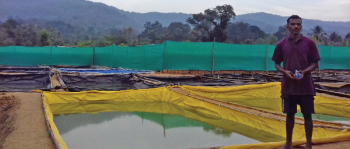
Modern times has seen the advent of more life-threatening diseases and disorders. In their quest to find cures, a few progressive farmers in Goa have begun cultivating medicinal herbs. Among these is Rajesh Gaonkar,a young farmer from Nagargao in Surangali who has taken to cultivating spirulina in his farmland, using traditional and non-traditional methods of farming.
Often regarded as the wonder algae, spirulina is an ancient herb with a long history as a food source in East Africa and pre-colonial Mexico. Said to contain more nutrients than eggs, milk, vegetables etc, it is used as a food supplement and for malnutrition. Spirulina also contains medicinal properties and is useful in treatment of knee pain, hair loss, greying of hair, cancer, diabetes, AIDS, eye disorders, tooth ache, fits and convulsions etc.
A lover of experimental farming, Rajesh, began cultivating it in his farm on November 5 last year and within a month and a half, on December 25, 2017 to be specific, the production began. He has been guided and assisted by The Dharbandora Panchayat in this initiative.
“I have constructed 16 tanks for this project, of 12 ft width, 21 ft length and two ft deep. The total space of cultivation is around 800 sq metres,” informs Rajesh.
Unlike other types of farming, there’s no danger of destruction of crop by animals in this type of cultivation. Good weather and three to four hour sunlight is enough to give an ample amount of crop in lesser space and that’s where the secret lies, says Rajesh.
Explaining how it is cultivated, he says, the tanks are constructed and a solution is created with mixing of various fertilisers, especially, sodium bicarbonate (8-10 grams), NPK / suphala (0.5 grams) and magnesium sulphate (0.5 grams). These three are mixed and this mixture begins the process of growing spirulina. Within 10-12 days the solution matures and becomes thick. The layers are then separated.
While one can cultive the crop the whole year round, depending on the seasons, the amount of harvest increases or decreases. In the rainy season, the algae absorbs the moisture from the air, so the use of a drier is beneficial.
If the amount of ingredients in the water is inappropriate or the sunlight is less, or there’s too much of rain, then the Spirulina gets a yellow tinge and spoils. If this happens, the entire tank water has to be replaced, tank cleaned thoroughly and filled with a new solution.
Spirulina can also be grown in poly houses or glass houses using mechanised process. The spirulina collected after harvesting is dried, made into powder and capsules are filled with one and two grams of powder. Given that it os high in nutrients , it is used as a food supplement and for malnutrition.
Given it’s many health benefits, cultivation of the same is a golden opportunity for unemployed youth in Sattari and there is a big market for it. “The local Panchayat has contacted an international company for the sale of spirulina. As there are a number of people who are ill in every village, there is a demand for the powder,” says Rajesh, adding that people in Suranguli have joined hands to cultivate spirulina, forming a farmer’s groups.