Dr ALVARINHO J LUIS
Fish-curry rice has been the staple food of Goa since time immemorial. Fishing has been an integral part of Goa’s coastal heritage for generations, sustained by traditional fishing communities such as the Kharvis, Gabits, Ramponnkars, Magkars, Kanttaikars, Pagelkars and Arrikars. Each community traditionally operated within designated fishing zones and used specialised nets such as koble, kanttai, pagel, and ramponn to catch various fish species. These communities, belonging to both Hindu and Catholic traditions, developed a close relationship with the sea and depended on it for their livelihood. Traditional fishing in Goa is essentially a cooperative enterprise, with the sea treated as a shared resource and fishing organised collectively.
Traditional ramponn
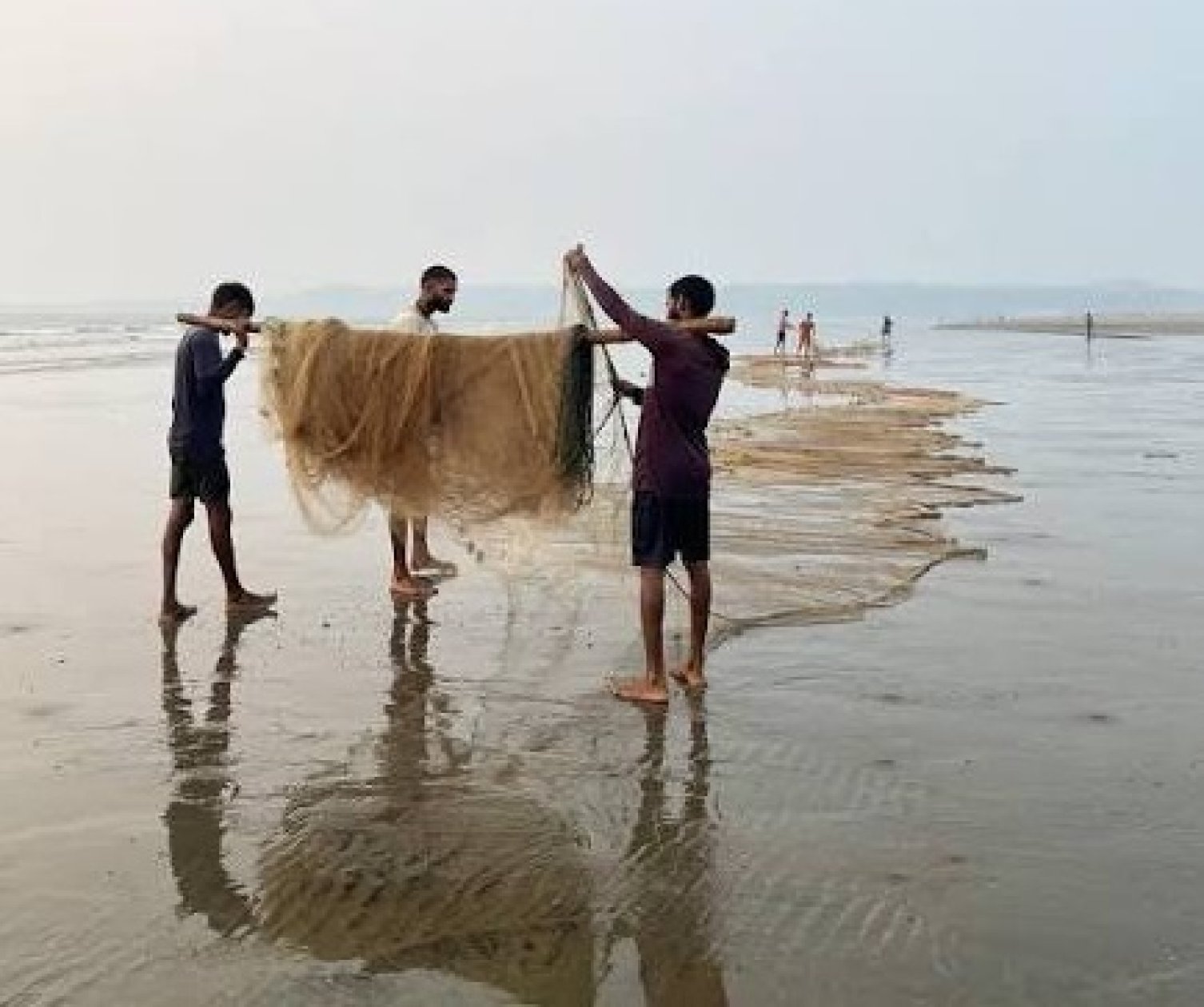
The ramponn is a traditional Goan fishing method based on collective effort, shared ownership and generations of maritime knowledge. Around 35–40 men, known as ramponnkars, jointly operate the giant net, made by stitching several smaller nets together. Traditionally, preparing the net was equally laborious: cotton nets were treated with water and forest plant extracts, sun-dried, dipped in cashew oil and dried again for durability. The finished nets were stored in makeshift huts near the shore.
A fisherman from Baga, Ciril, who is a ramponnkar, recalls that in the 70s they used boats carved from mango-tree trunks. Wooden canoes provided buoyancy - an important safety advantage, as they could remain afloat in the event of an accident, allowing the crew a better chance of rescue. Equally important was their respect for the natural breeding cycle of fish. Goa’s traditional fishermen observed the monsoon fishing ban, refraining from fishing during the breeding season and allowing fish populations to replenish naturally.
Laying the Ramponn
The traditional ramponn fishing technique was a remarkable display of teamwork and knowledge of the sea. Fishermen ventured into shallow waters, usually within 2 km of the shore, and spread the giant net in a U-shape, securing it with pieces of lead called chins. By observing the tides and colour of the water, they timed the operation so that fish moving shoreward with the rising tide were trapped in the net. Then two groups of men hauled the heavy net ashore. Nets were usually cast at night and pulled in the early morning.
The catch was divided according to ownership shares. While landlords once owned the boats and nets, later groups of 30–40 ramponnkars became co-owners, sharing the catch with helpers. At times, the catch was so abundant that surplus fish were even used as manure for coconut trees and other plantations.
The Nostalgia
A fisherman from Nerul, Joao, with 66 years of ramponn fishing experience, said that ramponn fishing is inherently environmentally friendly. They used cotton nets with relatively large mesh sizes, allowing juvenile fish to escape and mature. The slow, labour-intensive method generated less by-catch. At the same time, unwanted fish were carefully separated from the catch in the water and released alive, minimising unnecessary species loss and supporting marine conservation.
Traditional fishing was also regulated to protect near-shore fishing grounds and marine resources. The Portuguese administration restricted the operation of ramponn close to the shore and, in 1897, prohibited trawling within five fathoms from the shore. Domingo, a fisherman from Colva now in his seventies, recalls that during the colonial period, a stretch measuring about ten bamboo sticks from the sea was reserved exclusively for traditional fishermen. This space was used for essential activities such as mending nets, keeping boats, and drying fish. The authorities also strictly regulated net mesh sizes, stipulating that the mesh should not be smaller than an aana coin, allowing juvenile fish to escape and continue growing. Nets that violated the prescribed size were reportedly confiscated and burnt. The administration also discouraged the use of nylon nets, with unauthorised nylon nets similarly destroyed.
Until Liberation, fishing was primarily for consumption. So, with an emphasis on subsistence rather than profit, there was no threat of a fish famine. But after Liberation and the introduction of modernisation, the situation took on a different turn. Joao laments that with modernisation, nylon nets replaced cotton nets and fibre boats replaced wooden craft, gradually transforming a centuries-old fishing tradition.
Mechanisation and Challenges
In 1953, the Government of India initiated the mechanisation of fishing by providing loans to fishermen to purchase trawlers. However, most traditional fishermen could not afford the required investment. Consequently, trawlers were acquired mainly by businessmen and politicians as fishing became increasingly profitable, driven by a growing export market. The trawlers sought access to the 2-km coastal zone, a crucial breeding and habitat area for commercially valuable species, and challenged the existing fishing restriction in the Judicial Commissioner’s Court. Seeing the threat to traditional fishermen’s livelihoods and fishing rights, Mr Matahany Saldanha founded Goenchea Ramponnkarancho Ekvott (GRE) in 1975. In 1978, GRE demanded a 5-km exclusive fishing zone for traditional fishermen.
The movement expanded nationally, leading to the formation of the National Forum for Catamaran and Country Boat Fishermen Rights and Marine Life. The Central Government acceded to the demands and subsequently directed states/UTs to reserve the 5-km zone. Despite strong opposition from trawler owners, Goa enacted the Marine Regulation Bill in 1980, though some mechanised vessels continued to violate the provisions. After a prolonged struggle, the Supreme Court in 1994 banned mechanised fishing within 5 km of Goa’s shore, strengthening and protecting their fishing grounds. GRE continues to act as a watchdog against violations. In May 2015, ramponnkars protested the proposed seaplane service, fearing aircraft operations would disrupt fish and traditional fishing along Goa’s coast. Apart from legal challenges, ramponnkars now face another growing menace: their nets often haul in more plastic waste than fish. Over the years, many ramponnkars have passed away, while their children have largely moved away from the trade, leaving only a handful to keep this age-old tradition afloat.
(Dr Luis is a scientist, freelancer, and a son of the soil from Taleigão)